Lofoten Islands
Black peaks planted in a turquoise sea, blood-red fishermen's cabins on stilts and beaches worthy of the tropics at 68° north: the Lofoten are the archipelago that makes all the others jealous.
Suggested stay — 4 to 5 nights
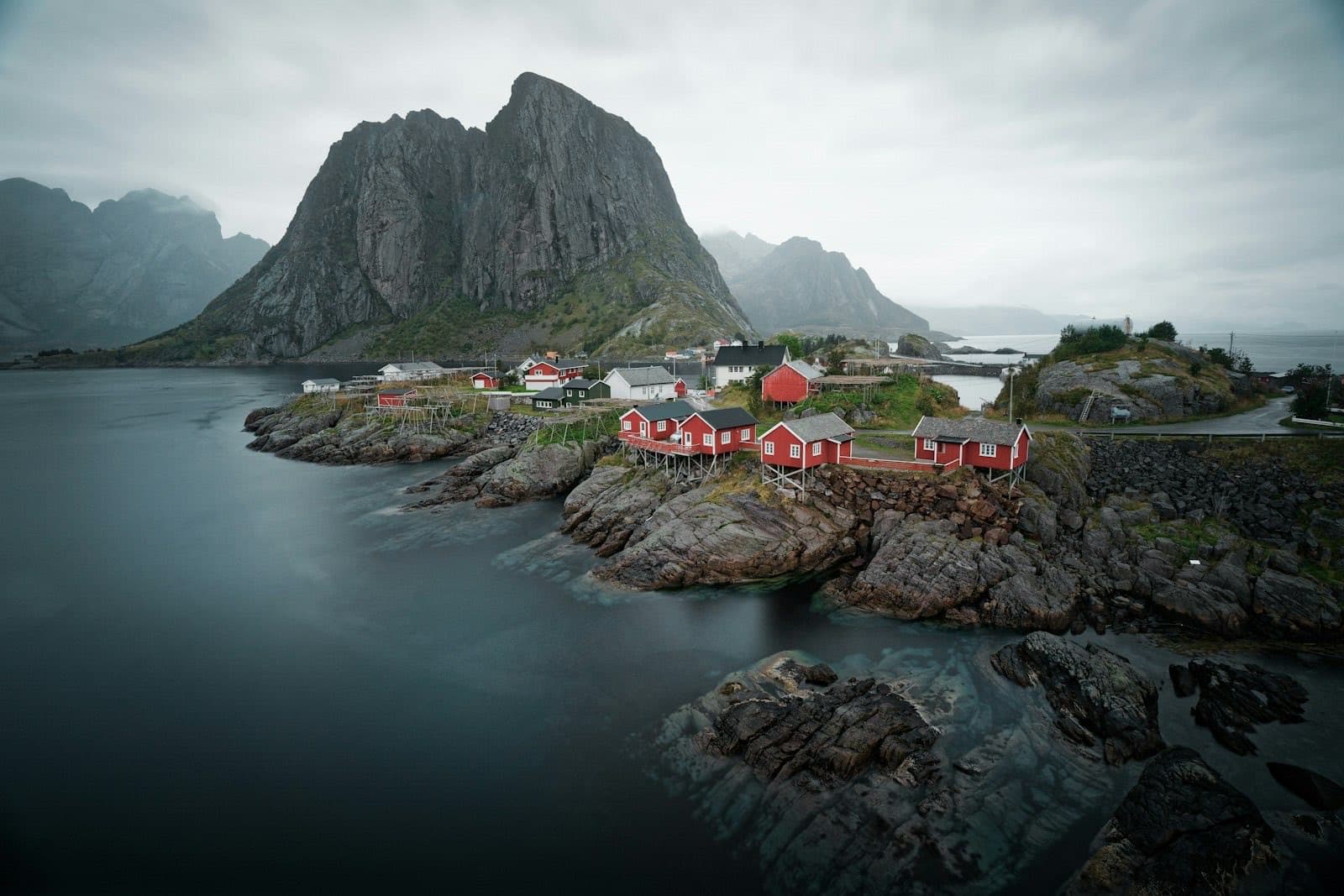
The E10 unrolls the archipelago east to west like a film's opening credits: Henningsvær and its football pitch perched on an islet, unspoilt Nusfjord, then the final triptych of Hamnøy-Sakrisøy-Reine, where the red rorbuer (fishermen's cabins) stand out against the wall of the Reinebringen. Everywhere, the cod-drying racks are a reminder that skrei, fished in winter, kept these islands alive a thousand years before Instagram.
The Lofoten's other face is earned on foot: Kvalvika beach after a 45-minute trail, Haukland and Uttakleiv reachable by car — white sand, 12 °C water, courage required — and the steep climb of the Reinebringen up its sherpa-built stone steps for THE panorama of the archipelago. In summer the sun never sets from late May to mid-July; in winter the same peaks frame the auroras.
Don't miss
- Reine and Hamnøy in low light, from the Hamnøy bridge for the classic shot
- Haukland and Uttakleiv beaches, linked by an easy coastal path
- Henningsvær, its quays, its galleries and its island football stadium
- The Reinebringen climb (448 m, steep steps) in dry weather only
Our tips on the ground
- Book the Bodø-Moskenes ferry weeks ahead in summer if you need a specific crossing — or enter by road via Narvik and the E10, longer but risk-free.
- Wild camping has become regulated around Reine, Uttakleiv and Kvalvika: summer exclusion zones exist, so use the designated areas and campsites — the archipelago saturates in July.
- Build in buffer half-days: when the light finally breaks after three days of grey, the whole archipelago makes up for it in a few hours.
Our flagship guide — €44
Guide available“Norway on Your Own”, the complete edition, is out
10 chapters: day-by-day itineraries, driving and transport, a costed budget and checklists — the same method as our Namibia guide.
The guide is currently written in French — an English edition is in the works.
No time to do it yourself?
A professional can take care of it: tailor-made trip, equipped 4x4 rental or a local guide. Describe your plans and, with your consent, we pass them on to partner professionals.
1. What you need
Before you go
Readers' questions about Lofoten Islands
Summer or winter for the Lofoten?
Summer (June-August) for hiking, swimming for the brave and easy driving under the midnight sun — with the crowds as the trade-off. Winter (February-March) for auroras over snowy peaks, the skrei fishery and studio-quality light, at the price of short days and sometimes icy roads. Photographers vote winter, hikers vote summer.
How many days do the Lofoten really need?
Four nights is the honest minimum: the archipelago runs 150 km end to end, the weather sets the pace and the finest moments (Kvalvika at dusk, a clear Reinebringen) can't be ordered up. In two days you drive through a backdrop; in five you inhabit an archipelago — the difference is worth the budget.