Norway on your own
Knife-cut fjords, roads that dive into the sea, the right to sleep almost anywhere and, in winter, a sky that dances: Norway is the dream country for independent travel.
When to go
Two Norways coexist: summer (June-August) for the midnight sun up north, the hikes and the open mountain passes — with July's crowds on the headline sites — and winter (September-March for auroras, December-February for snow), reserved for calm drivers and northern stops like Tromsø. May and September are the secret months: swollen waterfalls or autumn colours, gentler prices, breathable sites. The mountain roads (Trollstigen, Aurlandsfjellet) only open between late May and October.
What it costs
The painful line item: campervan €130-200/day in summer (compact car €55-90), petrol around €1.80-2.00/L, campsites €30-45 a pitch, hytter €70-130, hotels rarely under €140. Ferries stay reasonable (€5-20 per crossing, car included) and tolls collect themselves via AutoPASS. Budget €2,500-4,000 for two over 12-15 days in a van with wild camping — the supermarket (Rema 1000, Kiwi) and the right to camp free are your two best allies.
Driving & transport
Right-hand driving, headlights on day and night, low limits (80 km/h outside towns, 100-110 on the rare motorways) and merciless speed cameras: fines start around €600 and the alcohol limit is 0.02% — effectively zero. The traps: underestimating journey times (fjords, ferries, hairpin tunnels like Lærdal's 24.5 km), meeting a motorhome on single-track roads (use the 'M' passing places), and free-roaming sheep on the carriageway. In winter, studded or Nordic tyres are de facto compulsory, and never let the gauge drop below half north of Narvik.
Norway invented the road-trip paradise without meaning to: eighteen national scenic routes designed by architects, ferries that extend the tarmac from one fjord to the next, and the allemannsretten — the right to roam, as old as the country itself, which allows free camping more than 150 m from any dwelling. You drive slowly here, window open onto thousand-metre walls, and every bend justifies a stop.
Our guide for this country: See what's inside — €44 →
The campervan is king, but a simple car and a tent will do: immaculate campsites, cabins (hytter) at every pass, and the world's densest network of EV chargers. Norway's real luxury isn't in the wallet — you will have to reckon with the prices — but in time: budget generously, as real averages rarely exceed 55 km/h between the ferries, the tunnels and the photo stops.
The destinations that matter
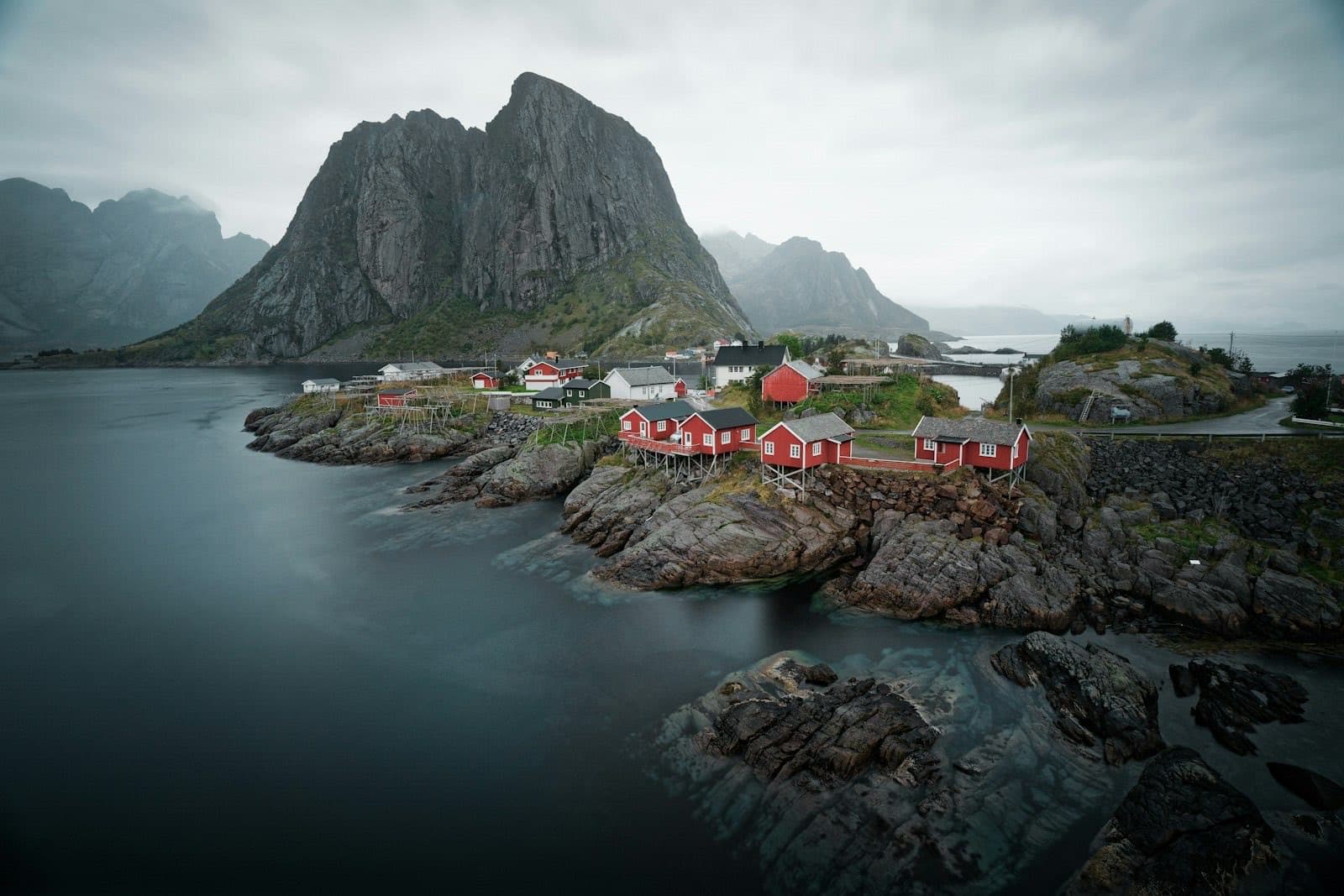
5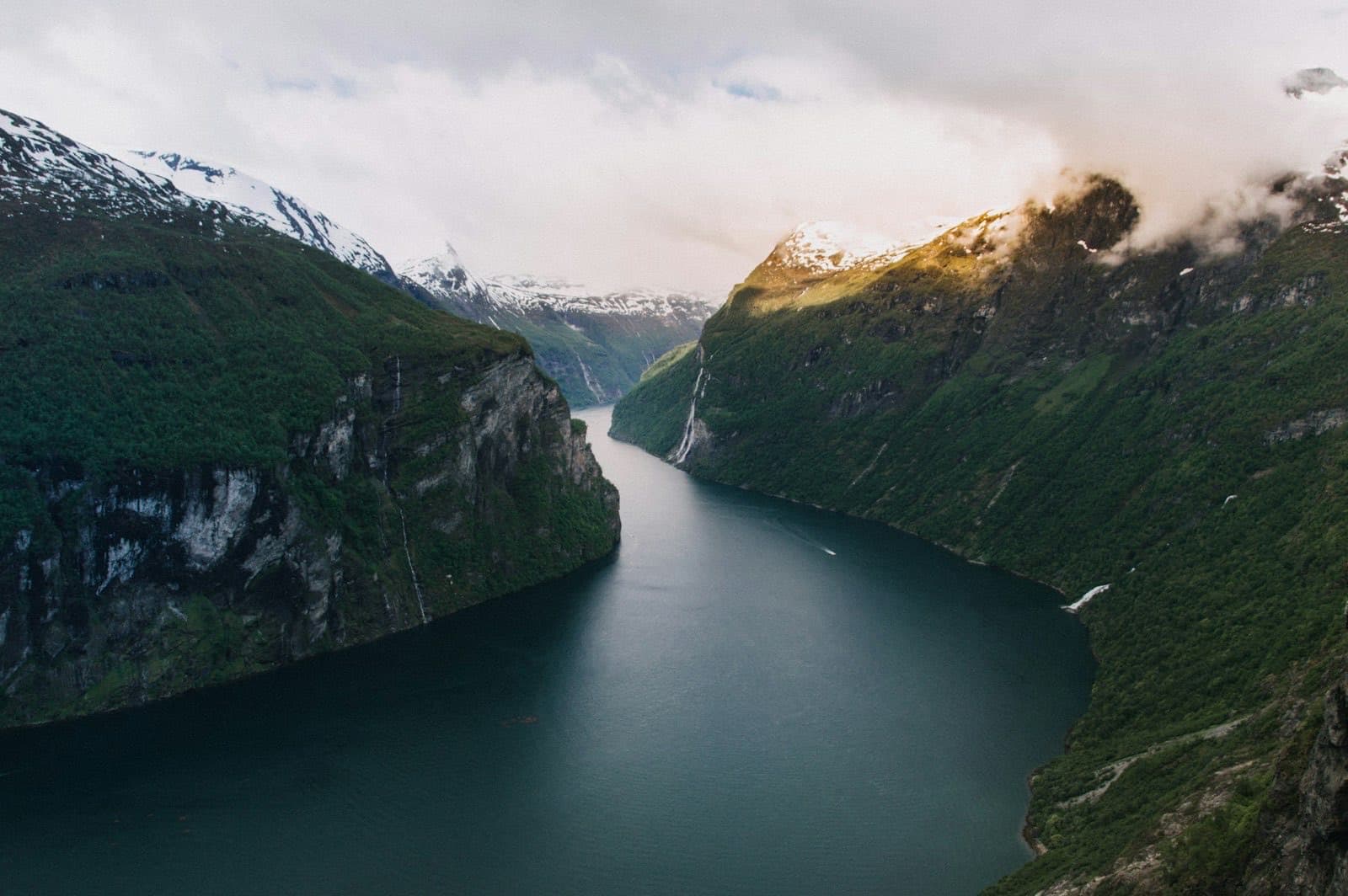 No. 013 to 4 nightsWestern fjords: Geiranger and NærøyfjordTwo UNESCO-listed fjords, waterfalls plunging 500 metres and hairpin roads drawn with a compass: the beating heart of postcard Norway.No. 021 to 2 nightsAtlantic Ocean RoadEight kilometres of road leaping from islet to islet, a bridge that seems to plunge into thin air and the Atlantic exploding over the parapets on stormy days: Norway's most famous road keeps its promises.No. 034 to 5 nightsLofoten IslandsBlack peaks planted in a turquoise sea, blood-red fishermen's cabins on stilts and beaches worthy of the tropics at 68° north: the Lofoten are the archipelago that makes all the others jealous.No. 043 nightsTrolltunga and PreikestolenA tongue of rock suspended 700 metres above a lake, a granite pulpit towering over the Lysefjord: Norway's two most photographed hikes must be earned — and prepared.No. 052 to 3 nightsSenjaThe same jagged peaks as the Lofoten, the same turquoise beaches — but car parks with spaces and trails where you meet three people: Senja is the least deserved secret of Arctic Norway.
More stops worth adding to the trip
Tromsø and the northern lights
A lively city 350 km north of the Arctic Circle, snowy fjords twenty minutes from the centre and, whenever the sky opens, aurora green at the zenith: Tromsø is the pocket Arctic capital.
What to see
- An aurora chase by car towards Kvaløya or the Ullsfjord, aurora-weather app in hand
- The Fjellheisen panorama at dusk (ride the cable car up, walk down in summer)
- The orcas and humpback whales of Skjervøy, from November to mid-January
Suggested time: 3 to 4 nights
Norway: practical notes
Tolls, fines, money, seasons, budget, rental: the essentials, gathered on this page.
Money in Norway: Kroner, Bank Cards and ATMs for a Self-Drive Road Trip
A self-drive road trip in Norway raises an unusual question: is it even worth exchanging any money at all? The country has one of the lowest cash-payment rates in the world — barely 3 to 4% of in-store purchases — and the bank card, or even the phone, replaced the wallet here well before southern Europe caught up. That makes budgeting a lot simpler, but it also means getting it wrong is easy if you arrive with kroner bought at the airport or the assumption that a banknote always saves the day. Here's how to split your spending between kroner, card, and the few cases where cash still, against all odds, comes out ahead.
| Expense | Safest payment method | What to plan for |
|---|---|---|
| Rental car, fuel, hotels, campsites | Bank card (contactless) | Notify your bank before departure |
| AutoPASS tolls and ferries | Automatic charge by number plate | See our dedicated article, nothing to pay on the spot |
| Self-service fruit or fish stands | Cash in small notes, or Vipps | Keep a few 50 and 100 NOK notes |
| Unstaffed mountain cabins (DNT) | Depends on the site: deposit box, card or Vipps | Check the cabin's payment method before setting off |
| Coin-operated campsite laundry and showers | Cash or the campsite's own app | Ask at reception on arrival |
Renting a Car in Norway: Insurance, Excess and Deposit Before You Hit the Road
Renting a car in Norway is straightforward at the counter — a French or other EU licence is accepted with no extra paperwork, and rental desks are plentiful at the airports of Oslo, Bergen or Tromsø — but the insurance contract deserves a proper read before you sign. The base excess tends to run higher than elsewhere in Europe, single-track roads multiply small wing-mirror scrapes, and damage linked to gravel or the underbody is often left out of the standard package. The real excess in kroner, the deposit blocked on your card, the licence required depending on your nationality, and what insurance doesn't always cover on mountain roads: here is what to check before setting off for the Lofoten Islands, the Western fjords or the Atlantic Road.
| Insurance option | Excess after damage | Typical surcharge | Worth knowing |
|---|---|---|---|
| Basic CDW (included with the rental) | NOK 10,000 to 20,000 (≈ €900 to €1,850) | None | Often excludes windscreen, tyres, gravel damage and underbody |
| Excess reduction (SCDW) from the rental company | NOK 0 to 1,000 (≈ €0 to €90) | +€27 to €40/day | Check the remaining exclusions before paying |
| Independent excess insurance bought online | €0 (reimbursed afterwards) | €3 to €8/day on average | Buy before departure, usually cheaper than at the counter |
Our flagship guide — €44
Guide available“Norway on Your Own”, the complete edition, is out
10 chapters: day-by-day itineraries, driving and transport, a costed budget and checklists — the same method as our Namibia guide.
The guide is currently written in French — an English edition is in the works.
No time to do it yourself?
A professional can take care of it: tailor-made trip, equipped 4x4 rental or a local guide. Describe your plans and, with your consent, we pass them on to partner professionals.
1. What you need
Explore other countries