South Africa on your own
Two oceans, vineyards, the Big Five on a self-drive in Kruger and one of the world's finest coastal roads: the continent-country made for a varied road trip.
When to go
Two opposing logics: the Cape region has a Mediterranean climate (dry summer November to March, rainy winter), while Kruger is best in the southern dry season (May-October, concentrated wildlife, malaria at its lowest). The perfect combination: April-May or September-October.
What it costs
One of the world's best value road trips: a compact car from €25-40/day (a 4x4 isn't essential), excellent guesthouses at €50-90, Kruger entry ~€25/day. Budget €2,500-4,500 for two over 15 days excluding flights.
Driving & transport
Left-hand driving on a largely tarred, well-maintained network. Watch-points: no driving at night outside towns, doors locked in cities, nothing visible in the vehicle, and tolls on the major axes. An international driving permit is recommended.
South Africa concentrates on one territory what other countries offer separately: a spectacular metropolis (Cape Town), a mythic coastal road (the Garden Route), a self-drive safari park as accessible as Etosha (Kruger, tarred roads included) and three-thousand-metre mountains (the Drakensberg).
Our guide for this country: See what's inside — €44 →
Independent travel here is simple: an excellent road network, accommodation for every budget, moderate costs thanks to the rand. The trade-off: enormous distances between the blocks (Cape Town and Kruger are 2,000 km apart), which force a choice — or a domestic flight — and a sharper security awareness than Namibia, above all in cities.
The destinations that matter
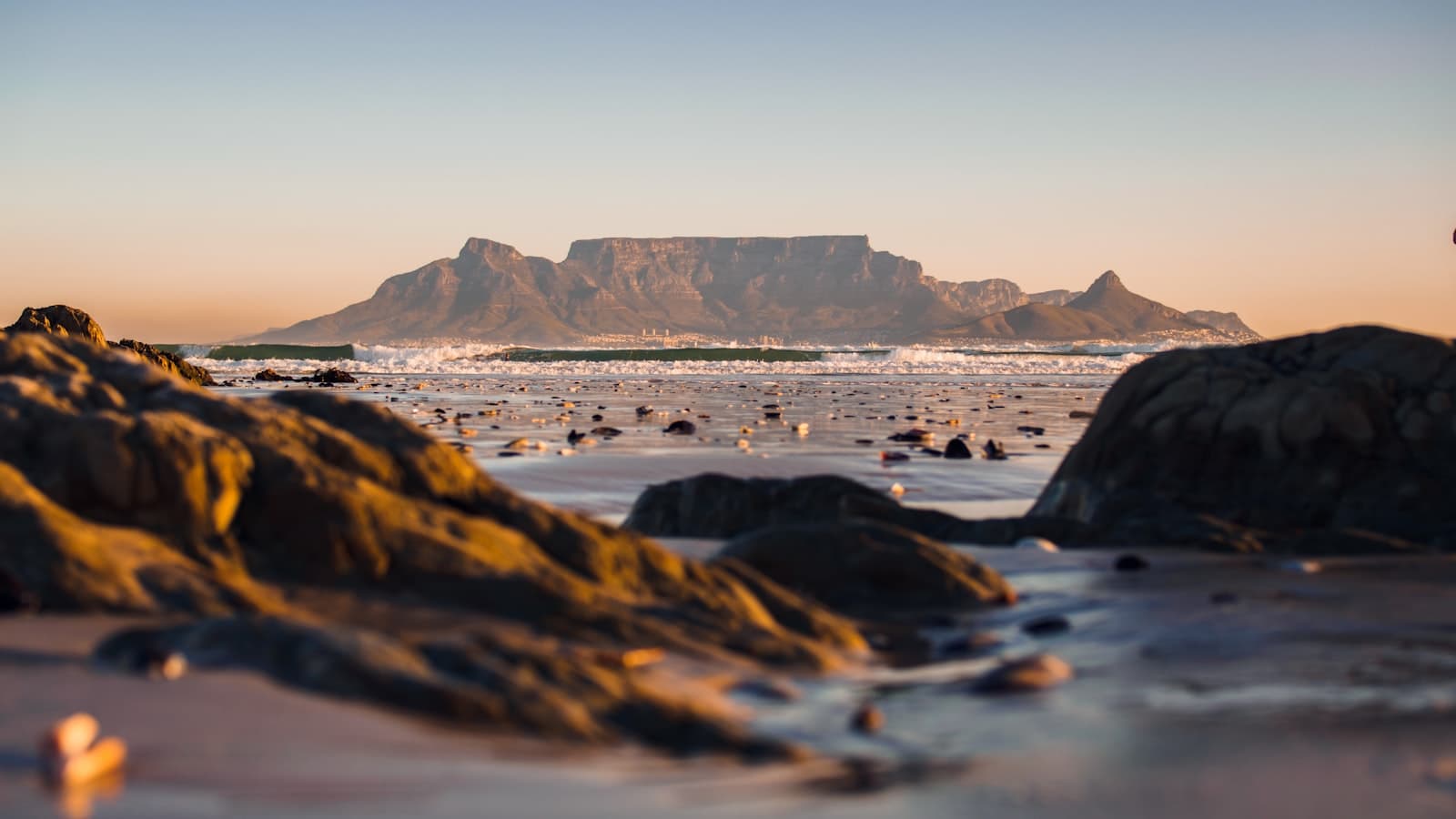
6No. 013 to 4 nightsCape Town and its peninsulaA flat mountain set between two oceans, penguin beaches and the world's most beautiful urban coastal road: Africa's most spectacular city stop.No. 024 to 5 nightsGarden Route300 kilometres of coast between lagoons, primary forest and beaches: Africa's most famous coastal road is savoured slowly, over four or five nights.No. 033 to 4 nightsKruger ParkThe Big Five from your own car, on partly tarred roads: Kruger is the world's most accessible independent safari.No. 042 to 3 nightsDrakensbergA 3,000-metre basalt wall raised above the Zulu grasslands: South Africa's hiking paradise, between two blocks of safari and ocean.No. 052 to 3 nightsRoute 62 and the KarooThe inland alternative to the coast: vineyards, spectacular passes, ostrich farms and the sleepy villages of the Little Karoo — South Africa's Route 66, only better.No. 062 to 3 nightsiSimangaliso and St LuciaHippos grazing the village lawns after dark, wild Indian Ocean beaches and a safari with sand between your toes: tropical South Africa.South Africa: practical notes
Tolls, fines, money, seasons, budget, rental: the essentials, gathered on this page.
Cash, Card and ATMs in South Africa: What to Know Before a Self-Drive Road Trip
In South Africa, a bank card works almost everywhere — self-service fuel pumps, national park entrance gates, street markets with improvised contactless readers. That's the exact opposite of neighbouring Namibia, where cash is still king the moment you leave the main towns. But all that card infrastructure has a flip side: the country has one of the best-documented card fraud rates in southern Africa, with well-identified theft techniques at ATMs. Here's how to handle cash and card without a nasty surprise, and what changed on the regulatory side in 2026.
| Item | Typical amount | Frequency |
|---|---|---|
| Fuel attendant or restaurant tip | R10-30 / 5-10% | each service |
| Car guard (street parking) | R5-10 | each time you park in town |
| Roadside markets and curios | R100-300 | per stop |
| Daily cash buffer | R300-500 for two | kept in reserve, not always spent |
Night driving in South Africa: why almost every self-drive traveler avoids it
"Can you drive at night in South Africa?" Technically, nothing on public roads forbids it — unlike neighbouring Namibia, where the ban on after-dark driving is written into almost every 4x4 rental contract in black and white. Yet nearly every self-drive traveler, consular services and rental companies themselves strongly advise against it, for two entirely separate reasons: kudu and other large animals stepping onto rural roads without warning, and a vehicle-theft risk that climbs noticeably once the sun goes down. Here is what the research says about both dangers, what actually happens at Kruger's and the private reserves' gates, and how to build an itinerary that never leaves you on the road after dark.
| Situation | What to know |
|---|---|
| Driving in a city in the evening (Cape Town, Johannesburg, Durban) | Tolerated, with extra caution at red lights and isolated intersections |
| Rural road between towns (Garden Route, R62, KwaZulu-Natal) after sunset | Real wildlife risk: avoid, especially April to July |
| Self-drive in Kruger or a reserve after gate closing | Forbidden under park rules, with a fine attached |
| Organized night drive in a private reserve (ranger and spotlight) | The only legal way to watch wildlife after dark |
| Unexpected delay on the road | Stop at the first well-lit town or petrol station, don't push on to the planned stop |
Police checks and fines in South Africa with a rental car: speed, alcohol and fake roadblocks
On the N3 between Johannesburg and Durban as much as on the back roads of the Garden Route, running into a South African Police Service (SAPS) or metro police checkpoint is part of everyday driving in South Africa. The country combines fairly standard speed limits, one of the lowest drink-driving thresholds in the region, and a quirk that catches more than a few travellers off guard: the real, if rare, risk of running into a fake roadblock staffed by criminals posing as police. Here are the rules in force, what changes with the new AARTO demerit points system, and how to tell a legitimate checkpoint from a scam.
| Road type | Speed limit |
|---|---|
| Built-up area (town, village, township) | 60 km/h |
| Secondary road outside built-up areas | 100 km/h |
| Freeway and national road (N) | 120 km/h |
SIM Cards and Internet in South Africa: Staying Connected from Cape Town to Kruger
Between the distances from Cape Town to Kruger, the GPS running non-stop on the Garden Route or Route 62, and the safety reflex that weighs heavily in planning a South African road trip, mobile connectivity isn't a comfort detail: it's a navigation tool, a budgeting tool and sometimes a safety tool. Unlike neighboring Namibia, South Africa has a dense, reliable mobile network across nearly all major tourist routes — but one little-known formality, RICA, often catches travelers off guard on arrival, and some pockets remain off-grid, especially in the Kruger bush. Here's how to get set up before hitting the road: mandatory registration, carriers, eSIM, and where the signal actually drops.
- Check whether your current plan includes South Africa roaming at a reasonable rate; if not, plan for a local SIM or an eSIM.
- Buy your Vodacom or MTN SIM at an official carrier shop at the airport (OR Tambo, Cape Town) — never from an informal reseller — with your passport and your first accommodation's address.
- Activate an eSIM before departure (Airalo, Holafly) to cover the first few hours without any airport queue.
- Download offline maps (Google Maps, Maps.me) before entering Kruger or any remote part of the Drakensberg.
- Install the Namola app before you leave, for a geolocated emergency button anywhere the network reaches.
- Mount the phone on a dashboard holder and rely on voice guidance rather than holding it while driving.
| Carrier/plan | Indicative price | Note |
|---|---|---|
| MTN — 2 GB + 60 min | R99 (≈$5) | Best value for light data use |
| MTN — 15 GB + 400 min | R399 (≈$21) | Best rate per gigabyte |
| Vodacom — 5 GB + 50 min + airtime | R449 (≈$24) | All-in tourist bundle, 30 days |
| Vodacom — 10 GB + 100 min + airtime | R699 (≈$37) | Best rural coverage on the market |
Self-driving the Kgalagadi Transfrontier Park: Twee Rivieren, Nossob, Mata Mata
If you have already self-driven Kruger or Etosha, the Kgalagadi looks like the obvious next step: same principles, completely different scenery. Except the red Kalahari does not forgive improvisation. There are only three camps with fuel, the tracks are sand and calcrete, distances lie, and accommodation is fought over almost a year ahead. This article answers the practical questions: is your car good enough, how do you book, how much range do you need, and under what conditions can you exit into Namibia or Botswana.
- Auob and Nossob valleys: a vehicle with good ground clearance is enough, 4x4 not required
- Access roads to some wilderness camps: soft sand, 4x4 strongly advised
- Bitterpan, Grootkolk, Gharagab: 4x4 mandatory, sand tracks including one-way sections
- Nossob 4x4 Eco Trail, Polentswa, Mabuasehube: low-range 4x4, in convoy, separate booking
- Botswana sector (Mabuasehube, Kaa): 4x4 plus full water and fuel self-sufficiency
- Speed limit of 50 km/h in the park and 20 km/h inside camps
| Camp | What you will find | Fuel | Vehicle needed |
|---|---|---|---|
| Twee Rivieren | Chalets, camping, shop, restaurant, pool, reception, immigration | Yes (unleaded and diesel) | Tarred road right to the gate |
| Nossob | Chalets, camping, shop, waterhole hide | Yes (unleaded and diesel) | Good ground clearance is enough |
| Mata Mata | Chalets, camping, shop, border post into Namibia | Yes (unleaded and diesel) | Good ground clearance is enough |
| Kalahari Tent Camp, Urikaruus, Kieliekrankie | Equipped units, unfenced, full self-sufficiency | No | High clearance, sandy access |
| Bitterpan, Grootkolk, Gharagab | Equipped units, unfenced, full self-sufficiency | No | 4x4 mandatory |
The Garden Route by Car: Itinerary from Cape Town to Gqeberha, Stops and Ideal Duration
The Garden Route is arguably the most accessible road trip in southern Africa: roughly 750 km of sealed road between Cape Town and Gqeberha (the former Port Elizabeth), along a coastline that alternates lagoons, ancient forests and cliffs pounded by the Indian Ocean. Officially, the Garden Route only covers the stretch between Mossel Bay and Storms River, but everyone includes the drive from Cape Town, Hermanus detour included. A rental saloon car is all you need, the N2 is in excellent condition, and 7 to 10 days let you savour every stop without rushing. Here is our annotated itinerary, the unmissable stops and the few driving habits specific to South Africa worth knowing.
- Book the car early and check the one-way fee if you're dropping off in Gqeberha rather than Cape Town.
- Spend at least two nights in Knysna or Wilderness so you can explore without repacking every day.
- Time the Hermanus stop between June and November if whales are on your list.
- Finish every driving leg before nightfall, no exceptions.
- Keep cash and a bank card for petrol stations, where an attendant fills up for you (a small tip is customary).
- In summer, check fire alerts and wind forecasts before any hike at Robberg or Tsitsikamma.
| Stop | What to do there | Recommended time |
|---|---|---|
| Hermanus (detour off the N2) | Southern right whales watched from shore (roughly June-November) | 1 night |
| Mossel Bay | Official start of the Garden Route, museums, beaches | Stopover or 1 night |
| Wilderness | Lakes, rivers, forests, kayaking and gentle hikes | 1-2 nights |
| Knysna | Lagoon, Knysna Heads, indigenous forests | 2 nights |
| Plettenberg Bay | Robberg reserve, fur seals, beaches | 1-2 nights |
| Tsitsikamma / Storms River | Suspension bridges, coastal trails of the national park | 1-2 nights |
| Gqeberha (Port Elizabeth) | End of the route, car drop-off or flight home | 1 night |
Tolls in South Africa: e-toll, N3, N4, what still charges with a rental car in 2026
For many travellers, the word "toll" in South Africa still brings up the infamous Gauteng e-toll — the overhead-gantry system installed around Johannesburg and Pretoria, boycotted en masse for over a decade before being permanently shut down. The good news: it's genuinely gone, and no longer applies to any rental car. The other thing worth knowing before you leave: two major routes still charge real tolls at physical booths — the N3 between Johannesburg and Durban, and the N4 between Johannesburg and Kruger — plus a single toll on the Garden Route. Here's what to budget for, fee by fee, on a rental-car road trip in 2026.
| Route | Stretch | Toll plazas | Indicative total (Class 1) |
|---|---|---|---|
| N3 | Johannesburg – Durban | 5 plazas (Wilge, De Hoek, Tugela, Mooi River, Mariannhill) | ≈ R222 (≈ €12) |
| N4 | Johannesburg – Nelspruit (toward Kruger) | 3 TRAC plazas (Diamond Hill, Middelburg, Machadodorp) | ≈ R261 (≈ €14) |
| N2 | Cape Town – Garden Route – Port Elizabeth | 1 plaza (Tsitsikamma) | R73 (≈ €4) |
Our flagship guide — €44
Guide available“South Africa on Your Own”, the complete edition, is out
10 chapters: day-by-day itineraries, driving and transport, a costed budget and checklists — the same method as our Namibia guide.
The guide is currently written in French — an English edition is in the works.
No time to do it yourself?
A professional can take care of it: tailor-made trip, equipped 4x4 rental or a local guide. Describe your plans and, with your consent, we pass them on to partner professionals.
1. What you need
Explore other countries