Sri Lanka on your own
An island the size of Ireland where a single day carries you from royal citadels to tea plantations, and from leopards to blue whales — a compressed Asia best travelled at tuk-tuk height.
When to go
Two monsoons share the island: the southwest monsoon (May-September) drenches Colombo, the south coast and the mountains; the northeast one (October-January) hits Trincomalee, Arugam Bay and Jaffna. December-March is regal for the classic circuit (triangle, tea, south); May-September shifts the game to the east coast and stays decent in the cultural triangle, which is often dry. The island's green is non-negotiable: it rains somewhere all year round, rarely everywhere.
What it costs
The island's great argument: rental tuk-tuk €12-18/day with insurance and local permit included, car with driver €55-75/day all-in (vehicle, fuel, driver's lodging), petrol around €1/litre. Guesthouses €15-35, very good hotels €50-90. The line items that sting: cultural-triangle sites (Sigiriya ~$35/person) and safaris (€60-90 per jeep). Budget €1,800-2,800 for two over 15 days excluding flights.
Driving & transport
Left-hand driving, a British inheritance. An international permit is not enough: you need a Sri Lankan recognition permit (obtained online or through your rental company, budget €30-40), which serious tuk-tuk outfits include in their package. The road's real rules: biggest goes first (bus > truck > you), the horn is a language of courtesy, and nobody drives at night — dogs, pedestrians and unlit trucks. In a tuk-tuk, 150-200 km a day is a comfortable maximum; the climbs to Ella are done in first gear, without shame.
Sri Lanka compresses a subcontinent into 65,000 km²: two-thousand-year-old cities in the cultural triangle, tea mountains at 1,900 m where the fleece comes back out, leopard and elephant parks, a palm-fringed south coast and the Tamil peninsula of Jaffna, far north, which feels like another country. Between stages, rarely more than three or four hours of road — and a colonial railway that beats the road outright in the mountains.
Our guide for this country: See what's inside — €44 →
Independence here comes in a local flavour: self-drive car hire exists but stays marginal (dense traffic, a local permit required, buses driven with flair). The two real formulas are the car with driver — surprisingly affordable, with zero compromise on route freedom — and, for the adventurous, the long-term rental tuk-tuk, now a travel institution in its own right: 250 cc of freedom at 40 km/h, repairable in every village.
The destinations that matter
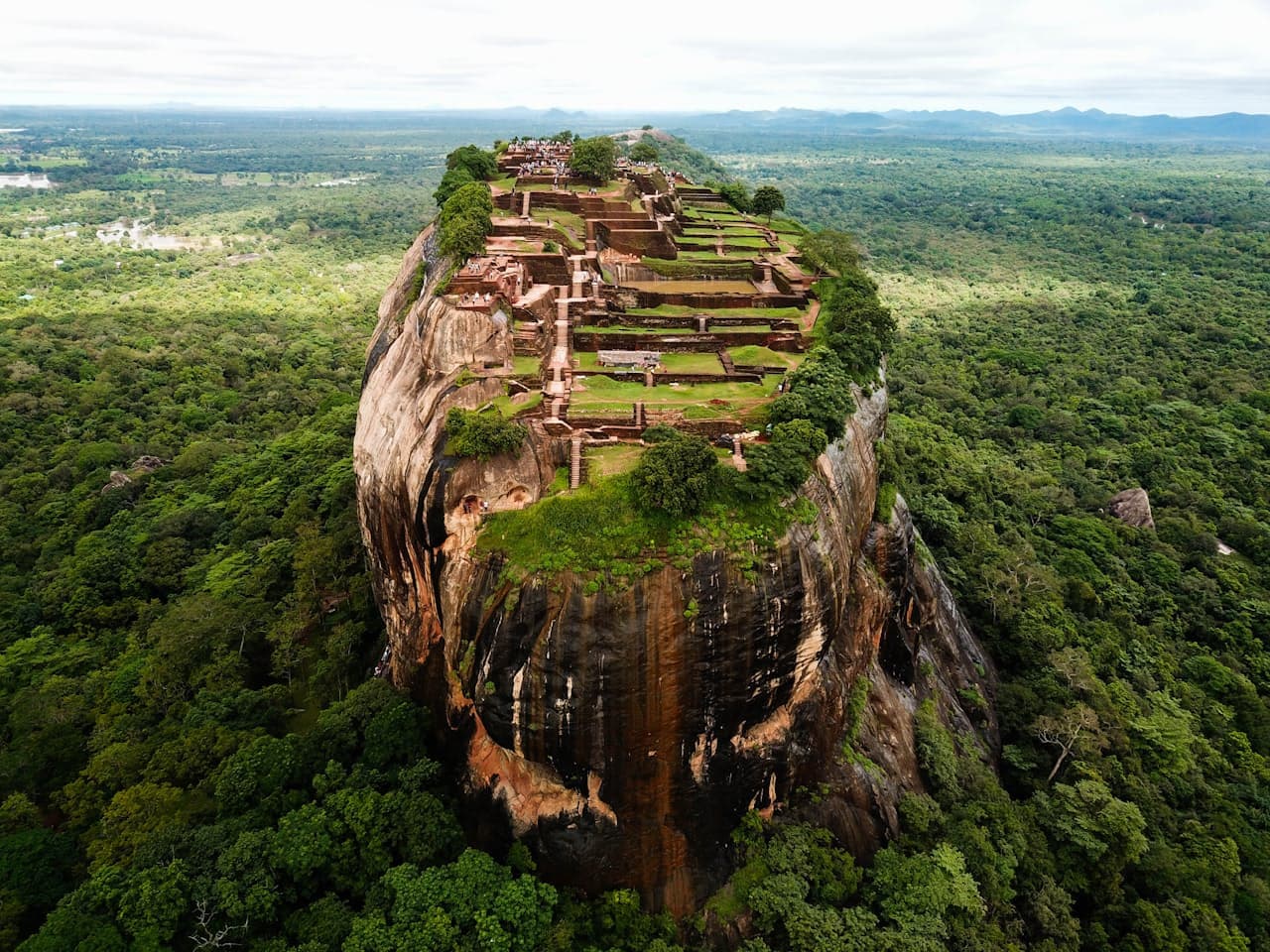
2No. 012 to 3 nightsSigiriya and the cultural triangleA royal fortress perched on a 200-metre monolith, ruined cities explored by bicycle and elephant gatherings at dusk: the island's ancient heart, an hour from everything.No. 022 to 3 nightsJaffna and the northern peninsulaPalmyra palms, Hindu temples shrieking with colour and flat islands laid on a turquoise lagoon: the Tamil north, long cut off from the world, is the island's most disorienting counterpoint.More stops worth adding to the trip
Kandy
The island's last royal capital, curled around a lake and a relic of the Buddha: Kandy is the country's spiritual pivot — and the departure platform for Asia's most beautiful train.
What to see
- The Temple of the Tooth during a puja (6.30 pm, the most accessible)
- The Peradeniya botanical gardens, 60 hectares and 4,000 species
- The lake loop on foot at daybreak, before the traffic
Suggested time: 1 to 2 nights
Ella and the tea mountains
Hills stitched with tea bushes where Tamil pluckers move through the mist, a legendary viaduct and sunrises above the clouds: the high country is the tropical island's other face.
What to see
- Little Adam's Peak at sunrise, before the heat and the crowd
- The Nine Arch Bridge at a train crossing (times posted in every café)
- Lipton's Seat at dawn from Haputale, through the Dambatenne plantations
Suggested time: 2 to 3 nights
Yala and Udawalawe
The planet's highest density of leopards on one side, elephants at arm's length on the other: the southern savannahs offer Asia's most accessible safari — provided you choose your jeep and your park.
What to see
- A morning safari (5.45 am at the gates) or an afternoon one in Yala's block 1 or 5
- Udawalawe's elephants around the reservoir in low evening light
- The calf feedings at the Elephant Transit Home (fixed times)
Suggested time: 2 nights
Galle and the south coast
A Dutch fort set upon the ocean, surfers' coves under the coconut palms and the largest animal that has ever lived cruising offshore: the south coast is the seaside reward — and not only that.
What to see
- The ramparts of Galle Fort in the day's last hour
- A blue-whale trip from Mirissa (November-April, responsible operator)
- Weligama bay for a first wave, or Hiriketiya for the confidential version
Suggested time: 3 to 4 nights
Sri Lanka: practical notes
Tolls, fines, money, seasons, budget, rental: the essentials, gathered on this page.
Money in Sri Lanka: Rupees, Bank Cards and ATMs Before a Road Trip
Paying for a road trip in Sri Lanka raises a problem few other destinations do: since the 2022 crisis, accommodation registered with the Sri Lanka Tourism Development Authority (SLTDA) has been legally required to bill foreign visitors in foreign currency — dollars or euros — while everything else, from drivers to tea sellers to tuk-tuks, runs purely on Sri Lankan rupees (LKR) in cash. Add a currency that collapsed by nearly 45% in a single year and ATMs that occasionally run dry away from Colombo, and cash planning becomes a real part of preparing your trip. Here's how to split your budget between rupees, dollars and card before you go.
| Expense | Safest payment method | What to plan for |
|---|---|---|
| SLTDA-registered hotel or lodge | Foreign currency (USD/EUR) in cash or international card | Check the payment policy when booking |
| Driver, rented tuk-tuk, family guesthouse | Cash in rupees | Withdraw before leaving the larger towns |
| E01-E04 expressway tolls | Cash in rupees, small notes | Have change ready before taking the expressway |
| National parks (Yala, Wilpattu) | Card or cash depending on the site | Confirm the foreign-visitor rate before entry |
| Markets, tips, small purchases | Cash in small notes | Keep a reserve separate from your foreign currency for hotels |
Police checks and fines in Sri Lanka: tuk-tuks, alcohol limits and paying via GovPay
On the road to Sigiriya or in the dense traffic of Kandy, an officer waving a vehicle to the shoulder is part of the scenery for many travellers in Sri Lanka — whether they're riding a rental tuk-tuk, the island's favourite way to travel independently, or driving one of the rarer self-drive rental cars. Two things changed in 2026: fines are now mostly paid online through GovPay, and dangerous driving offences have been pulled out of the on-the-spot fine system and sent straight to court. Here's how to be ready.
| Document | Why it's asked for |
|---|---|
| National licence | Baseline document, in the language and format of your home country |
| International Driving Permit | A required addition, but not sufficient on its own on the island |
| Sri Lankan recognition permit | Mandatory alongside the IDP, provided by most tuk-tuk rental companies |
| Passport (or colour copy) | Identity and validity of the visa or ETA |
| Rental agreement and insurance | Proves the right to drive this specific vehicle |
Renting a Self-Drive Car in Sri Lanka: Deposit, Insurance and Excess Before You Take the Wheel
In Sri Lanka, a "classic" self-drive car rental — no driver included — remains a minority choice: most travellers opt for a rented tuk-tuk or a car with a private driver, often cheaper in practice and without the hassle of a local driving permit. But the option exists, and it appeals to a specific kind of road-tripper: comfortable with left-hand traffic, not keen on sharing the cabin eight hours a day with a stranger, or simply after full independence between the Cultural Triangle and the tea plantations around Ella. For that traveller, three things are worth checking before signing the contract: the deposit held at handover, what the insurance actually covers in a fender-bender, and the excess left on your shoulders. Here is what Sri Lankan rental companies typically set out in 2026, item by item.
| Item | Typical amount |
|---|---|
| Deposit required at pickup | ≈ $300 (refundable) |
| Minor-damage threshold deducted from deposit | up to ≈ $60 |
| Insurance excess (at-fault accident) | $500 to $1,000 |
| Optional excess waiver | $5 to $15/day depending on the rental company |
SIM card and internet in Sri Lanka: staying connected between the hill train and the tuk-tuk
In Ella, in the tea-growing hills of the central highlands, the network holds up well in town but drops in and out along the legendary train line to Kandy and on the trails around Little Adam's Peak. Mobile coverage is never far away in Sri Lanka — the island has one of the highest mobile penetration rates in South Asia — but getting connected looks different depending on whether you're touring by chauffeur-driven car, a rented tuk-tuk, or the hill train. Here is how to get equipped before you go, and where coverage really weakens between the Cultural Triangle, the tea highlands and the southern parks.
- Check what your home plan actually covers in Sri Lanka (Free 5G+/Free Max or Orange's Pass Évasion 3) before relying on it for the whole trip.
- Activate an eSIM before departure (Airalo, Holafly) to secure the airport-to-hotel leg as soon as you land.
- For an extended trip through the highlands or the south, a Dialog SIM bought at the airport remains the widest coverage.
- A passport is always required for biometric SIM registration — keep it within reach.
- Download offline maps before the Kandy–Ella line, the tea trails and the Jaffna islands: the network drops without warning there.
- Mount the phone on a dashboard holder and avoid holding it, even when stopped in traffic.
| Carrier | Sri Lanka offer | Indicative price |
|---|---|---|
| Free | 35 GB included (5G+ plan) or unlimited Free Max | €19.99 or €29.99/month |
| Orange | Pass Évasion 3 (1 GB, 20 min, 50 SMS, 31 days) | ≈ €29 |
| RED by SFR | Not covered — out-of-plan per MB | out-of-plan rate |
| Bouygues Telecom | Not covered — out-of-plan per MB | out-of-plan rate |
Tolls in Sri Lanka: The E01-E04 Expressways, Rates and How to Pay in a Rental Car
Away from the expressways, almost the entire Sri Lankan road network stays free — coastal roads, mountain roads toward Ella or Nuwara Eliya, the Jaffna ring road. Since 2013, though, the country has built four toll expressways (E01, E02, E03, E04) that genuinely reshape the drive between the airport, the south coast and Kandy. Here is their route, ballpark 2026 rates for a rental car, which class applies, and how to pay without an international bank card.
| Route | Expressway | Class 1 fare (indicative) |
|---|---|---|
| Katunayake airport → Colombo (Peliyagoda) | E03 | ≈ LKR 300–400 (≈ €0.90–1.20) |
| Colombo (Kottawa) → Galle | E01 | ≈ LKR 300–500 (≈ €0.90–1.50) |
| Colombo (Kottawa) → Matara (full route) | E01 | ≈ LKR 500–700 (≈ €1.50–2.10) |
| Colombo (Kadawatha) → Kandy (Galagedara exit) | E04 | ≈ LKR 400–600 (≈ €1.20–1.80) |
Travel Insurance for Sri Lanka: Dengue, Private Hospitals and Medical Evacuation
Sri Lanka treats patients well, but treating a foreign visitor comes at full price: the country runs a free public healthcare system, a legacy of British-era administration and known for the quality of its doctors — but that free access is, in practice, reserved for residents. A sick or injured tourist ends up billed as if at a private clinic, on an island where dengue circulates year-round and where the road remains, for a driver unused to left-hand traffic or to the local hierarchy of "biggest vehicle wins," one of the trip's main risks. Between a rented tuk-tuk, a chauffeur-driven car and mountain detours to Ella or Adam's Peak, a well-chosen travel insurance policy isn't an administrative afterthought — it's the difference between a mosquito bite handled in an evening and a five-figure bill.
| Item | Reality in Sri Lanka | Covered without travel insurance? |
|---|---|---|
| Consultation and hospitalization at a public hospital | Free for Sri Lankan residents and citizens | Not applicable to tourists in practice, almost always billed |
| Hospitalization for dengue at a public tertiary hospital | Real cost ~USD 234 per patient covered by the system (2022 study, south of the island) | A foreign visitor with no agreement is billed in full |
| Private hospital (Colombo, Kandy, Galle) | Market rates, often payable upfront or by deposit | Never free for a visitor |
| Medical evacuation / repatriation to Europe | Medically escorted flight billed separately, cost can climb to several tens of thousands of euros | Never covered by the Sri Lankan system |
Our flagship guide — €44
Guide available“Sri Lanka on your own”, the complete edition, is out
10 chapters: day-by-day itineraries, driving and transport, a costed budget and checklists — the same method as our Namibia guide.
The guide is currently written in French — an English edition is in the works.
No time to do it yourself?
A professional can take care of it: tailor-made trip, equipped 4x4 rental or a local guide. Describe your plans and, with your consent, we pass them on to partner professionals.
1. What you need
Explore other countries