Costa Rica on your own
Steaming volcanoes, cloud forests, sloths by the roadside and two oceans three hours apart: the most accessible concentrate of wild life you can drive.
When to go
Dry season December to April (high season, the Pacific grilled in sun); green season May to November: afternoon downpours, explosive nature, gentle prices — and the best period for turtles on the Caribbean side. The Caribbean runs its own weather, often inverted: September-October are superb there.
What it costs
Pricier than you'd imagine: a 4x4 SUV €60-110/day including the compulsory, incompressible insurance, lodges €80-180, national parks €15-20/person. Budget €3,000-4,500 for two over 12-15 days excluding flights in simple comfort; cabinas and sodas (local eateries) lighten the bill.
Driving & transport
Right-hand driving. The local rules: NEVER cross a ford without wading it first (or watching a local pass), avoid night driving (rain, pedestrians, potholes), one-lane bridges with signed priority ("ceda"), and keep fuel above half in remote areas. The basic insurance is legally compulsory and billed on top of tempting online rates.
Costa Rica made nature its national project: a quarter of the territory is protected, ecotourism is a second language, and wildlife shows itself like nowhere else — howler monkeys at dawn, toucans at breakfast, a sloth in the car park's cecropia. By car, everything chains together: Arenal volcano, the Monteverde cloud forests, Pacific beaches, the deep jungle of the Osa peninsula.
Our guide for this country: See what's inside — €44 →
Driving here is a sport of patience more than technique: short distances but slow averages (a real 40-50 km/h), potholed tracks to the finest corners, river fords in the green season. The compact 4x4 SUV is the standard choice, and Waze the national co-pilot.
The destinations that matter
3No. 012 to 3 nightsArenal volcano and La FortunaA perfect cone above the pastures, hot rivers beneath the jungle: Arenal is the trip's first thrill — and its best organised.No. 022 nightsMonteverdeA forest perpetually bathed in mist, orchids on every branch and the Americas' most mythical bird: Monteverde is the country's green cathedral.No. 033 to 4 nightsGuanacaste and NicoyaThe guaranteed-sun coast: blond coves, surf spots for every level and coastal tracks where the 4x4 finally earns its keep — the circuit's seaside reward.More stops worth adding to the trip
Manuel Antonio
Sloths above the trails, bag-thieving capuchins and blond coves beneath the jungle: the country's smallest park is its most irresistible concentrate.
What to see
- The main trail and the Punta Catedral loop
- Manuel Antonio beach inside the park (calm swimming, supervised by monkeys)
- The sloths of the car park and access road — often the best placed
Suggested time: 2 nights
Osa Peninsula and Corcovado
"The most biologically intense place on Earth" according to National Geographic: Osa is jungle with a capital J — tapirs on the beach, scarlet macaws in pairs, and zero compromise.
What to see
- A guided day in Corcovado (San Pedrillo or Sirena station by your base)
- The Golfo Dulce by kayak or boat: dolphins, whales in season
- The scarlet macaws of Puerto Jiménez and the Carate road — free and guaranteed
Suggested time: 3 to 4 nights
Tortuguero
A labyrinth of canals between sea and jungle, a carless village and, in summer, the Atlantic's greatest green turtle nesting: the trip's amphibious parenthesis.
What to see
- The canals by canoe or electric boat at dawn (the outing that justifies everything)
- Green turtle nesting on a guided night walk (July-October)
- The Cerro Tortuguero trail for the view over the labyrinth
Suggested time: 2 nights
Free decoder
The Mexico & Costa Rica car rental insurance decoder
TPL / seguro obligatorio no counter can remove, CDW-LDW, the deducible, the blocked deposit, comparison-site teaser rates: our decoder goes through the Mexican or Costa Rican quote line by line, with the check-out checklist and the 5 questions to ask before paying. Instant access, with the current promo code.
Costa Rica: practical notes
Tolls, fines, money, seasons, budget, rental: the essentials, gathered on this page.
Arenal Volcano and La Fortuna by Car: What to See, Hot Springs and the Road to Monteverde
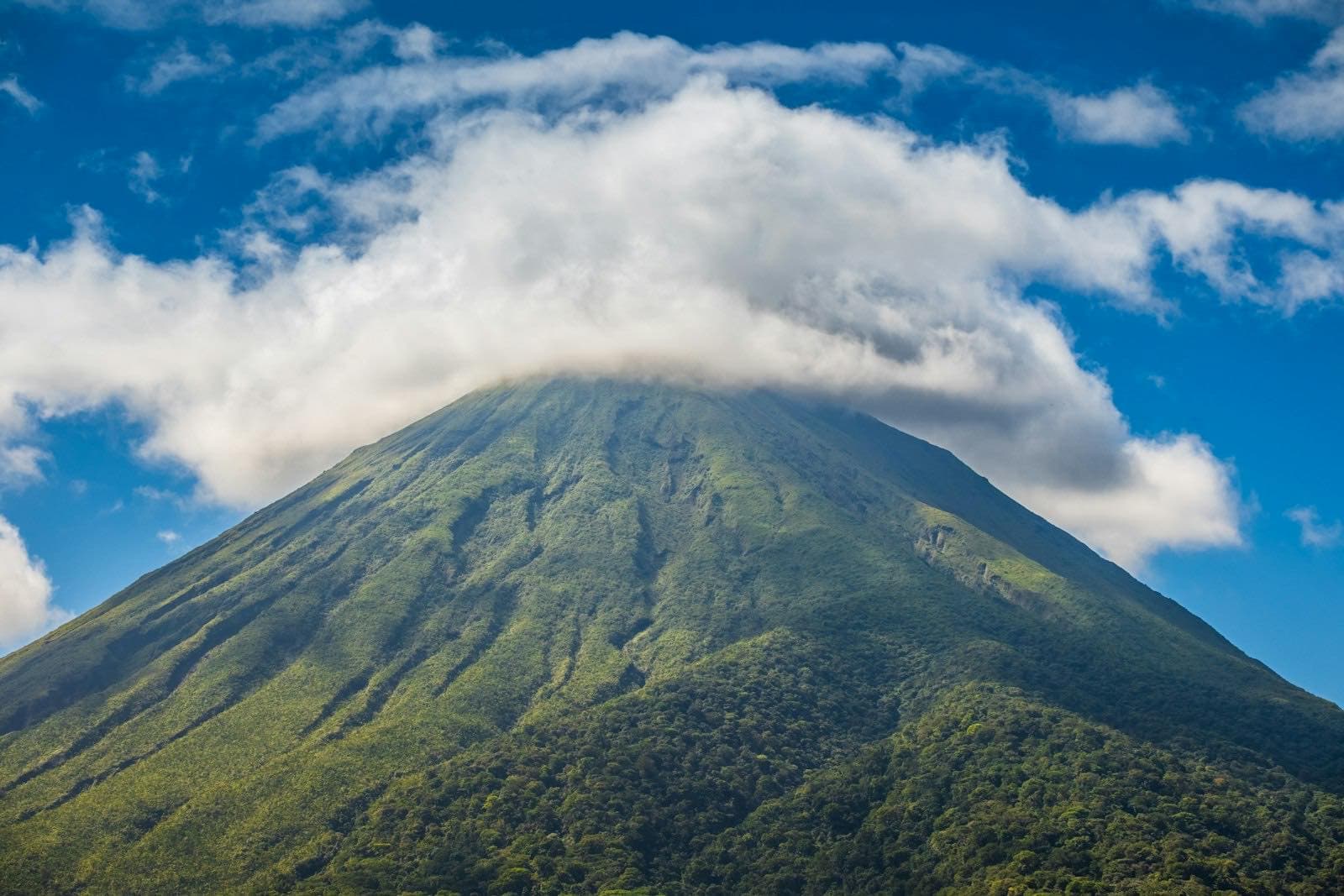
An almost perfect cone rising above plantations and pastures: Arenal is Costa Rica's most famous image, and La Fortuna, the small town at its feet, an unmissable stop on any road trip through the country. About three hours' drive from San José, the region packs in a national park laid over the 1968 lava flows, a spectacular waterfall, hot springs heated by the volcano and the country's largest lake. It's also the starting point of one of Costa Rica's most debated driving legs: the road to Monteverde, which loops around the lake before finishing on gravel. Here's how to plan the stop, and what genuinely deserves your time.
- Leave La Fortuna early: Route 142 is winding and the final gravel sections are far easier in daylight.
- Fill the tank before leaving La Fortuna or Tilarán: fuel stations thin out afterwards.
- In the rainy season, favour a 4x4 or high-clearance SUV and check track conditions the day before with your accommodation in Santa Elena.
- Never trust the GPS blindly: follow the main route via Tilarán rather than a suggested «shortcut».
- Plan a stop around Nuevo Arenal: the lake viewpoints are worth pulling over for.
| Option | What you get | Best for |
|---|---|---|
| High-end resort (Tabacón and similar) | Landscaped pools in the forest, spa, dinner packages | A special evening out, on a comfortable budget |
| Mid-range establishment (Baldi, Eco Termales…) | Multiple pools at varied temperatures, family-friendly or more intimate depending on the venue | The best price-to-comfort compromise |
| Free riverbank spots | Naturally warm water among the rocks, no facilities | Budget travellers, a rustic experience |
Money in Costa Rica: colón, dollar and cards for a road trip
Costa Rica has an almost split relationship with money: the official currency, the colón costaricense, is what changes hands at sodas and remote petrol stations, while car rental companies, lodges and most tour operators quote their prices in US dollars. For a self-drive road trip, that dual-currency setup raises a very practical question: should you arrive with dollars in your pocket, withdraw colones at the ATM, and where does a bank card actually get you through on the backroads of Guanacaste or the Osa Peninsula?
- Always decline the dynamic currency conversion (DCC) the ATM offers and explicitly choose to withdraw in colones.
- Withdraw comfortable amounts (200-300 USD equivalent) rather than making several small withdrawals hit by flat fees.
- Keep a reserve of small-denomination colones for sodas, isolated stations and beach car parks, where cards don't work.
- Check the credit card planned for the rental deposit: sufficient limit, and ideally a second card in reserve.
- Pay in dollars for whatever is billed in dollars (rental, accommodation, excursions) to avoid needless exchange losses.
| Route | ATMs along the way | Cash recommended (2 people, a few days) |
|---|---|---|
| Central valley, San José, Alajuela | Plentiful and reliable | 20,000-30,000 CRC as a top-up |
| Arenal, Monteverde, Route 27 | Available in stopover towns | 30,000-50,000 CRC before setting off |
| Guanacaste and southern Nicoya (Santa Teresa) | Concentrated in Tamarindo, Sámara, scarce beyond | 50,000-80,000 CRC before setting off |
| Osa Peninsula, Drake Bay, Puerto Jiménez | Rare outside the main towns | 60,000-90,000 CRC before setting off |
Police Checks and Fines in Costa Rica: Tránsito, Speed and Drink-Driving in a Rental Car
On the road from Arenal to Monteverde, or right out of Liberia airport, running into a Policía de Tránsito checkpoint ("reten") is part of the scenery on a Costa Rica road trip. Patrols, easy to spot in their white-and-grey pickups, check speed as much as the paperwork of foreign drivers — and the country has a well-earned reputation for coming down hard on drink-driving. Unlike some destinations where a roadside fine gets quietly negotiated, paying a Costa Rican officer in cash is a corruption offence, not a shortcut. Here are the current speed limits, the real cost of a fine, how it gets settled with a rental car, and the automated speed camera project due to change things by late 2026.
| Road type | Speed limit |
|---|---|
| Highway / national road | 100 km/h (min. 50 km/h) |
| Unsigned secondary road | 60 km/h |
| Built-up area | 50 km/h |
| School or hospital zone | 25 km/h |
Tolls in Costa Rica: The Ruta 27 to the Pacific Coast in a Rental Car
Costa Rica has a well-earned reputation for an almost entirely toll-free road network: no toll booth stands between you and Arenal, Monteverde or the Osa Peninsula. There is one exception most rental-car travellers run into within their first few days, often without expecting it: the Ruta 27, the highway linking San José to the Pacific beaches — Jacó, Manuel Antonio, Quepos — and still, as of 2026, the country's busiest toll road. Here is what to know about 2026 rates, the other, quieter toll roads, and how to pay without an unpleasant surprise on your rental credit card.
| Route | Light-vehicle toll | Euro equivalent |
|---|---|---|
| Ruta 27, San José–Caldera (one way, 4 plazas) | ≈ CRC 2,510 | ≈ €4.80 |
| Ruta 27, San José–Caldera (round trip) | ≈ CRC 5,020 | ≈ €9.55 |
| Ruta 32, San José–Guápiles–Limón (single plaza) | CRC 75 | ≈ €0.15 |
| Ruta 1 / Ruta 2 / Circunvalación (per plaza, San José area) | CRC 200–500 | ≈ €0.40–0.95 |
Travel Insurance for Costa Rica: Private Hospitals, Drowning and Evacuation — What to Cover Before a Road Trip
A Costa Rica road trip is planned around volcanoes, beaches and cloud forest, a rented 4x4 for the gravel stretches, and a budget worked out line by line — yet the "travel insurance" line is often the one ticked fastest, without a close look. It deserves better: Costa Rica isn't a dangerous country, but it's one where the public hospital system doesn't treat foreign visitors on the same terms as a resident, where a night in a private clinic bills at North American rates, and where the leading cause of death among foreign travelers is neither the road nor the wildlife, but swimming. Real costs, what Costa Rica's healthcare system covers (and doesn't), what the research on tourist drownings actually shows: here's what to check before you get behind the wheel.
- Compare at least two policies on the medical expenses cap (≥ €100,000) and international evacuation on an actual-cost basis.
- Check that whitewater rafting, diving, surfing and off-road driving are explicitly covered, not just "not excluded."
- Don't rely on CAJA or a home health card: without local affiliation, public coverage stops at emergency stabilization.
- Look for safety flags and ask about rip currents before every swim, especially on unpatrolled Pacific beaches.
- Avoid driving after dark on secondary roads: potholes, no lighting and stray animals are the main hazards.
- Keep the 24/7 assistance number (on paper and as a photo on your phone) in the glovebox, next to your driving licence.
| Type of cost | Typical amount |
|---|---|
| Emergency room visit (private clinic, uninsured) | $100-250 (€90-230) |
| ER visit with imaging and lab work | $500-2,000 (€450-1,850) |
| Hospitalization or surgery | $10,000-50,000 and more (€9,000-46,000) |
| International medical evacuation (air ambulance) | $50,000-120,000 and more (€45,000-110,000) |
When to Visit Costa Rica? Dry Season, Green Season and the Caribbean Exception
Costa Rica fits in a pocket handkerchief — 500 km from the Pacific to the Caribbean — yet stacks up microclimates that make 'when should I go?' subtler than it looks. The December-to-April dry season, the classic answer, really only holds for the Pacific side and the Central Valley: the Caribbean coast follows an almost opposite calendar, and the green season has arguments the brochures forget. Here is the real calendar, region by region, with its very concrete consequences for driving.
| Period | Pacific & Central Valley | Caribbean coast | Worth remembering |
|---|---|---|---|
| December-April | Dry season, clear skies, Guanacaste turning golden | Rain present, relative lull in February-March | Tourist high season: peak prices and crowds |
| May-June | Green season begins, afternoon showers, everything turns green | Rainy | Excellent price/weather compromise, superb landscapes |
| July-August | 'Veranillo': frequent lull in July, rain returning in August | Rainy, often rough seas | School holidays: crowds rise despite the green season |
| September-October | The two wettest months, difficult dirt roads | Driest window of the year: the time for Puerto Viejo | The southern Pacific (Osa) becomes very hard by car |
| November | Transition, rains spacing out | Rain returning | Good window before high season, still gentle prices |
Our flagship guide — €44
Guide available“Costa Rica on Your Own”, the complete edition, is out
10 chapters: day-by-day itineraries, driving and transport, a costed budget and checklists — the same method as our Namibia guide.
The guide is currently written in French — an English edition is in the works.
No time to do it yourself?
A professional can take care of it: tailor-made trip, equipped 4x4 rental or a local guide. Describe your plans and, with your consent, we pass them on to partner professionals.
1. What you need
Explore other countries