United States on your own
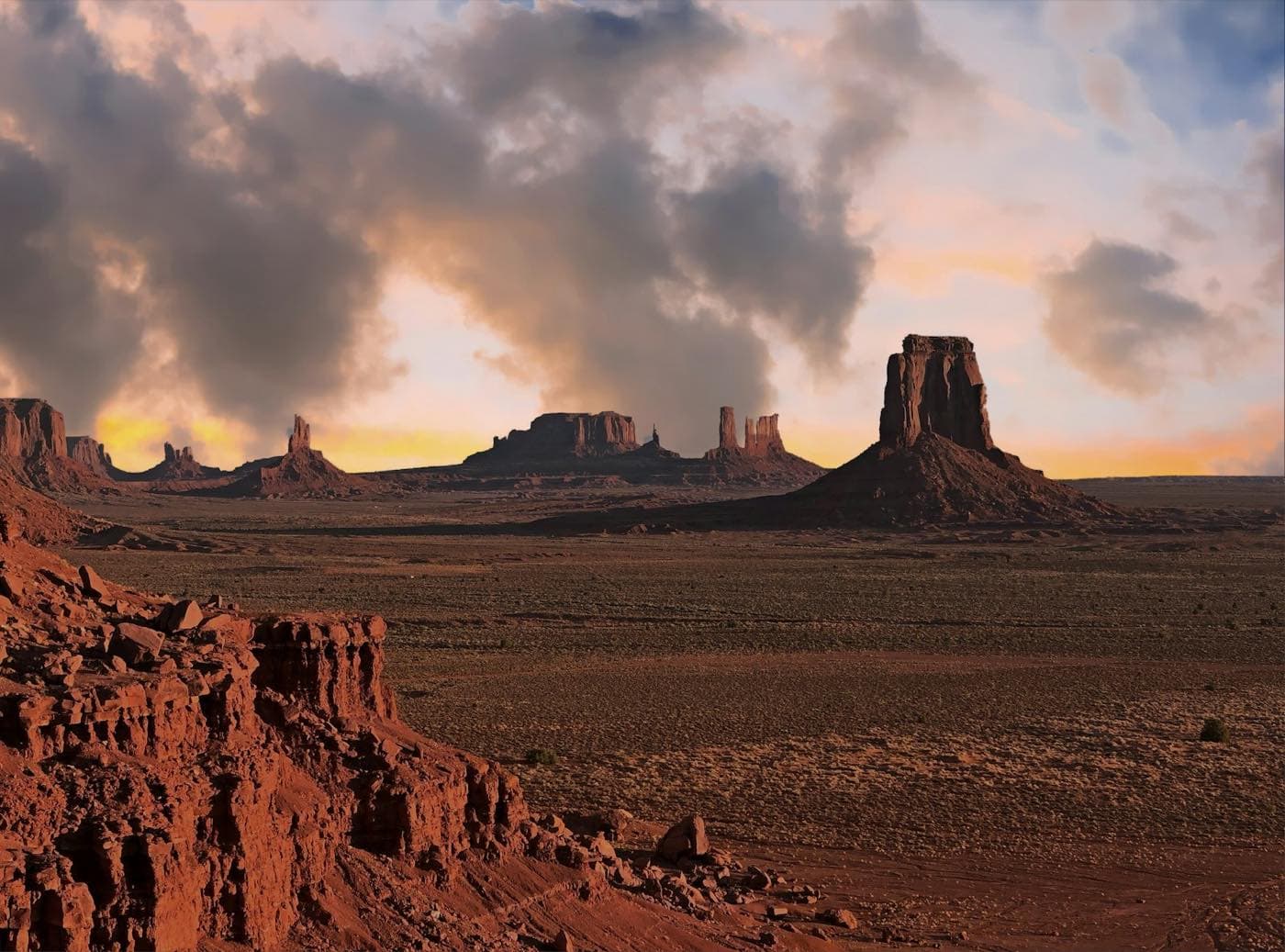
Canyons older than the continents, roads running dead straight to the horizon and neon-lit motels: the American West is the original road trip — the one all others descend from.
When to go
April-May and September-October are the kings: the Colorado Plateau fully driveable, bearable heat, thinner crowds. Summer (June-August) combines record crowds with furnace heat in the deserts (Arizona and Death Valley exceed 45 °C) but remains the only real window for Yellowstone, whose roads close from November to late April. Winter offers the Grand Canyon and Bryce under snow, spectacular but demanding — the Grand Canyon's North Rim closes entirely from December to May.
What it costs
Mid-size SUV $45-80/day (CDW/LIS insurance included), RV $150-300/day plus $0.35/mile with some rental companies and $50-90 a night for a campground with hookups. Fuel $3.20-4/gallon in the Rockies, $4.50-5.50 in California. Motels $90-160 a night, in-park lodges $200-350 (book 6-13 months ahead). Budget €4,000-6,000 for two over 15 days excluding flights on the SUV-and-motels formula, slightly less in a well-booked RV.
Driving & transport
Right-hand driving, universal automatic transmission, wide and easy roads — the traps lie elsewhere: strictly enforced speed limits (mobile radar, steep fines inside the parks), a FULL stop required at stop signs and flashing school buses, right turn on red allowed unless signed otherwise. In the deserts, fuel is managed like a vital resource: up to 150 km between stations, and GPS loses signal — download offline maps. Watch for wildlife at dusk (deer, elk, bison in Yellowstone: they have right of way, and they know it).
The American West invented the road trip and still practises it in capital letters: giant distances (expect 300-500 km between stops), national parks run with precision by the NPS, gas-station-general-stores in the middle of nowhere, and that unique feeling that the road itself is the destination. The classic circuit chains Grand Canyon, Monument Valley and Utah's parks across the Colorado Plateau; the ambitious add Yellowstone to the north or California's Highway 1 as an oceanic epilogue.
Our guide for this country: See what's inside — €44 →
Two schools of vehicle: the SUV with motels and lodges (maximum flexibility, hotel bookings essential in summer), or the RV — the American motorhome — which turns park campgrounds into rooms with a view. Either way, the trip is won months in advance on recreation.gov: NPS campgrounds, Angels Landing permits, Arches timed entry. The America the Beautiful pass ($80 for an annual per-vehicle pass) pays for itself by the third park.
The destinations that matter
4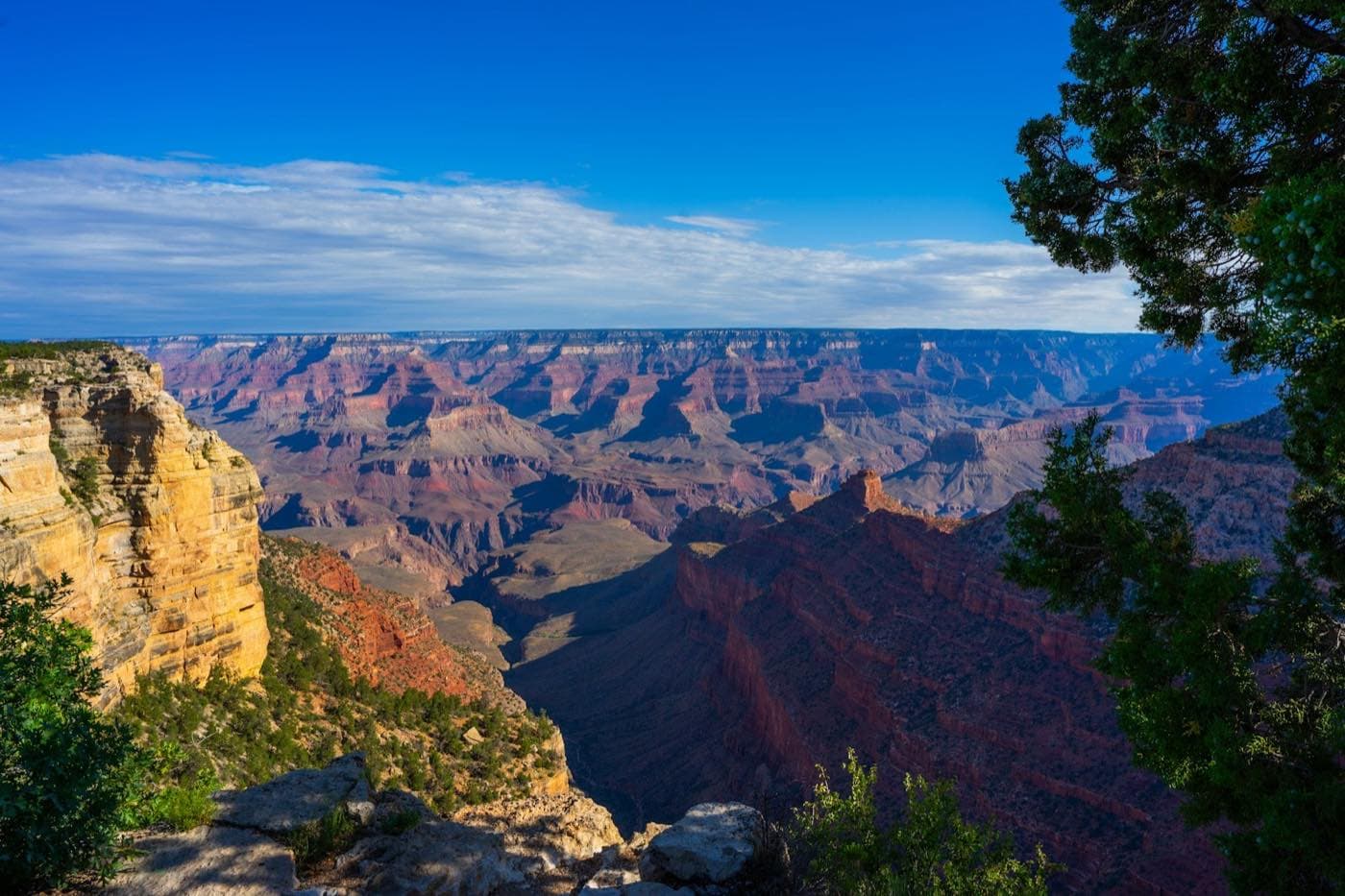 No. 012 nightsGrand CanyonA gash 450 km long and 1,600 m deep where the Colorado has sliced through two billion years of rock: no photograph prepares you for the moment the ground opens.No. 021 to 2 nightsMonument ValleyThree red buttes set on an ochre desert, a thousand westerns in the rearview mirror: Monument Valley is the West's most famous landscape — and it belongs to the Navajo.No. 031 to 2 nightsDeath ValleyAt 86 m below sea level, the hottest place on Earth lines up cracked salt flats, blond dunes and crumpled badlands: beauty in its mineral state, without a shadow.No. 042 to 3 nights between San Francisco and Los AngelesHighway 1 and Big SurTwo lanes suspended between the Santa Lucia mountains and the Pacific, redwoods touching the fog and elephant seals sprawled at the foot of the cliffs: America's most beautiful coastal road.
More stops worth adding to the trip
Utah's parks: Zion, Bryce and Arches
A cathedral canyon, an amphitheatre of orange spires and a desert pierced by two thousand arches: Utah lines up three masterpieces three hours' drive apart.
What to see
- Zion's Narrows, wading up the Virgin River (pole and canyon-shoe rental in Springdale)
- The Bryce amphitheatre at sunrise, then the Queens Garden-Navajo Loop
- Scenic Byway 12 between Bryce and Capitol Reef, with the vertiginous Hogback stop
Suggested time: 5 to 6 nights for the three parks
Yellowstone
A caldera the size of Corsica where the Earth still boils: geysers, rainbow springs, bison by the thousand — the world's first national park remains its most alive.
What to see
- The Grand Prismatic from the Fairy Falls trail overlook, at midday when the colours saturate
- The Lamar Valley at dawn, binoculars or a spotting scope for wolves and grizzlies
- Old Faithful and the Upper Geyser Basin walk out to Morning Glory Pool
Suggested time: 3 to 4 nights
United States: practical notes
Tolls, fines, money, seasons, budget, rental: the essentials, gathered on this page.
ESTA: US Entry Requirements for a Road Trip Across the American West
No classic visa needed for a road trip across the American West if you're French, Belgian or Swiss: the US Visa Waiver Program (VWP) exempts most European travellers. In exchange, it requires a mandatory online step, the ESTA, whose fee nearly doubled in late 2025 — and which has since been widely confused with an entirely different charge, the $250 "Visa Integrity Fee". Here's what to check before booking flights for the Grand Canyon, Monument Valley or Highway 1.
| Item | Amount | Timing | Validity |
|---|---|---|---|
| ESTA (processing fee) | $4, non-refundable | Instant to 72 h | — |
| ESTA (authorisation) | $36.27, refunded if denied | Instant to 72 h | 2 years, multiple entries |
| Total ESTA per person | $40.27 (~€34-35) | — | 90 days per stay |
| Visa Integrity Fee | $250 — doesn't apply to ESTA travellers | — | — |
How many days for an American West road trip?
The American West is the archetypal road trip — the one the format was invented for. But between the Grand Canyon, Monument Valley, Bryce, Zion, Death Valley and the California coast, the list of “must-sees” far exceeds what a single reasonable trip can hold: the Grand Circle of Utah and Arizona parks alone represents a 1,500-1,700 km loop, and California adds as much again. Short answer: 7 days for a tight Grand Circle out of Las Vegas, 10 to 12 days for the same without rushing — the reference format —, 15 to 18 days to add Death Valley and California, 3 weeks for the full grand loop from San Francisco back to San Francisco. Here's the detail, distances and park reservations included.
| Duration | Itinerary | Distance | What you give up |
|---|---|---|---|
| 7 days | Compact Grand Circle from Las Vegas | 1,500-1,700 km | The big hikes, California |
| 10-12 days | Comfortable Grand Circle + Monument Valley | 1,700-2,000 km | The Pacific coast |
| 15-18 days | Grand Circle + Death Valley + California | 2,500-3,000 km | Yosemite OR the coast, depending on choice |
| 3 weeks | Full grand loop from San Francisco | 3,500-4,000 km | Almost nothing — except Yellowstone |
Money in the USA: dollars, bank cards and tipping on a road trip
At a gas pump in Nevada or the counter of a diner on Route 66, a European bank card works almost everywhere in the United States, Visa and Mastercard leading the way. Two traps still await a traveller fresh off the plane: foreign transaction fees and dynamic conversion that nibble away at every payment, and tipping, a practice so deeply rooted it now sparks debate among Americans themselves. Here's how to handle your money without surprises, from the dollar to the tip on your last night.
| Type of service | Usual tip |
|---|---|
| Sit-down restaurant | 18-20% of the pre-tax amount |
| Coffee shop, counter, food truck | Optional, $0-2 |
| Taxi, Uber/Lyft | 10-15% |
| Housekeeping (hotel, motel) | $2-5 per night, in cash |
| Guide, activity (rafting, van tour...) | 15-20% if not included |
| Gas station, grocery store, campground | No tip expected |
Police checks and fines in the USA: speed, alcohol and the reckless-driving trap in a rental car
On the roads of the American West, flashing lights in the mirror aren't a disaster — most traffic stops are over in a few minutes. What tends to surprise European travellers more is that there's no national traffic code at all: every state sets its own speed limits, its own fine schedule and, for drink-driving, its own legal limit. The same speeding violation can cost 25 dollars in New Mexico, over 250 dollars in Arizona, and a court appearance in Virginia. Here's how American traffic stops actually work, what a violation costs depending on the state you're crossing, and how to react in front of an officer with a rental car.
| State | What a speeding ticket costs | What's different |
|---|---|---|
| California | ≈ $234 for 1-15 mph over (base $35 + fees) | Fees multiply the base fine by 4 to 5 |
| Nevada | ≈ $290 for 15 mph over the limit | Among the highest in the country |
| Arizona / Florida | ≈ $250 for 15 mph over the limit | On the high end |
| Georgia | Local fine + $200 "Super Speeder" fee | From 75 mph on a two-lane road or 85 mph anywhere |
| Virginia | Up to $2,500 and a mandatory court appearance | Becomes a criminal offence (reckless driving) past a set threshold |
| New Mexico / Nebraska | ≈ $25 for 10 mph over the limit | Among the cheapest in the country |
| National average | ≈ $130 for 10 mph over the limit | A useful benchmark, but highly state-dependent |
SIM card and internet in the USA: staying connected across the American West
Booking a Zion campsite from the Bryce Canyon parking lot, checking whether a dirt road is still open after a Nevada desert storm, or simply reassuring family back home from a straight stretch of Utah highway: on a road trip through the American West, mobile connectivity isn't a comfort detail, it's a genuine navigation tool. The country combines two realities that often surprise foreign travellers: some of the densest urban networks in the world, and real coverage gaps the moment you head into a national park or a desert track. Here's how to get set up before you drive, and where to expect radio silence instead of GPS.
- Check exactly what your home plan covers in the US (data included, cap, duration) before relying on it for the whole trip.
- Activate an eSIM before departure (Airalo, Holafly) to arrive already connected at the airport and the rental counter.
- For a multi-week circuit, switch to a Mint Mobile or Visible prepaid SIM — noticeably cheaper per gigabyte than roaming.
- Download offline maps before entering Yellowstone, Death Valley or any remote park — coverage there is partial at best.
- Carry a satellite communicator (Garmin inReach, Zoleo) for the most isolated tracks through the Utah, Arizona or Nevada desert.
- Mount the phone on the dashboard: most states ban holding it, with real fines attached.
- Treat the parks' dead zones as part of the trip rather than a problem to solve nonstop.
| Plan type | What it typically covers | Indicative price |
|---|---|---|
| Dedicated North America pass | 30-40 GB for the length of the stay | ≈ 25-30 € / trip |
| Unlimited-abroad plan (newer offers) | Unlimited data included, US covered | Included in the base subscription |
| Standard home roaming (no US add-on) | Often blocked or charged per MB | Can be very expensive — check first |
| Daily/weekly travel pass | A few GB per day, activates on use | ≈ 30-45 € for the trip |
Tolls in the United States with a rental car: E-ZPass, PlatePass and the fees that land weeks later
On travel forums planning a road trip through the American West, the same question keeps coming up: "I got a toll invoice a month after returning the car — is that normal?" The answer is yes, and it's actually the norm. Unlike Europe, almost every toll road in the United States has done away with booths and barriers in favor of a fully electronic system: a camera photographs the plate, and the rental company — the vehicle's legal owner — receives the bill before passing it on to the customer weeks later, with extra fees that can easily outweigh the toll itself. Here's how the system works, what it really costs, and how to keep the bill down.
| Rental brand | Program | How it bills |
|---|---|---|
| Hertz / Dollar / Thrifty | PlatePass | Daily pay-per-use fee, or a pricier but capped "all-inclusive" flat rate |
| Avis / Budget | e-Toll | Daily fee capped per rental, toll billed on top at the full posted rate |
| Enterprise / National / Alamo | e-Toll | Daily fee that varies by state, cap per rental |
Travel Insurance for the United States: What a Health Scare Really Costs on a Road Trip
A Western US road trip is planned like a budgeting exercise: an SUV or RV booked months ahead, an America the Beautiful pass in hand, an itinerary threading Grand Canyon, Zion and Yellowstone — yet the "travel insurance" line is often the one ticked fastest, without a close look. It deserves better: the United States has the most expensive healthcare system in the world, a single ER visit can top $20,000 for a serious case, and a helicopter evacuation from a remote national park runs into the tens of thousands of dollars. What US law actually guarantees in an emergency, what a health scare really costs without coverage, what the research shows about medical debt and surprise ambulance bills: here's what to check before flying out to the American West.
- Check the policy's medical expense cap: aim for at least $100,000, double the usual European standard.
- Check the evacuation cap: at least $100,000-250,000 in actual costs, with no deductible on this item.
- Don't count on a carte vitale or an EHIC: neither has any validity in the United States, even in a life-threatening emergency.
- Remember ground ambulances often stay out-of-network even after the 2022 law — check that they're explicitly covered.
- Keep the 24/7 assistance number (on paper and as a phone photo) in the vehicle, next to the international driving permit.
- Compare at least two policies rather than trusting the "a premium bank card will do" reflex.
| Type of cost | Typical amount (uninsured) |
|---|---|
| ER visit for a minor issue | $1,500-3,000 (€1,400-2,800) |
| ER visit for a serious case (fracture, high fever) | $10,000-20,000+ (€9,200-18,500+) |
| Standard hospital night | $3,000-3,300 (€2,800-3,000) |
| Uncomplicated appendectomy | $6,000-15,000 (€5,500-13,800) |
| Ground ambulance ride (urban) | $500-1,300 (€460-1,200) |
| Helicopter evacuation from a remote park | $12,000-80,000 (€11,000-73,000) |
Our flagship guide — €44
Guide available“The United States, Independently”, the complete edition, is out
10 chapters: day-by-day itineraries, driving and transport, a costed budget and checklists — the same method as our Namibia guide.
The guide is currently written in French — an English edition is in the works.
No time to do it yourself?
A professional can take care of it: tailor-made trip, equipped 4x4 rental or a local guide. Describe your plans and, with your consent, we pass them on to partner professionals.
1. What you need
Explore other countries