Madagascar on your own
An island-continent where 90% of species exist nowhere else: lemurs by the roadside, hundred-foot baobabs and red-earth tracks you have to earn — the most otherworldly road trip in the Indian Ocean.
When to go
Dry season April to November: the travel window, essential for the western tracks (the tsingy close from December to March). July-August: cold highland nights (5 °C in Antsirabe) but humpback whales at Sainte-Marie from July to September. September-November is the sweet spot: jacarandas in bloom, baby lemurs, warm sea and dry tracks. December to March: rain and cyclone season, above all on the east coast — avoid it for a circuit.
What it costs
The 4x4 with driver is the standard: €60-90/day depending on vehicle and season, fuel extra (diesel ~€1.10/L, allow 10-12 L/100 km on tracks); the driver's costs (meals, lodging) are usually included — check the contract. Self-drive is rare and barely cheaper: €70-100/day. Decent hotels €20-50, charming lodges €80-150, a hotely meal €2-4 and a good restaurant €10-15. National parks: ~65,000 Ar (€13) entry plus the compulsory guide (30,000-150,000 Ar by circuit). Budget €2,500-3,500 for two over 15 days excluding international flights.
Driving & transport
Right-hand driving, French and international licences accepted. The real rules: NEVER drive at night (unlit zebu carts, pedestrians, invisible potholes — it's the country's rule number one, and the drivers themselves obey it), fill up at every station in remote areas (they can run dry), and carry cash in ariary — cards only work in cities. Police checkpoints are frequent but good-natured: papers in order, a smile, and you're through. On the western tracks (Morondava-Bekopaka), the ferries over the Tsiribihina and the Manambolo only load in daylight: leave early.
You don't visit Madagascar, you cross it: split from Africa 160 million years ago, the Great Island invented its own creation — lemurs by the dozen species, the world's largest and smallest chameleons, spiny forests and cathedrals of limestone. The mythic axis remains the RN7, 900 km from Antananarivo to Tulear through the highlands, terraced rice paddies, the Ranomafana rainforest and the canyons of Isalo; the West adds the Morondava baobabs and the Tsingy de Bemaraha, the North its islands, the East its whales.
Our guide for this country: See what's inside — €44 →
Here, independent travel gets a new definition: car hire almost always comes with a driver — it's the local norm, often cheaper than self-drive, and the driver-guide becomes the trip's best asset. National roads are slow (a real 35-45 km/h average, potholes included), the western tracks demand a true 4x4 and the dry season, and every leg is measured in hours rather than kilometres. You come home certain you have travelled, not merely driven.
The destinations that matter
6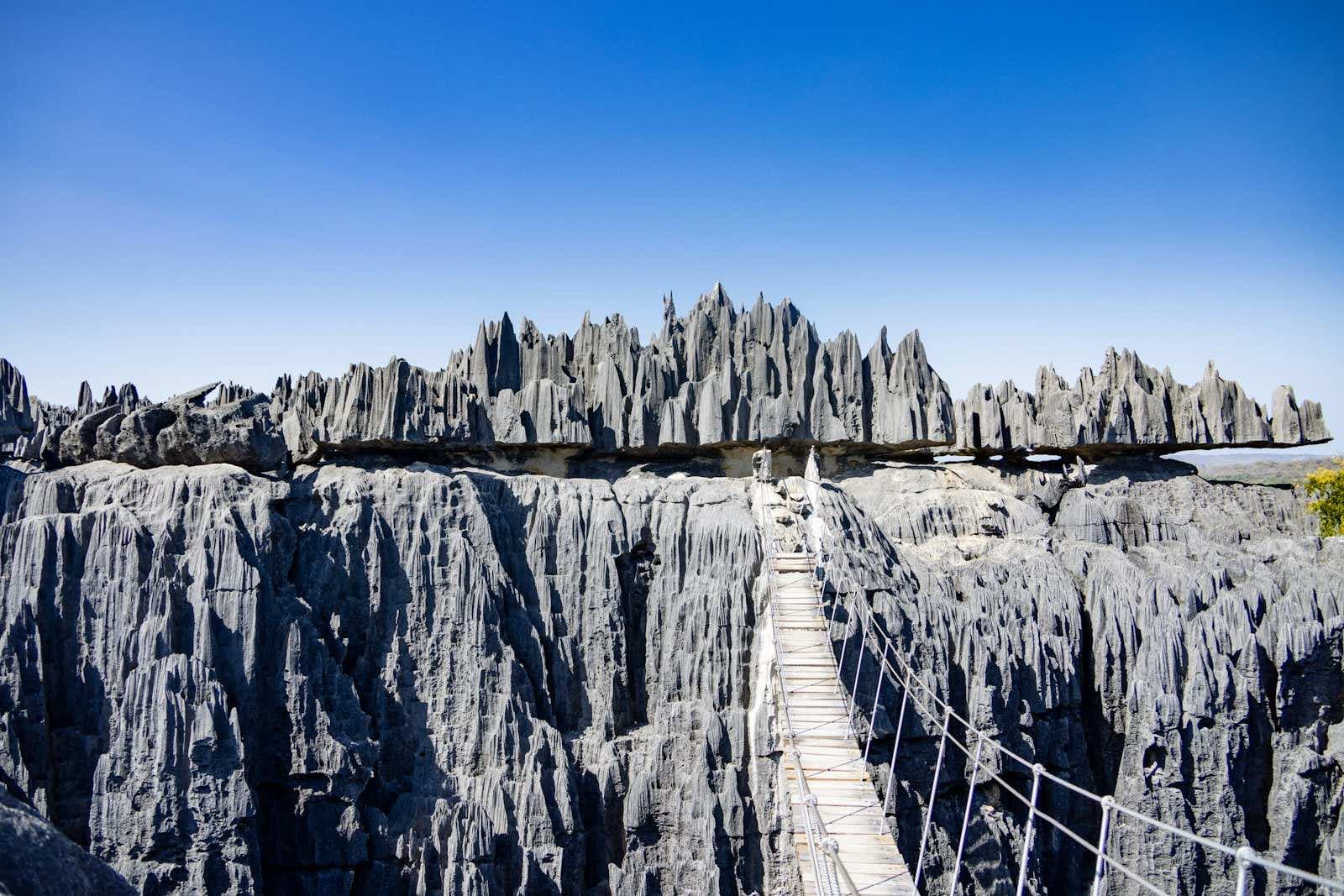 No. 043 to 4 nightsAvenue of the Baobabs and Tsingy de BemarahaEight-century baobabs lined up on red laterite, then a forest of limestone blades crossed in a harness: western Madagascar is the trip's adventure — dry season only.No. 053 to 4 nightsNosy Be and the northA volcanic island perfumed with ylang-ylang, an archipelago of lagoons and the last black lemurs: Nosy Be is the beach reward — with real wilderness one pirogue away.No. 063 nightsÎle Sainte-MarieFrom July to September, hundreds of humpback whales come to calve in the channel: Sainte-Marie is the Indian Ocean's greatest marine show — against a backdrop of pirate legends.
Madagascar: practical notes
Tolls, fines, money, seasons, budget, rental: the essentials, gathered on this page.
Money in Madagascar: Ariary, Bank Cards and ATMs for an RN7 Road Trip
A road trip in Madagascar means budgeting for two different monetary realities: Antananarivo, where bank cards are starting to work in hotels and big chain stores, and the RN7 the moment you leave the highlands, where ATMs thin out fast and cash becomes the only option for fuel, roadside eateries or national park entrance fees. On top of that, the ariary can't be bought before you leave — you won't find Malagasy currency at a French exchange counter. Here's how to split your budget between ariary, euros and card so you don't end up stuck halfway between Antsirabe and Ranomafana.
| Expense | Safest way to pay | Plan ahead |
|---|---|---|
| High-end hotels and restaurants in Tana | Bank card | Notify your bank before you leave |
| Fuel on the RN7 | Cash (ariary) | Fill up at half a tank south of Fianarantsoa |
| MNP park entrance fees | Cash (ariary) | Withdraw generously before entering a remote area |
| Roadside eateries, markets, craftspeople | Cash in small notes | Ask for small change in town |
| Tip for the driver-guide | Cash in ariary or euros | Set aside a dedicated envelope, paid at the end of the trip |
Police checks and fines in Madagascar: RN7 checkpoints and the 2026 crackdown in Antananarivo
On the RN7 between Antsirabe and Ambalavao, or on the outskirts of Antananarivo, a rope stretched across the road and two officers waving you down are part of the scenery on almost every Malagasy road trip. Nothing to worry about: in Madagascar, a checkpoint is less about chasing speeders than a standard security check — papers, vehicle condition, sometimes a word about the road ahead. Since 2026, though, the road police have resumed enforcement in Antananarivo after a months-long pause, and the actual speed and alcohol rules remain very real. Here's how a check really plays out on the Big Island, whether you're behind the wheel yourself or your driver-guide is.
- Valid French or EU licence, backed up by an International Driving Permit applied for before departure.
- Passport, visa or e-visa, vehicle registration and insurance certificate ready to show at any time.
- Stick to the official limits (50 km/h in town, 80 km/h on the open road), even though road conditions often force a much slower pace anyway.
- Zero alcohol before driving: Madagascar's limit (0.8 g/l) leaves no room for judgement calls.
- No night driving, and check travel advisories before departure to anticipate any protest barricades.
| Zone | Official limit | Real average speed (RN7) |
|---|---|---|
| Built-up area | 50 km/h | 20-30 km/h (village crossings) |
| Paved national road | 80 km/h | 35-45 km/h (road surface) |
| Dirt track (West, dry season) | Not signposted | 15-25 km/h, 4x4 recommended |
Travel Insurance for Madagascar: Malaria, Evacuation, and the RN7 Before a Road Trip
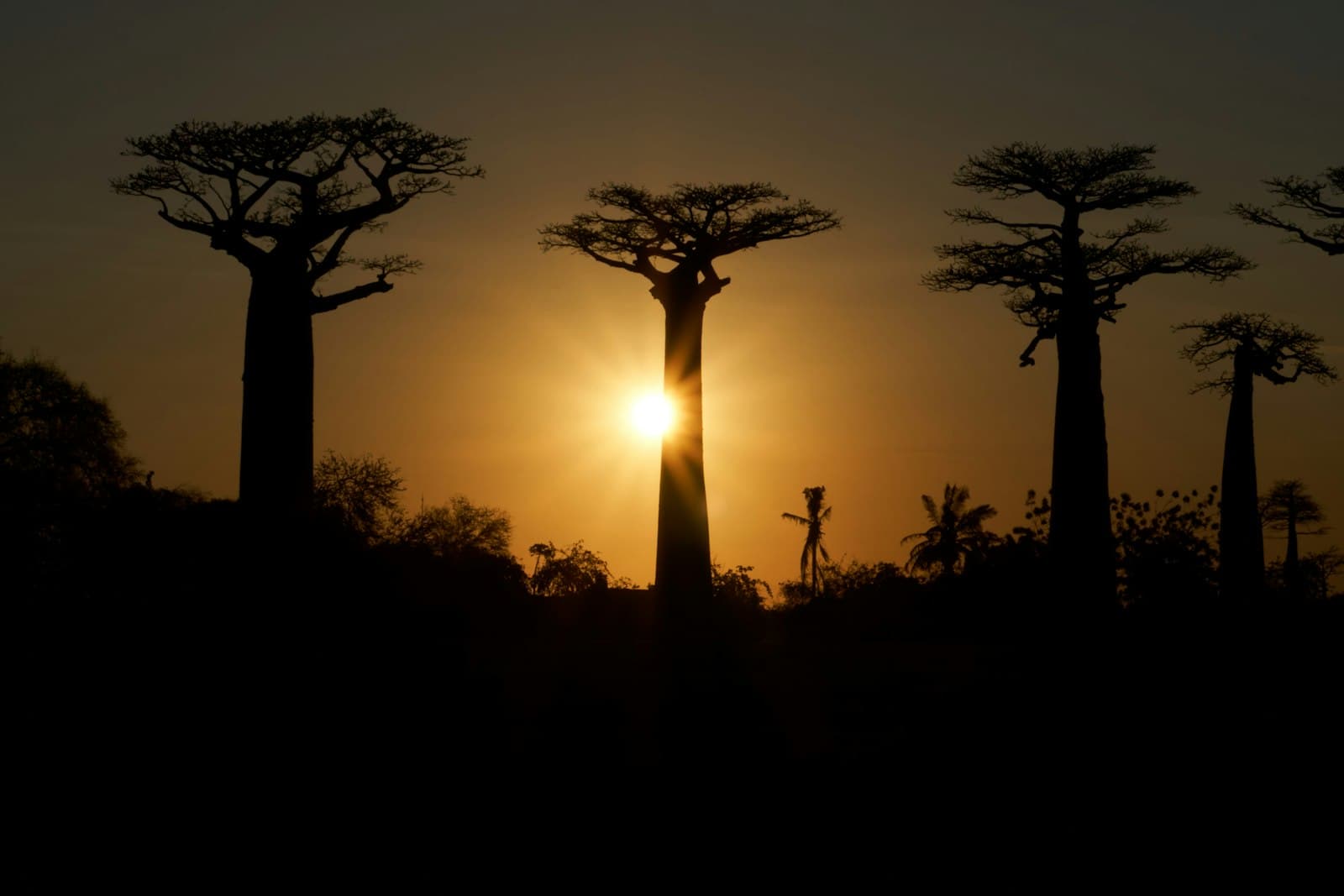
Baobabs along the Avenue of the Baobabs at sunset, the red laterite of the RN7 crumbling in places after the rainy season, nights among the tsingy far from any mobile signal: Madagascar rewards travelers willing to drive away from Tana, often hours from the nearest health post. Since 2024, the e-visa application has required proof of travel insurance in the file — a box many people tick without really knowing what it should cover. Between a limited local health system, malaria still the leading cause of medical repatriation from the Great Island, and rural roads where the nearest rescue is measured in hours, understanding what a policy should actually guarantee matters as much as checking the spare tire before setting off down the track.
- Aim for a medical expense cap of at least €100,000, repatriation on an actual-cost basis.
- Check that malaria and infectious diseases are not excluded from the policy.
- Make sure "driving a rental vehicle" is not excluded.
- Expect nothing from your carte Vitale: the Franco-Malagasy agreement doesn't cover tourists.
- Budget extra time for rescue delays off the RN7, in the South, and around the tsingy.
- Keep the 24/7 assistance number and a photo of your policy on your phone, offline.
- Don't tick the e-visa insurance box at random: the proof isn't checked, but the coverage still has to be real.
| Type of cost | Approximate amount |
|---|---|
| Consultation, private clinic (Tana) | €30 to €80 |
| Inpatient day | €500 to €1,500 |
| Initial stabilization at a private clinic | around €2,000 |
| Medical evacuation flight to Réunion | around €25,000 |
| Full repatriation without insurance | €30,000 to €40,000 |
Our flagship guide — €44
Guide available“Madagascar on Your Own Terms”, the complete edition, is out
10 chapters: day-by-day itineraries, driving and transport, a costed budget and checklists — the same method as our Namibia guide.
The guide is currently written in French — an English edition is in the works.
No time to do it yourself?
A professional can take care of it: tailor-made trip, equipped 4x4 rental or a local guide. Describe your plans and, with your consent, we pass them on to partner professionals.
1. What you need
Explore other countries