Morocco on your own
Three hours' flight from Paris: passes at 2,260 m, valleys of kasbahs and real Saharan dunes — the most exotic road trip you can fit into a week.
When to go
Spring (March-May) and autumn (October-November) are kings: mild everywhere, almond blossom or golden light. Summer crushes the south (45 °C at Merzouga) but suits the Atlas and the coast; winter is superb and cold at night in the desert, with snow possible on the passes.
What it costs
One of the cheapest road trips there is: a city car €20-35/day, charming riads €40-80 per room, a full meal €8-15, moderate fuel. Budget €1,500-2,800 for two over 10 days excluding flights, dune bivouac included.
Driving & transport
Right-hand driving, familiar rules, frequent radar and checkpoints (respect the limits scrupulously). The real vigilances: mopeds and pedestrians in towns, night driving to avoid (unlit vehicles, animals), and the Atlas passes in bad weather. The "false guides" at tourist junctions are declined politely.
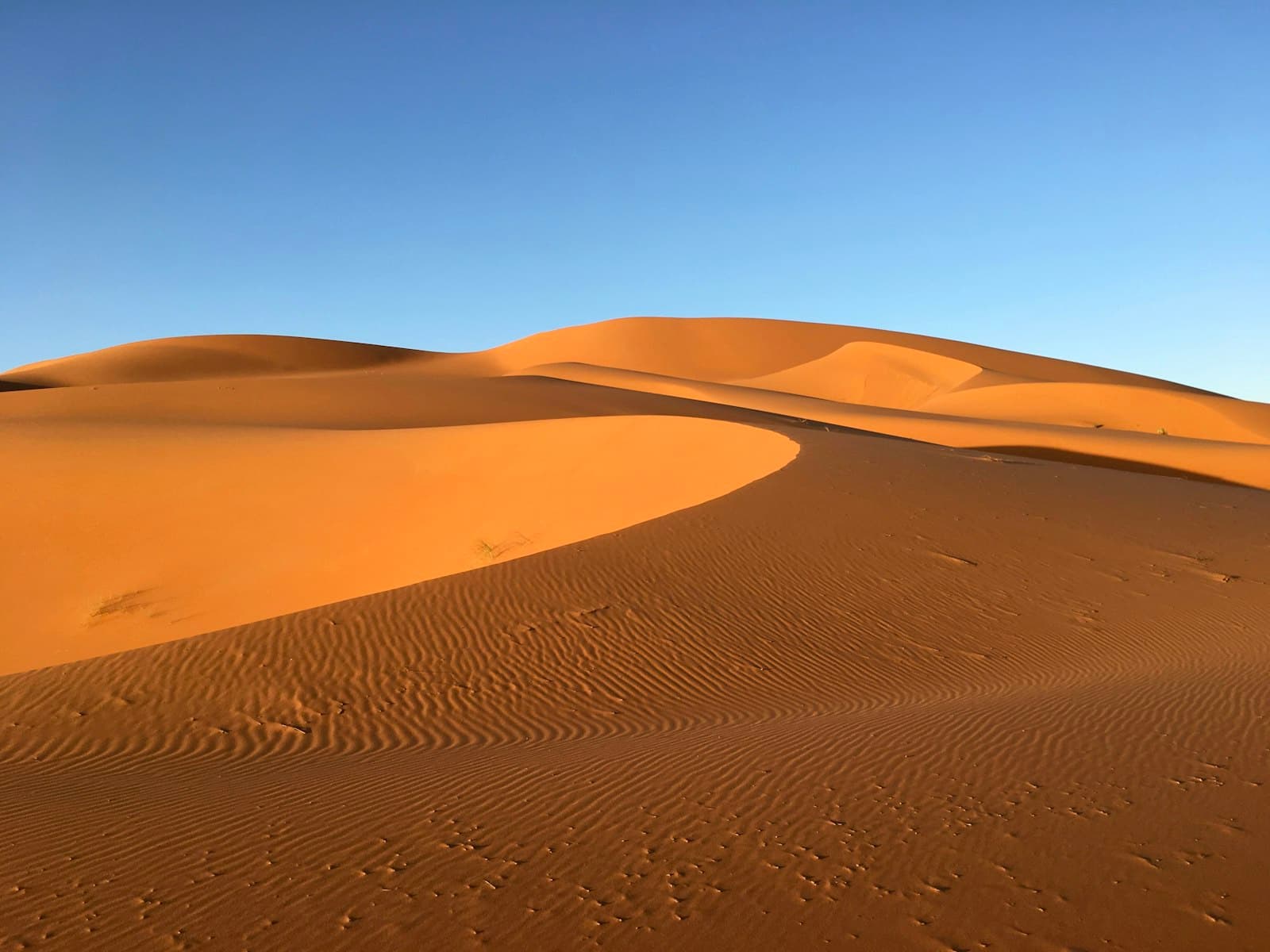
Morocco is the perfect playground for a first road trip beyond Europe: cheap rentals, decent roads, human distances, and a gradient of worlds within a few hours' drive — medinas, Atlas orchards, southern palm groves, the Erg Chebbi dunes, Atlantic trade winds.
Our guide for this country: See what's inside — €44 →
The classic loop from Marrakech (the Atlas via the Tizi n'Tichka, Aït-Ben-Haddou, the Dadès and Todgha gorges, the Merzouga dunes, back through the Drâa valley or Agdz, then Essaouira) fits into 8 to 12 days. An ordinary car suffices on the main route; a 4x4 adds only comfort and a few optional pistes.
The destinations that matter
1More stops worth adding to the trip
Marrakech
Jemaa el-Fna square at nightfall, the souks, the gardens: two days of urban intoxication before the silence of the Atlas.
What to see
- Jemaa el-Fna at sunset, first from a terrace and then in the throng
- The Ben Youssef madrasa and the Marrakech museum
- The souks by letting yourself get lost (landmark: the Koutoubia to get out)
Suggested time: 2 nights
Aït-Ben-Haddou and Ouarzazate
Southern Morocco's most beautiful fortified village, on its hill since the 11th century — and gatekeeper of the kasbah road that begins here.
What to see
- The ksar at sunrise, climbed to the summit granary for the palm-grove view
- The Tizi n'Tichka pass and the optional Telouet road (the Glaoui kasbah, under restoration)
- The Taourirt kasbah in Ouarzazate
Suggested time: 1 night
Dadès and Todgha gorges
Two parallel cuts into the High Atlas: the vertiginous Dadès hairpins, the orange walls of the Todgha — the beating heart of the thousand-kasbah road.
What to see
- The Dadès hairpins from the belvedere, then the road on towards the upper gorges
- The walk into the Todgha canyon, early, before the coaches
- The Tinghir palm grove from the roadside viewpoints
Suggested time: 2 nights (one per gorge)
Drâa Valley
A hundred kilometres of unbroken palm grove winding between black djebels, strewn with earthen ksour: the old caravan road is the south's most beautiful green line.
What to see
- The Tizi-n-Tinififft pass viewpoint between Ouarzazate and Agdz
- The ksar of Tamnougalt and its palm grove, walked with a village guide
- Zagora's dates in season (October), on the markets
Suggested time: 1 night
Essaouira
Atlantic-battered ramparts, a blue port, an artists' medina swept by the trade winds: the ocean breather that ideally closes the southern loop.
What to see
- The Sqala de la Kasbah and its cannons facing the ocean, at sunset
- The fishing port as the boats come in, then the fish grills at the quay
- The medina and its galleries, heirs of the hippie years
Suggested time: 2 nights
Morocco: practical notes
Tolls, fines, money, seasons, budget, rental: the essentials, gathered on this page.
How many days for a Morocco road trip?
“A week is enough for Morocco” is one of the most misleading pieces of advice you'll read before leaving. It's true that at three hours' flight from Paris, with modest distances on the map, the country feels like a short-format trip. But the classic self-drive Morocco loop — Marrakech, the Atlas passes, kasbahs, the dunes of Merzouga, back via the Atlantic coast — runs into a very concrete limiter: the Tizi n'Tichka pass, at 2,260 m, followed by the 500-600 km of mountain roads and tracks separating Marrakech from the Sahara. Short answer: 5 to 7 days for the Atlas and the kasbahs without the dunes, 8 to 10 days for the full loop to Merzouga and Essaouira, 12 to 14 days for the same loop without rushing, 3 weeks and up to add the north — Fez and Chefchaouen. Here's the detail, with distances and trade-offs included.
| Duration | Itinerary | Distance | What you sacrifice |
|---|---|---|---|
| 5-7 days | Marrakech, Tizi n'Tichka, Aït-Ben-Haddou, Dadès and Todra Gorges | 800-900 km | The Merzouga dunes, the Atlantic coast |
| 8-10 days | The full loop: Atlas, Aït-Ben-Haddou, Dadès/Todra, Merzouga, Drâa Valley, Essaouira | 1,200-1,400 km | Buffer nights, the north of the country |
| 12-14 days | The same loop, at a slower pace | 1,200-1,400 km | Fez, Chefchaouen, the Rif |
| 3 weeks and more | The southern loop + Fez + Chefchaouen | 2,300-2,500 km | Almost nothing |
Tolls in Morocco: the ADM network, the Jawaz badge, and pitfalls for a rental car
Nobody thinks about tolls when quoting a car rental in Morocco — the country has a well-earned reputation for cheap road trips. But the moment you leave the Atlas passes or the desert tracks to cover Marrakech to Agadir or Casablanca to Tangier, the motorway quickly becomes the fastest and safest option — and it isn’t free. The network, run as a near-monopoly by the state-owned company Autoroutes du Maroc (ADM), just went through its first general toll revision since 2018, effective April 1, 2026. Here’s how it works, what it costs route by route, and one pitfall specific to 4x4s and tall SUVs that few travellers see coming.
| Route | Class 1 rate (car) | Euro equivalent |
|---|---|---|
| Casablanca – Rabat | ≈ 23-25 MAD | ≈ €2.10-2.30 |
| Casablanca – Marrakech | ≈ 83-89 MAD | ≈ €7.60-8.20 |
| Kenitra – Tangier | from ≈ 78 MAD | ≈ €7.20 |
| Casablanca – Tanger Med | ≈ 123 MAD | ≈ €11.30 |
| Casablanca – Agadir | ≈ 164 MAD | ≈ €15.10 |
Travel Insurance for Morocco: Health, Repatriation and Road Accidents — What to Cover Before a Road Trip
Between the car rental contract, the deposit held on your card and the plane tickets, "travel insurance" is often the line ticked fastest before a Morocco road trip — a country that feels close, French-speaking in the big cities, almost familiar. That's exactly what's deceptive: two and a half hours' flight from Paris, Morocco has no social security accessible to visitors, no European health insurance card that applies, and a two-speed healthcare system — decent private clinics in Marrakech, Casablanca or Agadir, but a nearest hospital sometimes hours away by dirt track from the Tizi n'Tichka pass or the dunes of Merzouga. What the car rental company's insurance actually covers, what a travel insurance policy should provide, what research shows about risky driving behaviour in Morocco, and what a health mishap really costs without proper cover: here's what to check before hitting the road.
- Check the medical expense cap (at least €100,000) and the repatriation cap in real costs, with no artificial low limit.
- Confirm that driving on tracks and off paved roads isn't excluded: many generic policies exclude it by default.
- Don't confuse the rental company's insurance (the vehicle) with travel insurance (your health): both are needed, neither replaces the other.
- Carry the policy's 24/7 assistance number on paper and as a phone photo, next to your international driving permit.
- Plan for evacuation delays from remote areas (High Atlas, Draa valley, Merzouga): without a medical helicopter network, transfer to a clinic usually happens by road.
| Type of expense | Cost observed |
|---|---|
| Private clinic consultation (uninsured) | €50-100 |
| Night of hospitalisation in a private clinic | from €1,000 |
| Travel insurance for a one-week trip (family) | €40-120 |
| Medical repatriation flight to France | €10,000-30,000 |
| Complex case (heavy equipment, long distance) | up to €150,000 |
Our flagship guide — €44
Guide available“Morocco Self-Drive”, the complete edition, is out
10 chapters: day-by-day itineraries, driving and transport, a costed budget and checklists — the same method as our Namibia guide.
The guide is currently written in French — an English edition is in the works.
No time to do it yourself?
A professional can take care of it: tailor-made trip, equipped 4x4 rental or a local guide. Describe your plans and, with your consent, we pass them on to partner professionals.
1. What you need
Explore other countries