Tanzania on your own
The great migration through your own binoculars, a Noah's-ark crater, baobabs full of elephants and the Indian Ocean as an epilogue: Tanzania is safari written in capital letters — and you can drive it yourself.
When to go
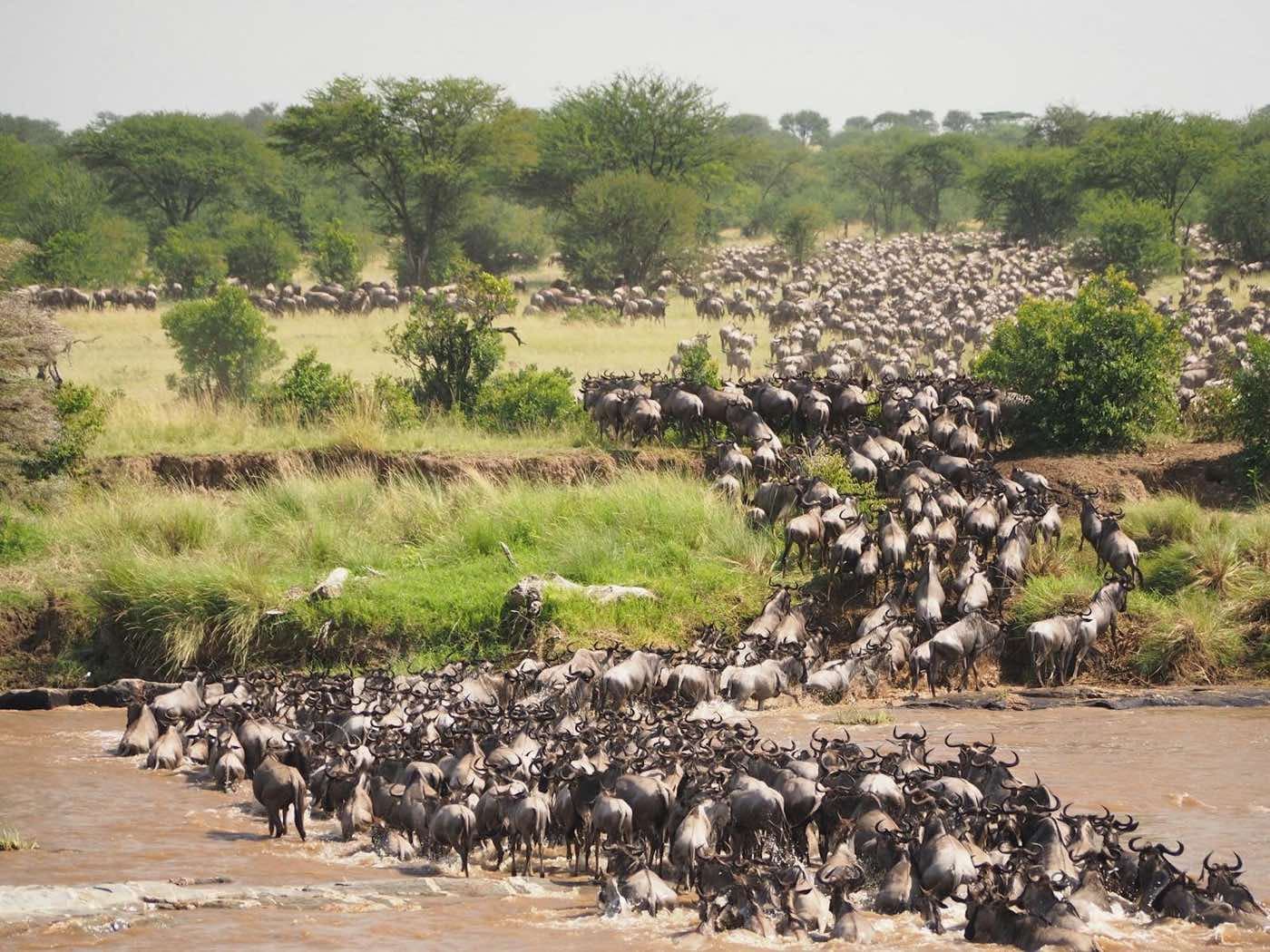
Dry season June to October: the benchmark, animals concentrated at waterholes and Mara River crossings in the northern Serengeti (July-September). January-March, the migration calves on the Ndutu plains in the south — the year's best predator show. Short rains in November-December (manageable), long rains April to May: black-cotton tracks become impassable and many camps close — avoid for self-drive.
What it costs
The biggest line item isn't the car but the parks: entries $50-82/person/day depending on the park (+ 18% VAT), foreign vehicle fee on top, crater descent $295 per vehicle, public camping around $35/person. An equipped 4x4 (Land Cruiser, rooftop tent, twin fuel tanks) rents for €150-250/day in Arusha. Diesel around €1.10/litre. For two over 12-15 days including Zanzibar: €6,000-8,500 excluding flights — public camping is precisely what keeps the bill manageable.
Driving & transport
Left-hand driving, a British legacy. On tarmac: frequent speed cameras, a strict 50 km/h through every village (the limits chain on endlessly), police checkpoints courteous but fussy — international permit, warning triangle and fire extinguisher required. Never drive at night: buses on full beam, pedestrians, livestock. Inside the parks: 25 km/h, stay in the vehicle, and note your entry time — gates close at 6 pm. Gate payments are by bank card only, never cash: check your card's limit before departure.
Tanzania concentrates East Africa's greatest myths: the endless plains of the Serengeti and their two million wildebeest in perpetual motion, the Ngorongoro caldera and its last black rhinos, the baobabs of Tarangire, the Maasai's sacred volcano above Lake Natron, the roof of Africa at 5,895 m — and Zanzibar to rinse off the dust. The northern circuit loops out of Arusha, and contrary to legend, it works very well without a driver.
Our guide for this country: See what's inside — €44 →
Let's be clear: this is the most demanding self-drive in this collection. Park fees are heavy (budget $70-80 per person per day in entries alone, payable by card only at the gates), the interior tracks demand a properly equipped 4x4 and a cool head, and Tanzanian administrative logic keeps its mysteries. In exchange: public campsites in the heart of the parks, hyenas circling the tent, and total freedom on the greatest wildlife stages on Earth.
The destinations that matter
5No. 013 to 4 nightsSerengetiTwo million wildebeest, plains touching the horizon in every direction and lions on every kopje: the Serengeti isn't a park, it's a country made of grass.No. 021 to 2 nightsNgorongoro CraterA caldera 20 km across, 600 m of cliffs and 25,000 large animals that almost never leave: Ngorongoro is Noah's ark with the walls still standing.No. 031 to 2 nightsLake NatronA soda lake that turns blood red, a pyramid volcano sacred to the Maasai and the nursery of millions of lesser flamingos: Natron is an alien planet at the end of the circuit's worst track.No. 046 to 8 days of trekking, 2 nights in Moshi either sideKilimanjaroAn ice-capped volcano standing alone at 5,895 m above the savannah: Kilimanjaro is climbed without rope or ice axe — but never without humility before the altitude.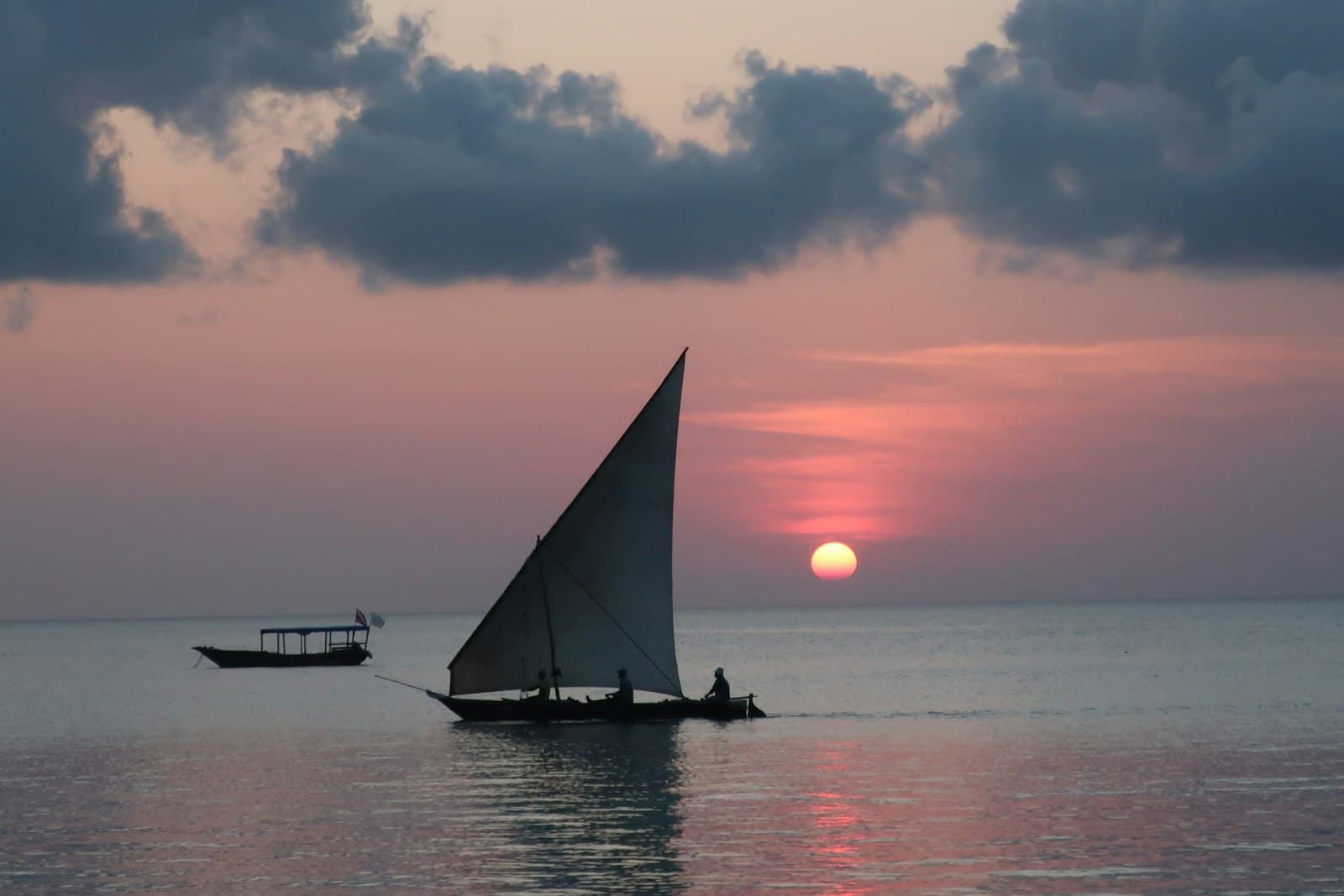 No. 054 to 5 nightsZanzibarSwahili lanes charged with a thousand years of the spice trade, then turquoise lagoons at high tide: Zanzibar is the dream decompression after the dust of the tracks.
More stops worth adding to the trip
Tarangire
An army of thousand-year-old baobab giants and the largest elephant herds in northern Tanzania: Tarangire is the opening act the rushed circuits skip.
What to see
- The Tarangire River loop in late afternoon, when the elephant herds come down to drink
- The giant baobabs of the main track — some are as old as Chartres cathedral
- The Silale swamps, a magnet for buffalo, lions and birds in the park's south
Suggested time: 1 to 2 nights
Tanzania: practical notes
Tolls, fines, money, seasons, budget, rental: the essentials, gathered on this page.
Daily budget for a self-drive safari in Tanzania: what a day on the road really costs
"How much will a day out there actually cost?" The question comes up constantly before a self-drive safari in Tanzania, and the answer often surprises people: here, it's neither the vehicle nor the accommodation that weighs heaviest on the daily bill, but the park fees, charged per person, per day, in US dollars, at every gate. An equipped 4x4 around €150-250/day, diesel at roughly €1.40-1.45/L after the April 2026 price hike, TANAPA public campsites at $35/person — here is, cost by cost, what a day between Tarangire, Ngorongoro and the Serengeti really costs, and how to plan for it before booking the vehicle.
- Skip the Ngorongoro crater descent ($295/vehicle) if the sunrise viewpoint from the rim is enough for you — it's the only genuinely avoidable one-off item on the circuit.
- Favor TANAPA public campsites over staffed tented camps: the difference can top €100 per night for two, without sacrificing the location at the heart of the park.
- Stock up at an Arusha supermarket before hitting the track rather than relying on half board everywhere — the food budget can be cut in half.
- Add a Zanzibar extension at the end of the trip: several days with zero park fees and beach accommodation that's often cheaper than a bush camp, which mechanically lowers the whole trip's daily average.
- Book the 4x4 several weeks ahead: the pool of equipped vehicles in Arusha is limited, and both rates and availability worsen noticeably as high season (June-October) approaches.
| Accommodation type | Price for two, per night |
|---|---|
| Simple campsite or guesthouse, outside parks | ≈ €15-25 |
| TANAPA public campsite, inside the park | ≈ €65 |
| Mid-range tented camp, half board | ≈ €150-250 |
| Upscale bush lodge | ≈ €400 and up |
Money in Tanzania: Shillings, Credit Cards and Paying for Parks on a Self-Drive Safari
A self-drive safari in Tanzania mixes three payment methods that don't overlap: shillings in cash for markets, small fuel stations and tips, a credit card for lodges and big-city stores, and, since TANAPA's switch to fully digital payments, a mandatory electronic method to get through a national park gate at all. Getting the split wrong can stall an entire day at the Serengeti or Ngorongoro. Here's how to balance the three before leaving the tarmac of Arusha or Moshi behind.
Police Checks and Fines in Tanzania for Self-Drivers: Checkpoints, the TMS System and the Grey Zone
A self-drive road trip to the Serengeti or the Ngorongoro Crater in Tanzania will inevitably cross police checkpoints — more of them than elsewhere in East Africa on the main roads linking Arusha to the parks. Most amount to a speed bump, a wave of the hand and a few seconds of checking — but knowing what to expect changes everything: which documents to keep within reach, the speed limits that drop without warning at the entrance of every village, how the Tanzania Police Force's digital TMS fines system works, and the well-documented grey zone of a cash request outside any official receipt.
| Document | Why it's asked for |
|---|---|
| National licence | Baseline document, in the language and format of your home country |
| International Driving Permit (IDP) | Required by most Tanzanian rental companies and checked at stops |
| Passport (or colour copy) | Identity and visa / eVisa validity |
| Rental agreement | Proves the right to drive this specific vehicle |
| Insurance certificate | Issued by the agency, keep it with the rental agreement |
Renting a 4x4 in Tanzania for a Self-Drive Safari: Licence, Insurance and Which Parks Allow It
Contrary to popular belief, a Tanzania safari doesn't have to mean sitting in the back of an agency vehicle with a driver-guide up front. Renting your own 4x4 in Arusha and driving into the Serengeti or Tarangire fully independently is entirely possible, with entry fees paid by credit card right at the gate. Tanzania is even one of the few East African countries where the parks authority treats a private traveller in a rented 4x4 exactly like a tour operator. But that freedom comes with its own rules: a licence that isn't as simple as your French one, left-hand driving to get used to on both tarmac and track, insurance worth reading line by line before signing, and one notable exception — the Ngorongoro Crater — where full independence stops dead. Here's what to check before booking.
| Vehicle | Recommended use | Indicative daily rate (self-drive, unlimited mileage) |
|---|---|---|
| Toyota RAV4 or compact SUV | Road routes, parks close to Arusha | ≈ $100–130 US |
| Toyota Prado | Tarangire–Ngorongoro–Serengeti loop | ≈ $150–190 US |
| 'Safari-fitted' Land Cruiser (pop-up roof, dual tank) | Longer circuits, remote tracks, fuel range | ≈ $180–270 US |
SIM Cards and Internet in Tanzania: Staying Connected on a Self-Drive Safari
On a track through the Serengeti, far past the last stretch of tarmac, the signal bar on a phone screen can matter more than a full tank of diesel. It's what shows the GPS trace when tracks fork without a single signpost, what lets you call the campsite after a flat tyre at dusk, or check at a glance whether a Tanzania National Parks Authority (TANAPA) gate is still open before closing time. Tanzania often surprises travellers used to picturing patchy African coverage: the network is actually solid across most inhabited areas, and mainly drops out deep inside the big parks. Here's how to get set up before you go, and where the connection really fails on a self-drive safari between the Serengeti, Ngorongoro and Zanzibar.
- Check what your French plan actually covers in Tanzania (data included, cap, duration) before relying on it for the whole northern circuit.
- Activate an eSIM before departure (Airalo, Holafly) to secure the airport-to-rental-counter leg.
- For an extended trip into the Serengeti, a Yas SIM bought in town gives the best coverage off the main roads.
- A passport is required to register any SIM card in Tanzania.
- Download offline maps before entering the Serengeti, the Ngorongoro Crater or Tarangire: the network often drops there without warning.
- Mount your phone on a dashboard holder and favour voice guidance: holding it while driving is penalised throughout the country.
| Carrier | Tanzania offer | Indicative price |
|---|---|---|
| Free | 35 Go included (350 Go plan) or Free Max unlimited | €19.99 or €29.99/month |
| Orange | Pass Voyage 3 (20 Go, 31 days) | ≈ €29 |
| RED by SFR | 35 Go included (Spécial Voyage plan) | €15.99/month |
| Bouygues Telecom | Pass Monde, 3 Go | ≈ €30 |
Tanzania eVisa: Entry Requirements, Cost and Pitfalls Before a Self-Drive Safari
Serengeti, Ngorongoro, Zanzibar: Tanzania ticks every box of the dream safari, but its entry requirements need sorting out before you board, not at the immigration counter. Contrary to a common mix-up among travellers combining several East African countries, Tanzania is not part of the shared tourist visa that covers Kenya, Uganda and Rwanda: it requires its own, separate, paid authorisation. The real cost of the eVisa, the official portal not to confuse with paid intermediaries, the documents to carry, and the licence needed to get behind the wheel of a rental 4x4 in Arusha: here is what to check before you go.
When to Visit Tanzania? Safari Seasons and the Great Migration
Tanzania can be visited year-round, but each season transforms the safari completely. Dry season for wildlife gathered near water, green season for lush landscapes and gentler prices, and above all a shifting calendar for the great wildebeest migration in the Serengeti. Here is how to choose your timing based on what you want to see, without falling for the false promise of fixed dates.
| Period | Where the wildebeest are | What to see |
|---|---|---|
| December-March | Southern plains (Ndutu / southern Serengeti) | Mass calving around January-February, births and predators |
| April-May | Moving to the north-west | Long rains, green landscapes, herds on the move |
| May-June | West (Grumeti River) | Rut and first Grumeti River crossings |
| July-October | North (Masai Mara border) | Spectacular Mara River crossings |
Our flagship guide — €44
Guide available“Tanzania on Your Own”, the complete edition, is out
10 chapters: day-by-day itineraries, driving and transport, a costed budget and checklists — the same method as our Namibia guide.
The guide is currently written in French — an English edition is in the works.
No time to do it yourself?
A professional can take care of it: tailor-made trip, equipped 4x4 rental or a local guide. Describe your plans and, with your consent, we pass them on to partner professionals.
1. What you need
Explore other countries