Australia on your own
A whole continent at the end of the steering wheel: red dunes to the horizon, reefs where you swim with whale sharks, koalas above the road — Australia is the world capital of the campervan.
When to go
The seasons are reversed and the country stacks several at once: the South (Great Ocean Road, Tasmania) is best from November to March; the Red Centre and tropical North from May to September, when the heat eases and the dry season opens the tracks; Ningaloo peaks from March to July with the whale sharks. From November to May, box jellyfish rule out free swimming north of Gladstone: the stinger suit is not a gimmick.
What it costs
Campervan €70-130/day (more for an equipped 4x4 — budget €130-200), fuel around €1.15-1.35/L in towns and up to €1.80 in the outback, campsites €15-35 a pitch — plus countless free or few-dollar rest areas. Parks: Uluru pass AUD 38 for 3 days, WA parks pass around AUD 120/month. For two over 3 weeks in a van, aim for €4,500-6,500 excluding flights; cooking in the van and free overnight stops change everything.
Driving & transport
Driving on the LEFT — regaining focus after every break is the real trap of the first days. Never drive at dusk or after dark outside towns: kangaroos cross without warning and a collision writes off a van (locals drive with bull bars, you don't). Road trains (up to 53 m) are overtaken over several hundred metres of clear road or not at all. Check your rental contract: most forbid unsealed roads, and outback recovery is billed in thousands of dollars. Fill up at every roadhouse once you leave the coast.
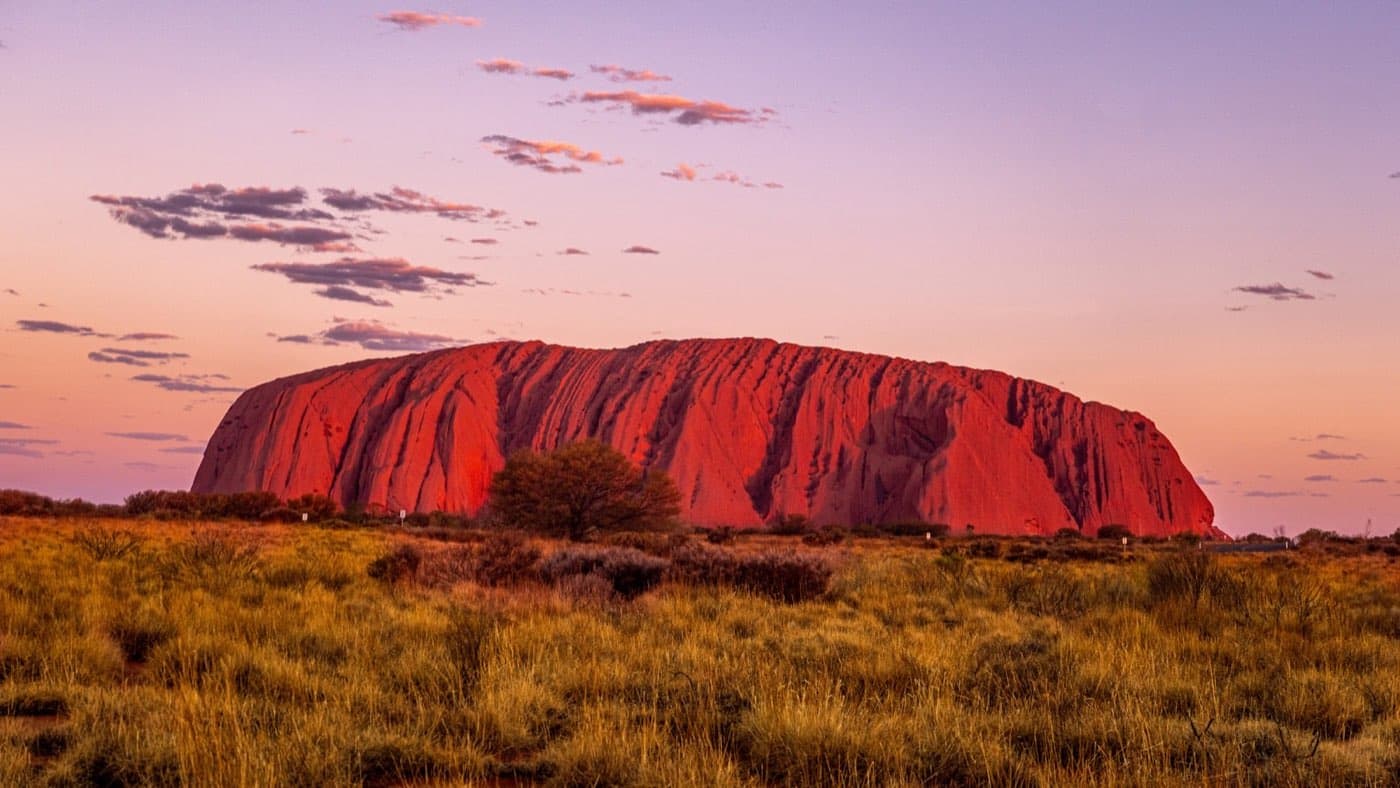
Australia built a way of life around the road trip: here the van is not a means of transport but an institution, with free rest areas mapped by apps (WikiCamps is the local bible), public barbecues in every park and fruit-quarantine checkpoints between states. The menu is outsized: the cliffs of the Great Ocean Road, the Uluru monolith at the continent's red heart, Ningaloo Reef where you wade in from the beach, the gorges of Karijini, the primeval forests of Tasmania.
Our guide for this country: See what's inside — €44 →
The country imposes its own scale: 4,000 km separate Sydney from Perth, and "just next door" often means three hours of driving. You don't do Australia — you choose a piece of it, a coast, the Centre, the West, and give it two to three weeks. The golden rule is learned fast: drive by day, camp before dusk, because kangaroos, wombats and emus take possession of the tarmac the moment the light fades.
The destinations that matter
2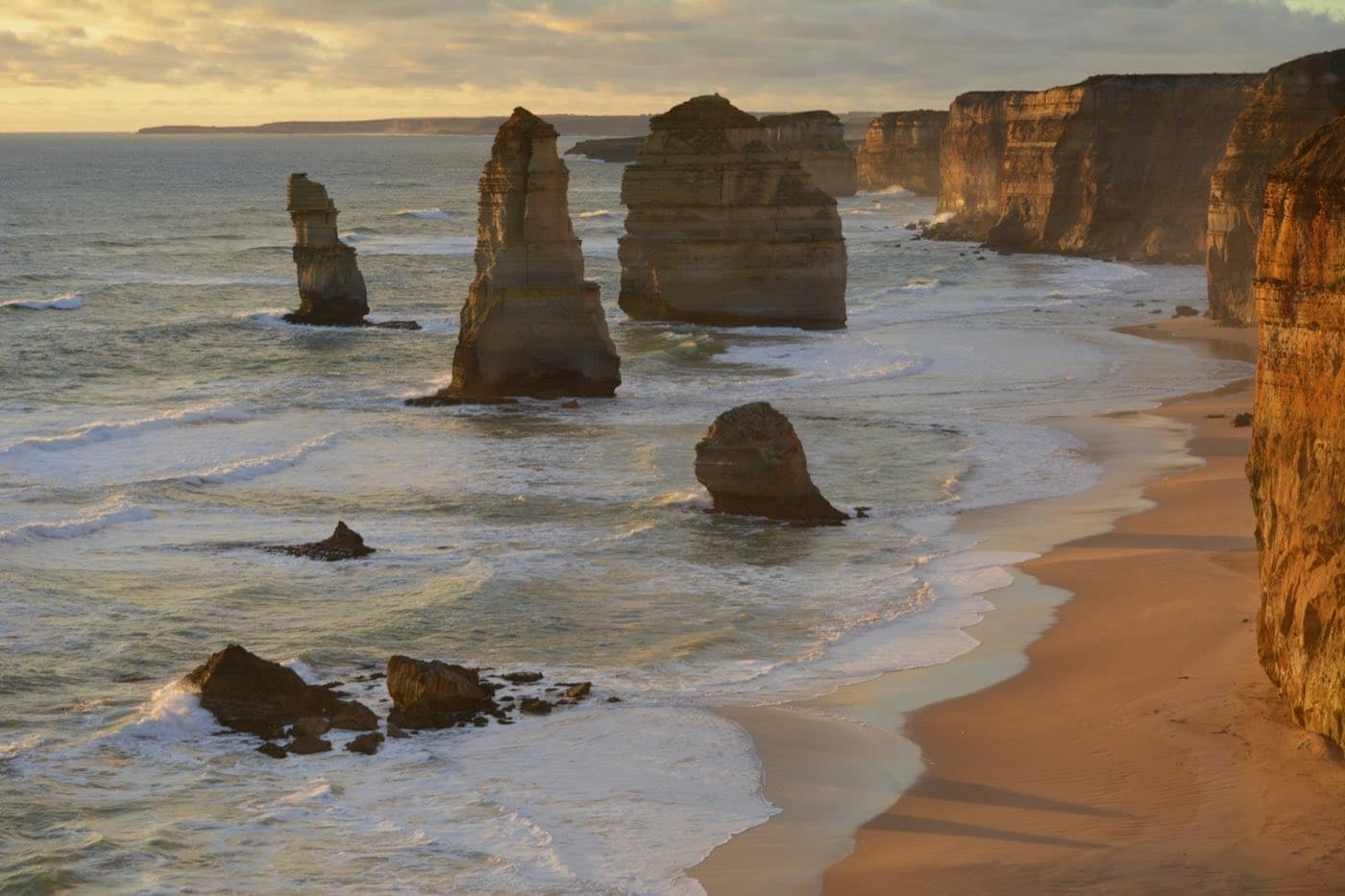 No. 012 to 3 nightsGreat Ocean Road243 km of curves between eucalypts and the Southern Ocean, limestone needles battered by the swell and koalas asleep above the tarmac: the most famous coastal road in the southern hemisphere.No. 023 to 4 nightsRed Centre: Uluru, Kata Tjuta and Kings CanyonA 348-metre monolith that changes colour with every hour of the day, set at the exact centre of the void: Uluru is earned over 450 km of dead-straight road — and repays them with a single sunrise.
More stops worth adding to the trip
Byron Bay and the east coast
The continent's easternmost point, dolphins beneath the lighthouse, surf at every hour and a counter-culture turned way of life: Byron is the stop where vans always linger longer than planned.
What to see
- The Cape Byron Lighthouse loop at dawn: dolphins, and whales June to November
- A surf session at The Pass, the gentlest learner's wave on the coast
- The Bangalow farmers' market and the hinterland villages
Suggested time: 2 to 3 nights
Tropical Queensland
The world's oldest rainforest plunging into the planet's largest coral reef: between Cairns and Cape Tribulation, two World Heritage wonders touch — crocodiles included.
What to see
- A day on the outer reefs from Port Douglas (Agincourt) or Cairns
- The Daintree ferry, the canopy boardwalks and the beach at Cape Tribulation
- Mossman Gorge and its clear water in the forest, with the Kuku Yalanji Aboriginal custodians
Suggested time: 4 to 5 nights
Ningaloo and Karijini
A reef you enter from the beach to meet turtles and whale sharks, then gorges of red iron 2.5 billion years old: the wild West is the country's best-kept secret.
What to see
- The whale-shark swim from Exmouth (March-July), with a licensed operator
- The Turquoise Bay drift snorkel and the turtles of Coral Bay
- Dales Gorge at Karijini: Fern Pool, Fortescue Falls and the in-gorge circuit
Suggested time: 5 to 7 nights
Tasmania
An island at the end of the world where half the land is wilderness, wombats graze beside the trails and deserted beaches rival the Seychelles — cooler and emptier.
What to see
- Cradle Mountain: the Dove Lake circuit and the Ronny Creek wombats late in the day
- The Wineglass Bay lookout then the descent to the beach, in Freycinet
- The Bay of Fires and its orange boulders between Binalong Bay and The Gardens
Suggested time: 7 to 10 nights
Australia: practical notes
Tolls, fines, money, seasons, budget, rental: the essentials, gathered on this page.
Fuel in the Australian outback: where to refuel on a road trip
In Australia, running out of fuel isn't a minor inconvenience: on some outback tracks, it means calling for help from dozens of kilometres away from any mobile signal. Distances between fuel stations regularly exceed 250, even 300 km, and a large part of the country — the Northern Territory, western Queensland, inland Western Australia — still runs on isolated “roadhouses” with unpredictable opening hours. Here, route by route, are the real distances to know, the half-tank rule every outback regular follows, and what to know about jerry cans and prices before hitting the road.
| Route | Biggest gap without fuel | Surface | Watch out for |
|---|---|---|---|
| Stuart Highway (Adelaide-Darwin) | 253 km (Glendambo-Coober Pedy) | Sealed | The most reliable, but don't underestimate the central gap |
| Outback Way / Great Central Road (Laverton-Winton) | 303 km (Laverton-Tjukayirla) | Mostly unsealed | Mandatory transit permit on Aboriginal land |
| Gibb River Road (Derby-Kununurra) | 330 km (Mount Barnett-El Questro) | 4WD track | Seasonal stations, confirm hours by phone |
Paying by card on a road trip in Australia: card surcharges banned from 1 October 2026
In Australia, tapping a card has long been the norm: petrol stations, parking, souvenir shops — almost everything gets paid by card, even small amounts. But two things are worth knowing before a road trip. The first is a real, dated regulatory change: from 1 October 2026, the Reserve Bank of Australia (RBA) bans surcharges on almost every card payment, a rule that directly affects car rental companies. The second is a fact on the ground that this reform won't touch: out in the outback, far from the big cities, cash can still be the only way to pay for fuel.
| Payment method | Surcharge after 1 October 2026 |
|---|---|
| Debit or credit card — eftpos, Mastercard, Visa | Banned |
| American Express, JCB, UnionPay | Banned (voluntary removal announced for the same date) |
| PayPal | Still allowed if it reflects the actual cost |
| Buy-now-pay-later (Afterpay, Zip…) | Still allowed, outside the scope of the reform |
| Cash | Not applicable |
Police checks and fines in Australia: speed, breath tests and how rules differ from state to state in a rental car
In Australia, you're not renting a car for one country but for six states and two territories, each with its own road rules, its own fine schedule and its own speed cameras. The same speeding offence can cost nearly twice as much in Brisbane as in Melbourne, and the old myth of speed-limit-free outback roads officially ended back in 2016. Add to that one of the most systematic drink-driving enforcement regimes in the world — random breath testing, with no cause required to be pulled over — and it quickly pays to know, before setting off in a rental car, how an Australian roadside check differs from a European one. Here are the speed limits in force, what a speeding fine really costs depending on the state you're driving through, the nationally shared demerit points system, and how it's all settled with a rented vehicle.
| Road type | Default limit |
|---|---|
| Built-up area | 50 km/h |
| Sealed rural road (outside built-up areas) | 100 km/h |
| Freeway | 110 km/h |
| Dedicated sections, Northern Territory (e.g. Stuart Highway) | 130 km/h |
Renting a Car in Australia: Excess, Unsealed Roads and What to Check Before You Sign
On paper, renting a car in Australia sounds unintimidating: driving on the left as in the UK, signage in English, an excellent motorway network along the coast. That very ease is exactly what leads many travellers to book in two clicks without reading the fine print — a habit that gets expensive the moment an itinerary strays off the bitumen or crosses state lines. The standard excess often runs into several thousand Australian dollars, almost every rental contract excludes unsealed roads by default, and the sheer scale of the country turns a simple one-way drop-off into a budget line of its own. Here is what to check before signing, from your licence to your insurance, so you can drive from Sydney to the Kimberley without a nasty surprise at the return desk.
| Option | Remaining excess | Approximate cost |
|---|---|---|
| Base rental (no add-on) | AUD 3,000 – 8,000 depending on vehicle | Included in the quoted rate |
| Counter buy-down ("excess reduction") | AUD 0 – 500 depending on offer | AUD 21 – 45 / day |
| Premium credit card cover | Variable, often capped at €3,000-8,000 | Already paid (card fee) |
| Independent online insurance | AUD 0 in most cases | Roughly AUD 5 – 12 / day |
SIM Cards and Internet in Australia: Staying Connected Between the Stuart Highway and the Kimberley
On the Stuart Highway, between Coober Pedy and Alice Springs, more than 400 km sometimes separate two petrol stations, and mobile coverage disappears almost as soon as you leave town. Australia is nonetheless a well-connected country, in its coastal cities and along most tourist routes. But a self-drive road trip soon wanders further out: the Red Centre, the Kimberley, the Nullarbor, the tracks of the Outback west. Here's how to get set up before you go, and where the connection really fails once you leave the cities behind.
- Check what your French plan actually covers in Australia (data included, cap, duration) before relying on it for the whole trip.
- Activate an eSIM before departure (Airalo, Holafly) to cover the airport-to-rental-agency leg.
- For an extended trip away from the coast, a Telstra SIM bought locally remains the widest rural coverage.
- A passport is always required to activate a SIM card, in shops as at the airport — keep it handy.
- Download offline maps before the Stuart Highway, the Gibb River Road or the Nullarbor: the network disappears over long stretches there.
- For remote tracks (the Kimberley, Cape York, the Simpson Desert), carry a PLB beacon or a satellite messenger such as ZOLEO or Garmin inReach.
- Mount the phone on the dashboard and favour voice guidance: fines for phone use at the wheel rank among the heaviest in the country.
| Carrier | Australia offer | Indicative price |
|---|---|---|
| Free | 35 GB included (350 Go plan) or unlimited Free Max | €19.99 or €29.99/month |
| Orange | Pass Voyage, Oceania zone (5 to 35 GB, 31 days) | from €5 |
| RED by SFR | Asia/Oceania Stay Pack (10 GB, 30 days) | ≈ €35 |
| Bouygues Telecom | Pass Monde (3 GB) or Pass Confort (10 GB) | ≈ €30 to €35 |
Tolls in Australia: Linkt, e-tags and what a rental car actually pays in Sydney, Melbourne and Brisbane
On the Stuart Highway or through the Outback, tolls never come up: the vast majority of Australia's road network is free, including the major routes across the Red Centre or along the Great Ocean Road. The whole subject sits elsewhere, on a tiny slice of the country that almost every visitor still crosses at least once: the urban tunnels and motorways of Sydney, Melbourne and Brisbane, entirely tolled, entirely automatic, and with nowhere to pull over and pay. For a rental car, that total absence of a barrier changes how the bill actually reaches you — and explains why so many travellers find an unexpected charge on their card weeks after handing the car back.
| Item | Approximate amount | Euro equivalent |
|---|---|---|
| Linkt Rental Account service fee (Avis/Budget/Europcar/Thrifty/Sixt) | AUD 3.30 per day a toll road is used | ≈ €2/day |
| Hertz Toll Day Pass (optional flat daily rate) | varies by state — ask at the counter | — |
| CityLink Melbourne, 24-hour pass (Jan-Mar 2026 pricing) | ≈ AUD 24.25 | ≈ €14.50 |
| Weekly toll cap for NSW resident accounts | AUD 60/week (personal Linkt account) | ≈ €36 |
Travel Insurance for Australia: Medicare Agreements, Kangaroos and the Cost of a Medical Repatriation on a Self-Drive Road Trip
Australia has a reputation as an "easy" country to drive: pristine sealed roads along the coast, modern hospitals, English everywhere. That's exactly what leads some travelers to underestimate one crucial point before picking up a rented 4x4 or campervan: unlike the UK or New Zealand, most countries — including the US, Canada and much of Europe — have no reciprocal health agreement with Australia. A sprained ankle hiking at Kings Canyon or a collision with a kangaroo at dusk on an outback road then gets billed in full to the visitor, at rates that climb fast the moment a helicopter transfer or a repatriation flight enters the picture. Here's what an emergency actually costs without insurance in Australia, what is and isn't free in an evacuation, and how to pick a policy that fits a road trip.
| Type of expense | Typical range (AUD) |
|---|---|
| Walk-in clinic consultation | AUD 80-150 |
| Hospital emergency room visit | AUD 400-1,000 |
| Night of hospitalization, standard room | AUD 1,000-2,500 |
| Night in intensive care | AUD 3,000 and up |
| Ground ambulance (non-resident, outside QLD/TAS) | AUD 650-2,000 |
| Long-haul medically escorted repatriation to Europe | AUD 75,000 and up |
When to Go to Australia for a Road Trip? Tropical North, Red Centre and Temperate South
Asking 'when should I visit Australia?' amounts to asking when to visit a continent: between tropical Darwin, the Red Centre desert and temperate Tasmania, there is as much climatic spread as between Bangkok, the Sahara and Scotland. No single period suits the whole country at once — but each region has a clear window, and a well-designed itinerary is built around it. Here is the calendar region by region, with the seasonal traps that close entire roads.
| Period | Tropical north (Darwin, Kimberley) | Red Centre (Uluru, Alice Springs) | Temperate south (Sydney, Melbourne, Tasmania) |
|---|---|---|---|
| December-February | Wet season: monsoons, cut roads, possible cyclones | 40°C and above: trails closed during the day | Southern summer: high season, bookings essential |
| March-April | End of the wet, waterfalls at their peak, tracks still closed | Heat easing: good window from April | Pleasant late season, crowds thinning |
| May-August | Dry season: the best period, Kimberley tracks open | Mild days, cold nights (frost possible): ideal period | Southern winter: cool and damp down south, skiing in Tasmania |
| September-October | End of the dry, heat rising, stifling 'build-up' in October | Temperatures climbing again, still workable | Spring: wildflowers in Western Australia, a very good window |
| November | Start of the wet, storms | Hot, avoid for hiking | Pleasant early summer before the December crowds |
Our flagship guide — €44
Guide available“Australia on Your Own”, the complete edition, is out
10 chapters: day-by-day itineraries, driving and transport, a costed budget and checklists — the same method as our Namibia guide.
The guide is currently written in French — an English edition is in the works.
No time to do it yourself?
A professional can take care of it: tailor-made trip, equipped 4x4 rental or a local guide. Describe your plans and, with your consent, we pass them on to partner professionals.
1. What you need
Explore other countries