Scotland on your own
Valleys of legend, single tracks between lochs and moors, the right to camp almost anywhere: Scotland is the romantic road trip par excellence — midges included.
When to go
May-June is Scottish gold: endless days, gorse in bloom, midges still discreet. September-October: purple heather then autumn colour, the deer rut. July-August: high season and peak midges. Winter, dark and windy, keeps a real charm for storms and firelit pubs — very short days.
What it costs
Middling: a car €35-60/day, B&Bs €80-130 per room, distillery tours €10-25. Camping (wild and free, or sites at €20-30) and pubs serving honest food pull the budget down: count €1,800-3,500 for two over 10 days excluding travel there.
Driving & transport
Left-hand driving, and above all the school of single tracks: pull into passing places (on your left, or wait opposite one on the right), wave your thanks, never hold up a local in a hurry, and NEVER park in a passing place. Sheep on the road, slow averages: 60 km of single track = 1 h 30.
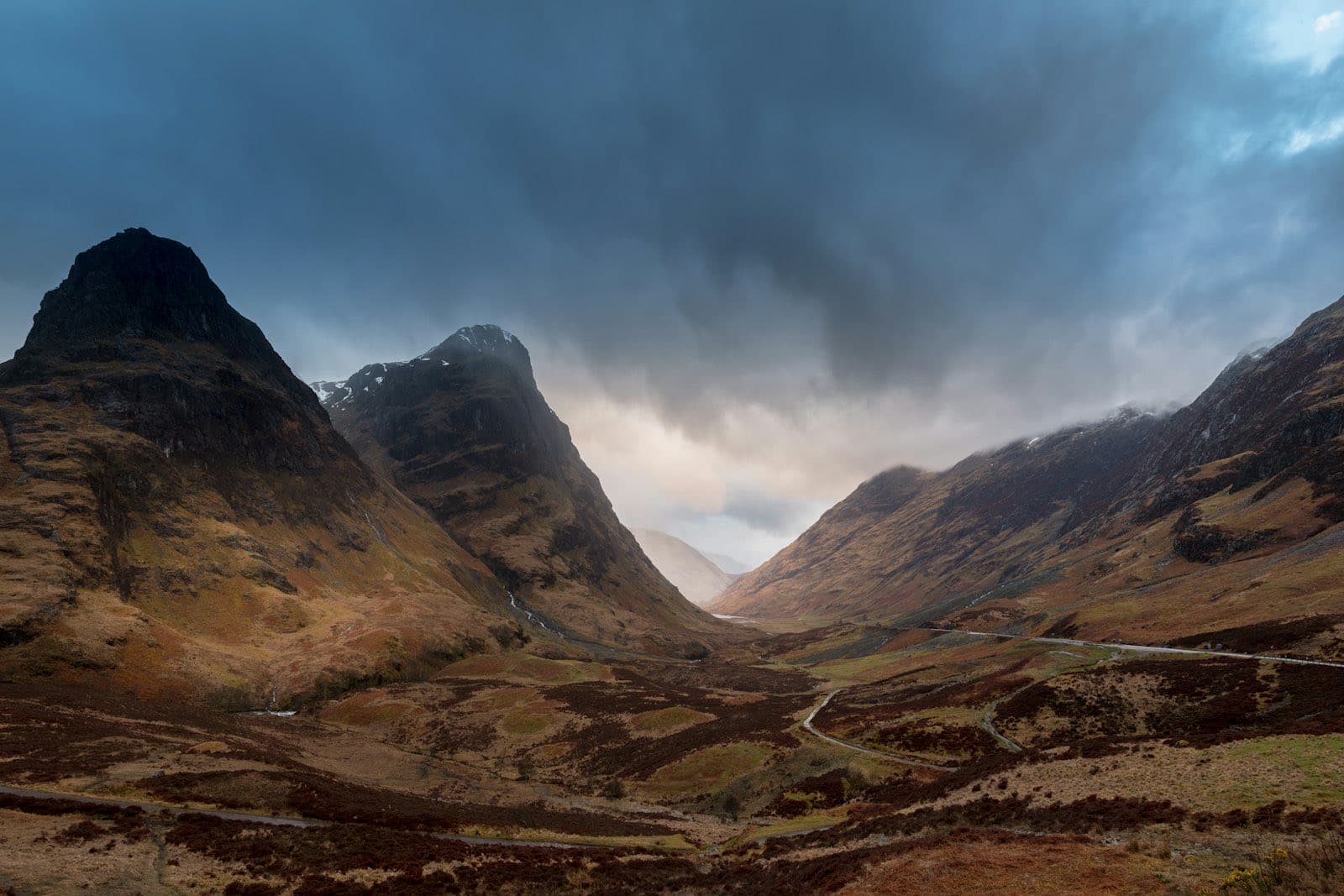
Scotland ticks every road trip box: dramatic scenery at every bend (Glencoe, Skye, Torridon), a dense heritage — castles, distilleries, battlefields — and a freedom rare in Europe: the Scottish right to roam allows responsible wild camping almost everywhere, van and tent alike (with a few local restrictions, such as Loch Lomond's shores in summer).
Our guide for this country: See what's inside — €44 →
The difficulty lies elsewhere: left-hand driving on single tracks (one-lane roads with passing places), four-seasons-a-day weather and, from late May to September, the midges — biting gnats of windless evenings. None of it survives good preparation.
The destinations that matter
4No. 011 to 2 nightsGlencoe and Glen EtiveA glacial valley pinched between dark walls, loaded with tragic history: Glencoe is the concentrate of Highlands that the A82 crosses through its heart.No. 022 to 3 nightsIsle of SkyeBasalt pinnacles in the mist, fairy pools and open-sky cliffs: Skye is Britain's most spectacular island — and its most courted.No. 035 to 8 daysNorth Coast 500830 km of wild coast around Scotland's roof: Caribbean-looking beaches (minus the water temperature), alpine passes and fishing villages — the "Scottish Route 66" earns its legend.No. 042 to 3 nightsHarris and Lewis (Outer Hebrides)Turquoise beaches worthy of the Seychelles under a North Atlantic sky, a stone circle older than Stonehenge: the Outer Hebrides are the Scottish road trip's final frontier.More stops worth adding to the trip
Loch Ness and the Cairngorms
The world's most famous loch, the last Caledonian forests and the planet's greatest concentration of distilleries: the Highlands' central triangle.
What to see
- Urquhart Castle and a boat trip on Loch Ness
- Loch an Eilein and its island castle in the Rothiemurchus forest
- A Speyside distillery (the big names book out; the craft ones improvise)
Suggested time: 2 nights
Edinburgh
A gothic capital built on volcanoes, a castle on its rock and a wild summit in the city: the ideal opening — on foot, before taking the wheel.
What to see
- The castle early, then the Royal Mile going downhill (not the reverse)
- Arthur's Seat at sunrise or sunset (45 min up)
- Dean Village and the Water of Leith walkway
Suggested time: 2 nights
Scotland: practical notes
Tolls, fines, money, seasons, budget, rental: the essentials, gathered on this page.
Money in Scotland: the pound sterling, bank cards and ATMs for a road trip
Brexit changed nothing about Scotland's currency: the pound sterling never left the UK, and the euro was never part of the picture between Edinburgh and the Highlands. What has changed is the country itself: contactless everywhere in town, but ATMs growing scarcer past Inverness or Fort William, and Scottish banknotes sometimes eyed with suspicion the moment you cross into England. Here's how to split cash and card before hitting the road on the North Coast 500 or catching a ferry to the Hebrides.
Police checks and fines in Scotland: the UK's strictest drink-drive limit and the NC500 speed cameras
On the North Coast 500 or the small roads through the Highlands, the idea of a police check rarely worries travellers — and rightly so: Scotland runs no systematic roadblocks and no cash fines paid roadside. The system works differently, by post, and comes with a quirk few continental drivers know about: the legal alcohol limit is lower here than in the rest of the UK. Here's how it all works, from Highland speed cameras to a charge that can land on your card weeks after you've returned the rental car.
- Valid French or EU driving licence, sufficient for a short tourist stay.
- Respect the four speed tiers: 30 / 60 / 70 mph, with extra care in the growing number of 20 mph town zones.
- Zero alcohol behind the wheel: Scotland's limit (50 mg/100 ml) is stricter than the rest of the UK.
- No cash payment to an officer, ever: any dispute goes through the post (NIP) and then the rental company.
- Plan for a possible card charge, fine plus administration fee, several weeks after returning the vehicle.
Taking a Hire Car on a CalMac Ferry: Booking, Boarding and Adding the Hebrides to Your Scottish Road Trip
Adding Mull, Skye, Harris or Islay to a Scottish road trip sounds simple: one more line on the itinerary, a boat, an island. Then the real questions start. Does the crossing need booking? Does the ticket cover the car? How early must you be at the pier? And above all: does your rental company actually allow the vehicle on board? Here is how the CalMac network works in practice in 2026 — what a crossing costs, what must be reserved, what runs on a queue, and the precautions to take on the hire car side.
- Bookable: Oban–Craignure (Mull), Ullapool–Stornoway (Lewis), Uig–Tarbert (Harris), Uig–Lochmaddy (North Uist), Kennacraig–Port Ellen / Port Askaig (Islay), Ardrossan–Brodick (Arran), Mallaig–Armadale (Skye), Berneray–Leverburgh (Sound of Harris), Oban–Castlebay (Barra).
- Turn up and go: Lochaline–Fishnish and Fionnphort–Iona (Mull), Sconser–Raasay, Claonaig/Tarbert–Lochranza (Arran), Tayinloan–Gigha, Wemyss Bay–Rothesay and Colintraive–Rhubodach (Bute), Largs–Cumbrae, Tobermory–Kilchoan.
- Vehicle check-in deadline: officially anything from 5 to 60 minutes depending on the route. Allow 45 minutes on Ullapool–Stornoway and Uig–Tarbert, 30 minutes on Oban–Craignure, 10 minutes on Lochaline–Fishnish. After that, your reserved space is reallocated to the waiting queue.
- Motorhomes, campervans and caravans are no longer admitted to standby queues: a pre-booked ticket is essential. For Mull and Tiree, CalMac also asks — at Argyll and Bute Council's request — that you have a campsite pitch secured before you travel.
| Crossing | Duration | Booking | Why it matters |
|---|---|---|---|
| Oban – Craignure (Mull) | 50 min | Essential in summer | The main gateway to Mull, Iona and Staffa |
| Lochaline – Fishnish (Mull) | 18 min | Not bookable, queue | Mull's back door, via Morvern |
| Ardrossan – Brodick (Arran) | 55 min | Essential | A whole island less than an hour from Glasgow |
| Mallaig – Armadale (Skye) | 30 min | Strongly advised | Loop in via the Road to the Isles instead of doubling back over the bridge |
| Kennacraig – Port Askaig (Islay) | 1 h 55 | Essential | Islay, its distilleries and the hop across to Jura |
| Uig – Tarbert (Harris) | 1 h 40 | Essential | The link from Skye to the Outer Hebrides |
| Berneray – Leverburgh (Sound of Harris) | 1 h | Essential | Connects the Uists to Harris without returning to the mainland |
| Ullapool – Stornoway (Lewis) | 2 h 40 | Essential | The way back into the Highlands after crossing the Hebrides |
Travel Insurance for Scotland: NHS, Free Rescue and Repatriation — What to Cover Before a Road Trip
Single track roads lined with heather between Applecross and Torridon, wild camping by a loch thanks to Scotland's right to roam, CalMac ferries stretching the road from one island to the next: self-drive touring in the Highlands is one of Europe's most generous road trips. It also raises a question few French travelers think about before leaving — what does a European Health Insurance Card (EHIC) actually cover in the UK since Brexit, and who pays if an accident on a single-track road goes wrong far from a hospital? Between free NHS emergency care for everyone, mountain rescue run by volunteers who never send a bill, and a flight home to France that no public system ever covers, here's what to actually check before hitting the North Coast 500.
- Request your EHIC (free, valid up to two years) from your health insurance provider before you leave.
- Compare at least two travel insurance policies on the medical expenses cap and actual-cost repatriation.
- Check that "driving on unpaved roads" and "hiking off marked trails" aren't listed among the exclusions.
- Save 999 (emergency) in your phone before setting off into the Highlands.
- Never treat Scotland's free rescue system as a reason to skip travel insurance: it never covers repatriation.
- Keep your insurer's 24/7 assistance number as a photo on your phone, including for when you're off signal.
| Type of cost | Actual cost |
|---|---|
| A&E care and ambulance to hospital | free for everyone, regardless of nationality |
| Mountain rescue (volunteer team or helicopter) | free, no bill sent to the person rescued |
| Emergency hospital admission with a valid EHIC/GHIC | free, at NHS resident rates |
| Hospital care for a non-EU/EEA visitor without an EHIC | 150% of the NHS national tariff — about £1,860 for cataract surgery, up to £8,570 for a hip replacement |
| Medically escorted flight home to France | never covered by the EHIC — potentially tens of thousands of euros, up to €80,000 according to France Diplomatie |
Our flagship guide — €44
Guide available“Scotland on Your Own”, the complete edition, is out
10 chapters: day-by-day itineraries, driving and transport, a costed budget and checklists — the same method as our Namibia guide.
The guide is currently written in French — an English edition is in the works.
No time to do it yourself?
A professional can take care of it: tailor-made trip, equipped 4x4 rental or a local guide. Describe your plans and, with your consent, we pass them on to partner professionals.
1. What you need
Explore other countries