Ireland on your own
Two and a half thousand kilometres of ragged coastline, cliffs plunging into the Atlantic, sheep on the road and a pub at the end of every peninsula: Ireland is Europe's king of road trips.
When to go
May and June are the crowning months: endless days (sunsets at 10 pm), gorse and rhododendrons in bloom, statistically the driest. July-August concentrate the crowds and prices on Kerry and Moher; September stays mild and quiet. Winter has its fans: photogenic storms, pubs by the fire — but 8-hour days and rural B&Bs closed. Year-round, the real rule is "four seasons in one day": the rain leaves as fast as it arrives.
What it costs
City car or compact rental €35-65/day in summer (far less off season), but beware the €2,000-3,000 excess: full excess waiver (super CDW, €15-25/day) or a credit card that covers Ireland changes the budget. Petrol/diesel around €1.75-1.90/L, B&Bs €100-140 for a double room, pub mains €15-25. Budget €2,000-3,000 for two over 10-12 days excluding flights; campsites and the month of September lighten the bill considerably.
Driving & transport
Left-hand driving — the reflex comes within a day, except at roundabouts (yield to the right) and on the first start each morning. The real difficulties lie elsewhere: single-track R roads and "boreens" between stone walls, where you pass in the widenings with a wave of the hand; the left wing mirror in permanent danger; sheep reigning over the tarmac from Connemara to Donegal. Take the smallest car possible, refuse ambitious daily mileages, and note that in Northern Ireland the limits switch to miles and the prices to pounds sterling — the border itself is invisible.
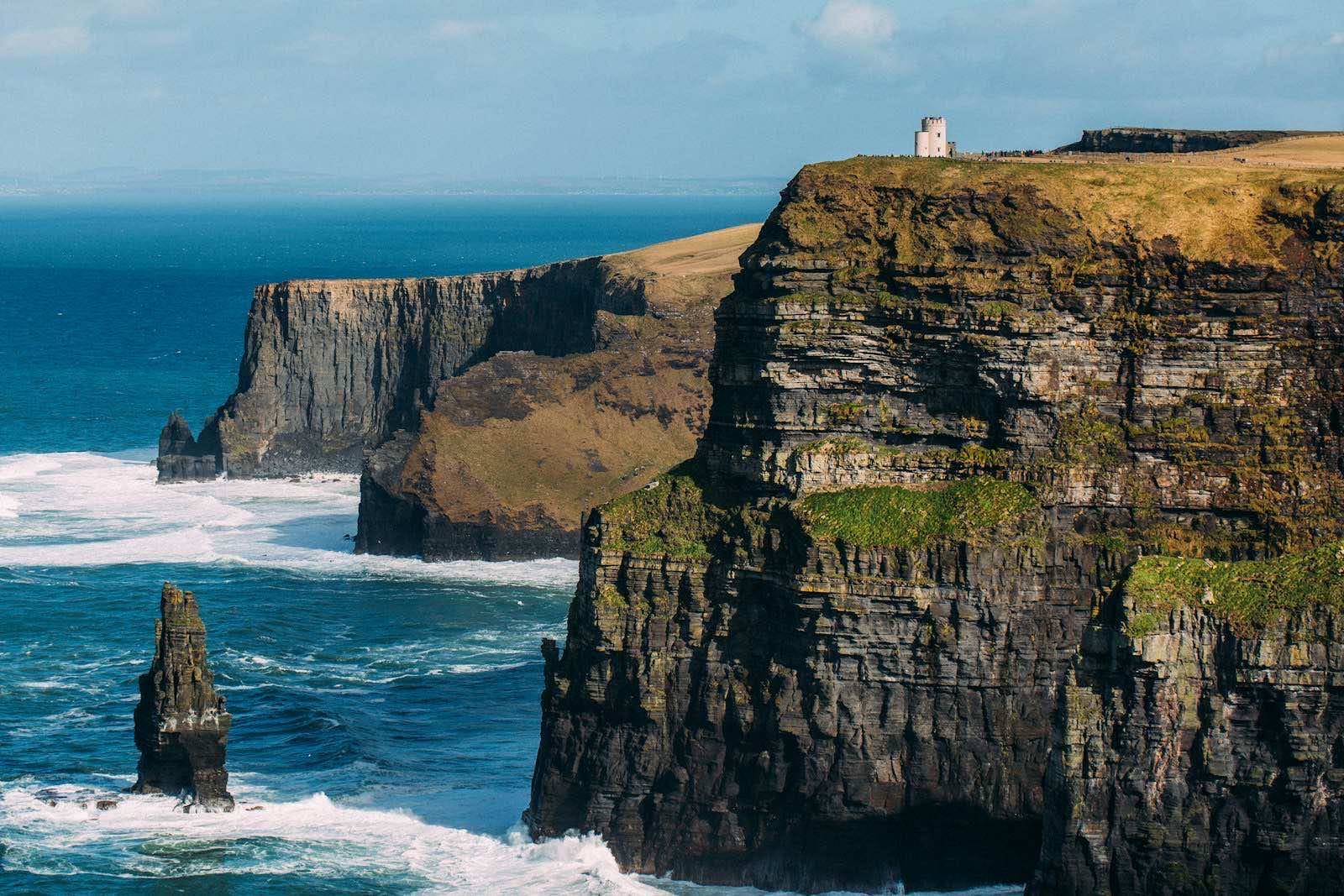
The Wild Atlantic Way — 2,500 signposted kilometres from Kinsale in the south to Malin Head at the very top — gave an official name to what travellers were already doing: tracing Ireland's west coast peninsula by peninsula, at the pace of the detours. The Cliffs of Moher, Connemara's black lakes, the Ring of Kerry, Donegal's ends of the earth: every bend opens a landscape the weather reinvents by the hour. And up north, Northern Ireland's Causeway Coast adds its 40,000 basalt columns to the picture.
Our guide for this country: See what's inside — €44 →
This is a country driven on the left, on roads often narrower than the car would like, between dry-stone walls and fuchsia hedges. You sleep in B&Bs — the national institution, full Irish breakfast included — and you quickly learn the trip's two rules: never plan more than 200 km a day, and never trust the weather beyond two hours. The rest is the magic of Atlantic light.
The destinations that matter
4No. 021 to 2 nightsCliffs of Moher and the BurrenTwo hundred and fourteen metres of vertical cliff above the Atlantic, eight kilometres of dizzying edge and, in spring, ledges full of puffins: Moher earns its legend — provided you dodge the herd.No. 032 to 3 nightsRing of KerryA 170-kilometre loop between mountains, lakes and the Atlantic, with the Skellig islands as the reward at the far end: Kerry is the absolute classic — and it survives its reputation very well.No. 042 to 3 nightsDonegalCliffs three times higher than Moher, beaches worthy of the Hebrides and empty roads all the way to the island's northernmost point: Donegal is the reward for those who push to the very end.More stops worth adding to the trip
Dingle Peninsula
The densest of Ireland's peninsulas: early-Christian ruins by the roadside, beaches beneath the cliffs, Gaelic in the pubs — and Dingle, the port that raised the pub evening to an art form.
What to see
- The Slea Head Drive clockwise, stopping at Dunbeg, the clocháns and Coumeenoole beach
- The Gallarus Oratory and the monastic site of Kilmalkedar on the northern loop
- Dingle's pub-groceries during a traditional music session (Dick Mack's, Foxy John's)
Suggested time: 2 nights
Causeway Coast (Northern Ireland)
Forty thousand perfectly hexagonal basalt columns, a rope bridge over the void and ruined castles on the headlands: the north coast earns the detour into Northern Ireland — passport unnecessary, pounds sterling useful.
What to see
- The Giant's Causeway early morning or after 5 pm, via the Dunseverick cliff path for the grand version
- The Carrick-a-Rede rope bridge and the turquoise water around the fishermen's island (online booking advised)
- Dunluce Castle at sunset, from the cove to the west for the best angle
Suggested time: 1 to 2 nights
Ireland: practical notes
Tolls, fines, money, seasons, budget, rental: the essentials, gathered on this page.
SIM Cards and Internet in Ireland: Staying Connected on the Wild Atlantic Way
Between the single-track boreens of Connemara, the Slieve League cliffs in Donegal and the Skellig Ring facing the Atlantic, an Ireland road trip regularly crosses zones where mobile signal gets scarce. Unlike some far-flung destinations, Ireland requires no registration formality for a prepaid SIM card — but it hides a subtler trap: crossing the invisible border into Northern Ireland moves you from an EU member state to a country that no longer is one, with real consequences for your data plan. Here's how to get set up before hitting the road: carriers, eSIM, formalities, and where the signal actually disappears.
- Check whether your home plan covers the Republic of Ireland under EU roaming at a reasonable rate, and whether the UK (and so Northern Ireland) is covered separately.
- Buy your Vodafone, Three or GoMo SIM directly from a vending machine or shop at Dublin Airport — no special formality is required in the Republic of Ireland.
- Activate an eSIM before departure (Airalo, Holafly) to cover the first few hours without a queue.
- Download offline maps (Google Maps, Maps.me) before Connemara, Donegal or the Skellig Ring.
- Check your plan or switch to a local eSIM before crossing the invisible border into Northern Ireland.
- Mount your phone on the dashboard and use voice guidance rather than holding it on a single-track boreen.
| Carrier/plan | Indicative price | Note |
|---|---|---|
| GoMo — tourist plan, 5G, 30 days | from €15 | 23 GB of EU roaming data included, good value/simplicity |
| Three — Direct, unlimited data, 30 days | ≈ €20 | Simple and clear for a short stay |
| Vodafone — 20 GB + unlimited Ireland calls/texts, 30 days | ≈ €25 | Best rural coverage (Connemara, Kerry, Dingle) |
Tolls in Ireland with a hire car: the barrier-free M50 trap
You collect a car at Dublin Airport, join the ring road to head west, and nobody stops you. Three weeks later an unexplained line appears on your bank statement. The M50 is a barrier-free toll: no booths, no barriers, just cameras reading your number plate. You have until 8pm the following day to pay, after which penalties start stacking up. This article covers how the M50 works in 2026, Ireland's other tolls, the Dublin Port Tunnel, what hire companies actually charge, and how to settle it yourself in three minutes.
- Leaving Dublin Airport and heading west or south-west (Galway, Limerick, the Burren, Connemara): the ring road takes you between Junctions 6 and 7.
- Driving around Dublin to avoid the city centre, in either direction — each crossing counts separately.
- Joining the N4 or the N3 from the north of the city, typically on day one of a road trip.
- Coming back towards the airport from the west at the end of the trip: you cross again, and that second crossing usually falls the day before your flight, when tolls are the last thing on your mind.
- Following a navigation app that optimises for journey time and gives no warning about a toll with no barrier.
| Toll | Car rate 2026 | How you pay | Deadline and risk |
|---|---|---|---|
| M50, West-Link bridge (between Junctions 6 and 7) | €3.80 unregistered, €2.60 with a tag | eflow.ie, eFlow app, Payzone shop, phone | By 8pm the next day, otherwise +€4, then +€51, then +€128 |
| Barrier tolls (M1, M3, M4, M7/M8, M8, N6, N18, N25) | roughly €1.80 to €3.60 depending on the plaza | Cash, card or tag at the barrier | Paid on the spot, no penalty possible |
| Dublin Port Tunnel, southbound (Santry to the port) | €14 from 6am to 10am Monday to Friday, €3.50 otherwise | Barrier, cash or card | Paid on the spot |
| Dublin Port Tunnel, northbound (port to Santry) | €12 from 4pm to 7pm Monday to Friday, €3.50 otherwise | Barrier, cash or card | Paid on the spot |
| Roads in Northern Ireland | no road tolls at all | not applicable | not applicable |
Travel Insurance for Ireland: Generous EHIC, a Private GP and Free Rescue — What to Cover Before a Road Trip
Cliffs at Moher dropping into the Atlantic, black bogland in the Connemara, the Skellig Ring left to those who bother to detour off the coach route, Donegal pushed all the way to the edge of the island: Ireland is a road trip of rare generosity, as long as you accept its deceptive distances and its four-seasons-a-day weather. As an EU member, the country often reassures travelers enough that they skip travel insurance altogether — and the European Health Insurance Card (EHIC) really is more generous here than in most of Europe since a 2023 reform. But it leaves one very concrete blind spot on the Wild Atlantic Way: the GP, often the only option for miles around. Here's what to actually check before hitting the road.
- Order your EHIC (free, valid for two years) at least two weeks before departure.
- Take out travel insurance that explicitly reimburses GP and out-of-hours unscheduled-care consultations, not just hospital treatment.
- Check the medical expenses cap (€100,000 minimum) and how repatriation is covered (actual cost, no low cap).
- Confirm that coastal walking and sea rescue costs aren't excluded from the policy.
- Take extra care during the first few days of driving on the left, especially at roundabouts and pulling out of a car park.
- Save 112 or 999 (emergency numbers, valid across the whole island) in your phone before hitting the road.
| Type of cost | Actual cost |
|---|---|
| Daytime GP consultation (private surgery) | roughly €45–70, paid on the spot |
| Out-of-hours unscheduled care service (evening/weekend) | often €80–100 or more depending on the region |
| Hospital Emergency Department without a valid EHIC (non-EU visitor) | roughly €447 for the first visit |
| Ambulance called in an emergency (999/112) | free, regardless of nationality |
| Medical repatriation to France | from a few thousand euros (ground transport or an escorted flight) to over €20,000 for a fully medicalized flight |
Our flagship guide — €44
Guide available“Ireland on Your Own”, the complete edition, is out
10 chapters: day-by-day itineraries, driving and transport, a costed budget and checklists — the same method as our Namibia guide.
The guide is currently written in French — an English edition is in the works.
No time to do it yourself?
A professional can take care of it: tailor-made trip, equipped 4x4 rental or a local guide. Describe your plans and, with your consent, we pass them on to partner professionals.
1. What you need
Explore other countries