From our field notes
Booking Botswana's National Park Campsites: The Self-Drive Playbook (Moremi, Savuti, CKGR)
Published 1 August 2026 · updated 27 September 2026 · 8 min read
By Clément Lacaille, publisher · our method
In short: there is no central booking office; each public campsite is booked by email with the concessionaire that runs it (or the DWNP for a few sites), a pitch is only confirmed once paid, and DWNP entry fees are paid separately. Book the nights before the 4x4. In Botswana, the classic self-drive mistake happens months before departure: you book your equipped 4x4, then discover that Third Bridge, Savuti or Piper Pan are full on every one of your dates. The public campsites inside the parks — around ten pitches each, run by a handful of private concessionaires — fill up very early for the May-to-October high season. Here is how this system, unique in southern Africa, actually works: who to write to, how to pay, and how to build your itinerary around availability rather than the other way round.
The golden rule: pitches first, 4x4 second
In most self-drive destinations, you book the vehicle first and sort out the stops afterwards. In Botswana it is exactly the reverse. The public campsites in the big parks — Moremi, Chobe/Savuti, the Central Kalahari (CKGR), Makgadikgadi and Nxai Pan — each hold only a handful of pitches: Moremi's four public camps run to around ten sites apiece. As a result, the most sought-after camps sell out months in advance for the May-to-October high season, and some travellers book up to a year ahead.
Locking in an equipped 4x4 before securing your nights therefore means risking a high-season rental rate… only to sleep outside the parks and make daily runs in from Maun or Kasane. The right sequence: sketch an itinerary, send availability requests to the campsite operators, adjust your dates around their replies, and only then confirm the vehicle. Our article on renting an equipped 4x4 in Botswana covers the next step — but it genuinely comes second.
Who runs what: one concessionaire per campsite
This is the quirk that throws everyone: there is no single central booking office. The parks' public campsites have been handed to private operators under concession — each manages "its" camps — while the Department of Wildlife and National Parks (DWNP) keeps direct control of a few sites, notably part of the CKGR and the Botswana side of the Kgalagadi. For a classic Moremi–Savuti–Chobe route, you therefore end up writing to two or three different operators, each with their own response times and conditions.
The table below sums up the split as it works at the time of writing. Concessions change hands as tenders are renewed: always double-check the current operator when you book, via the operators' own channels or a local agency.
| Park | Public campsites | Operator (reconfirm when booking) |
|---|---|---|
| Moremi | Third Bridge | Xomae Sites |
| Moremi | Xakanaxa, South Gate (Maqwee) | Kwalate Safaris |
| Moremi | Khwai / North Gate | SKL Camps |
| Chobe | Savuti, Linyanti | SKL Camps |
| Chobe | Ihaha (Chobe riverfront) | Kwalate Safaris |
| Nxai Pan | South Camp, Baines' Baobabs | Xomae Sites |
| Makgadikgadi | Khumaga | SKL Camps |
| CKGR and Khutse | Piper Pan, Sunday Pan, Passarge… | Bigfoot Tours (a few sites remain with DWNP) |
How to book in practice: email, patience and a deposit
Bookings are made mostly by email, sometimes by phone through the operators' Maun offices. Don't expect an instant-payment online platform across the board: you send a request with your dates, the campsite you want, the number of people and vehicles, then you wait. Response times range from a few hours to several days — polite follow-ups are simply part of the process. Once availability is confirmed, the operator sends an invoice; the booking is only firm once you have paid (a deposit or the full amount, depending on each concessionaire's terms), usually by international transfer or card.
Keep the written confirmation safe: you will be asked for it at the park gate, along with proof of payment. If the whole exercise feels heavy — time zones, transfers, follow-ups — the specialist agencies in Maun and the 4x4 rental companies will handle campsite bookings for you for a service fee: a shortcut that often pays for itself when an itinerary strings together three or four different operators.
The process boils down to six steps:
- Sketch an itinerary with two or three alternative dates for each stop.
- Identify the operator for each campsite you want (table above, to be reconfirmed).
- Send all your availability requests by email, in parallel.
- Adjust the route around the replies, then pay the invoices to confirm.
- Book the equipped 4x4 once your nights are secured.
- Print every confirmation and proof of payment for the gates.
DWNP park fees: a separate till
The system's second subtlety: paying for your campsite does not get you into the park. Entry fees — per person, per vehicle and per day — are collected separately by the DWNP. At the time of writing, they are paid at the park gates in cash (pula), or in advance at DWNP offices, notably in Maun, Kasane and Gaborone, where card payment is possible. Carry spare cash and check the current arrangements just before departure: the payment methods accepted at the gates do change.
These fees are no budgetary footnote, and visitors themselves recognise their legitimacy: a study by G. Mmopelwa, D. L. Kgathi and L. Molefhe published in 2007 in Tourism Management, surveying self-drive tourists and mobile-operator clients in Moremi Game Reserve, found that visitors said they were willing to pay entry fees above the going rates if park management improved in return (study online: doi.org/10.1016/j.tourman.2006.08.014).
In practice, at every gate you show your campsite confirmation, pay or validate your park fees, and note the hours: gates open and close with the sun, and driving inside a park after closing time is prohibited — one more reason to plan realistic daily stages.
On the ground: camps wide open to the bush
Arrive knowing what you have signed up for: Botswana's public campsites are unfenced. Elephants strolling through camp at Savuti, hyenas patrolling Third Bridge after dark, opportunistic baboons at Xakanaxa — animals move freely through the sites, and that is precisely what makes the system magical. The ground rules are non-negotiable: food locked in the vehicle, no rubbish left out, no walking around after nightfall, children under constant supervision.
Comfort is deliberately rustic: simple ablution blocks (sometimes wood-fired hot water, sometimes a bucket shower in the Kalahari), no electricity or phone signal in most camps, and above all no resupply — no fuel, no guaranteed drinking water, no shop of any kind inside the parks. Everything is loaded in Maun or Kasane: full autonomy in water, food and diesel is the price of admission. Wild camping, meanwhile, is illegal: you sleep on the pitch you booked, full stop.
Third Bridge, Xakanaxa, Savuti, Piper Pan: why these names go first
A few camps concentrate most of the demand, and it is no accident. Third Bridge, set beside a log-pole bridge in the heart of Moremi, gives direct access to the Mboma lagoons and prime lion territory; Xakanaxa combines shaded pitches with immediate access to some of the delta's most game-rich lagoon-edge tracks. Savuti, in Chobe, lives to the rhythm of its marsh and its elephants; Piper Pan, away from the CKGR's main tracks, offers some of the finest solitude in the Kalahari.
That success has a long-documented flip side: a study by Joseph E. Mbaiwa published in 2003 in the Journal of Arid Environments showed as early as then that tourism development in the Okavango Delta, a major source of jobs and foreign exchange, comes with environmental impacts such as off-track driving and poor waste management (study online: doi.org/10.1006/jare.2002.1101). The tiny number of pitches is therefore no bureaucratic quirk: it is the central tool of Botswana's low-volume tourism policy. Booking early means working with a system that protects exactly what you are coming to see.
To choose your stops inside Moremi, our destination page covers sectors, tracks and seasons; and if your dates are still open, our article on the Okavango flood will help you decide between the dry season and the green season.
The alternative outside the parks: Maun, Kasane and the riverbanks
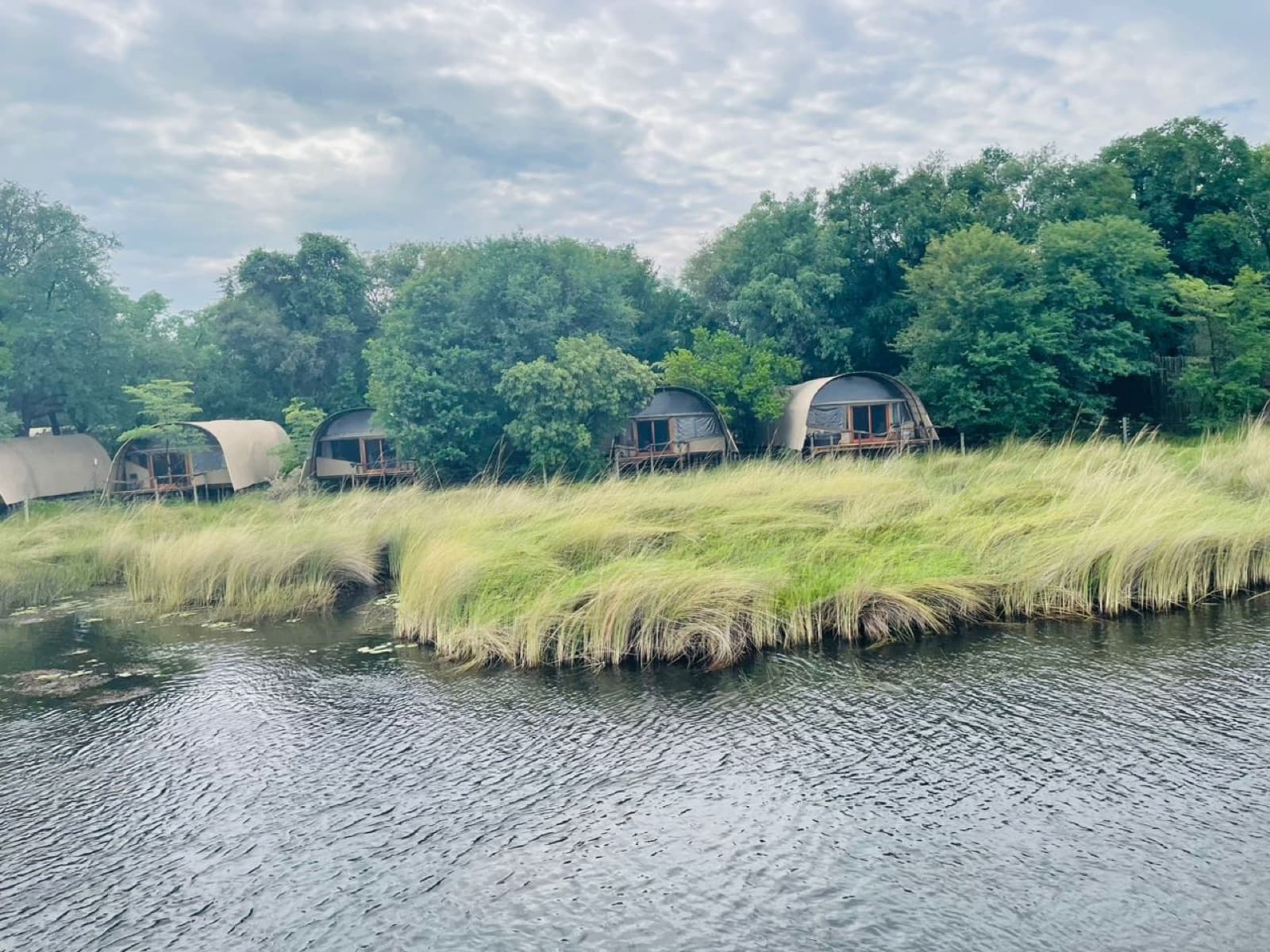
If the camps inside the parks are full, all is not lost. Around the parks, a far more flexible private scene has grown up: Maun campsites along the Thamalakane River, sites in and around Kasane on the Chobe riverfront, community camps in the Khwai area at Moremi's northern exit. They offer what the park camps do not — a bar, sometimes a pool, electricity, straightforward and often online booking — and the bush atmosphere remains very real at the riverside sites.
These bases enable two strategies: day trips into the parks (paying that day's park fees, gates open sunrise to sunset), or a hybrid itinerary alternating two "comfort" nights with two nights at whichever park camp you managed to secure. In the green season, from December to March, the pressure eases considerably: park pitches become findable again just a few weeks out — with mud and thunderstorms as the trade-off.
Build the itinerary around availability — not the other way round
The method that works: start from a skeleton route (say Maun, Moremi, Khwai, Savuti, Kasane), request availability across a range of dates, then let the replies shape the trip. No night to be had at Third Bridge? Reverse the direction of the loop, shift by three days, or swap in Xakanaxa. It feels counter-intuitive if you are used to planning to the day, but it is the only way to sleep in the legendary camps without starting a year in advance.
Keep your daily stages realistic too: 60 kilometres of sand can take four hours, and reaching camp before dark is not optional but mandatory. Our article on how long a Botswana road trip should be will help you size the loop; and for the full preparation — vehicle, navigation, water, borders — the "Botswana on Your Own" guide walks through the whole process, campsite bookings included, in the order it needs to happen.
Travel tips
Get our independent-travel tips by email
The house methods — costed budgets, driving, itineraries — straight to your inbox. Instant bonus: our free excerpt “The 7 mistakes to avoid on a first Namibia road trip” and the current promo code.
No time to do it yourself?
A professional can take care of it: tailor-made trip, equipped 4x4 rental or a local guide. Describe your plans and, with your consent, we pass them on to partner professionals.
1. What you need
Before you go
Readers' questions
How far in advance should I book Moremi or Savuti campsites?
For the high season (May to October), aim for six to twelve months ahead at the most popular camps such as Third Bridge, Xakanaxa or Savuti: each camp has only around ten pitches. In the green season (December to March), a few weeks is often enough.
Who handles bookings for Botswana's park campsites?
Private concessionaires, each for "its" camps: at the time of writing, Xomae Sites (Third Bridge, Nxai Pan), Kwalate Safaris (Xakanaxa, South Gate, Ihaha), SKL Camps (Khwai, Savuti, Linyanti, Khumaga) and Bigfoot Tours (most of the CKGR), with the DWNP keeping a few sites. Concessions change hands: reconfirm the operator when you book.
How do I pay Botswana's park entry fees?
Separately from the campsite: park fees are paid to the DWNP, at the park gates in cash (pula) or in advance at its offices — notably Maun, Kasane and Gaborone — where cards are accepted. Keep the receipts: they are checked at the gates.
Can you camp outside your booked pitch in Botswana?
No: wild camping is illegal, inside the parks and outside designated areas alike. You sleep on the pitch you booked, confirmed in writing and shown at the park gate. Outside the parks, the private campsites of Maun, Kasane or the Khwai area offer a flexible fallback.