Namib Desert · Stop 02
Deadvlei
A floor of cracked white clay, acacias dead for centuries, a wall of orange dunes: Deadvlei is one of the most surreal landscapes on the planet — and it is earned on foot, early in the morning.
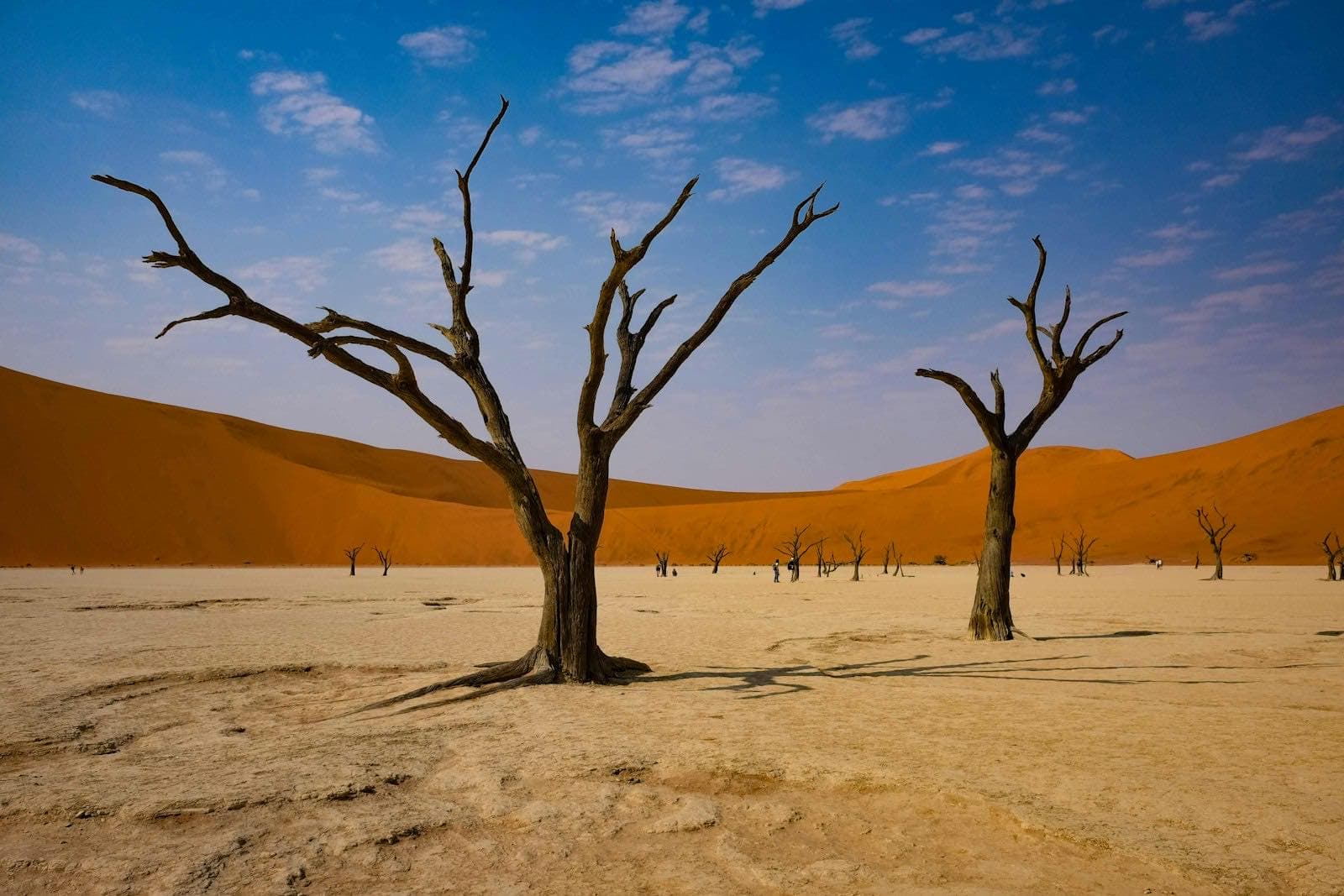
Deadvlei ("the dead marsh") is a former flood pan of the Tsauchab river, cut off from its water by the advancing dunes around 900 years ago. The camelthorns that grew there died standing and, too dry to decompose, froze into black silhouettes on the white clay.
The site lies at the far end of the Namib-Naukluft park, about 1.1 km on foot from the Sossusvlei 4x4 car park, along a post-marked trail that skirts a dune. The walk is easy but utterly shadeless: do it in the early morning, without fail.
Contrary to what the photos suggest, Deadvlei is no secret spot: in high season the pan fills with visitors from 9 am. Being among the first changes everything, for the light and for the solitude.
What to see and do
1.The pan and its trees
The heart of the site: some thirty dead acacias scattered across the white clay. The morning light sets the great dune behind ablaze while the pan stays in shadow — the contrast that made the place famous. Allow a good hour on site.
2.Big Daddy, the plunging view
The ~325 m dune towering over Deadvlei is climbed from Sossusvlei in 1 h 30 to 2 h. From the crest, a vertical view onto the white pan, then a straight full-sand descent to the trees in a few euphoric minutes. Mornings only, with 2 litres of water per person.
3.Hiddenvlei
The "forgotten" pan, about 2 km from the 2x4 car park along a little-used trail. Less spectacular than Deadvlei but often deserted: the smart choice if you want a dead-tree pan to yourself.
4.Photography at the right moment
The white floor, black trunks and orange dune saturate naturally between park opening and 9:30 am. After that, vertical light flattens everything. No tripod needed; wide-angle and short telephoto are both relevant.
Where to stay
By category — the guide covers how to choose and when to book.
Inside-the-gate camping at Sesriem
Same logic as for Sossusvlei: it is the strategic base, because its guests pass the inner gate before official opening and reach Deadvlei in the best light.
Lodges and campsites around Sesriem
All categories along the C19. Perfectly viable provided you are at the park gate at opening — set the alarm accordingly, the entrance is then an hour's drive from the site.
Driving advice
- Deadvlei is reached from the Sossusvlei 4x4 car park: same rules as for the sand section (4L, deflated tyres, steady momentum), or the shuttle from the 2x4 car park.
- The 1.1 km trail is not drivable: closed shoes (the sand burns from midday), a hat and at least 1.5 litres of water per person.
- Don't follow vehicle tracks that leave the marked route: the clay pans are protected and the fines are real.
Distances to neighbouring stops
| To | Distance | Driving time | Road |
|---|---|---|---|
| Sossusvlei (car park) | 1 km | 15 – 20 min on foot | Marked trail through the sand, 1.1 km |
| Swakopmund | 350 km | 4 h 30 – 5 h from Sesriem | C19 then C14 via Solitaire, gravel |
| Windhoek | 320 km | 4 h 30 from Sesriem | C24/C14, mostly gravel |
This stop in our itineraries
These stops link together in our three day-by-day circuits:
Our flagship guide — €44
Plan this trip without leaving anything to chance
The “Namibia on your own” guide covers this stop and everything else: renting the 4x4 without the insurance traps, 10/15/21-day itineraries day by day, the Etosha strategy, a full budget and checklists. Now available in English.
Instant download · 14-day money-back guarantee
No time to do it yourself?
A professional can take care of it: tailor-made trip, equipped 4x4 rental or a local guide. Describe your plans and, with your consent, we pass them on to partner professionals.
1. What you need
Before you go
Readers' questions about Deadvlei
Are Deadvlei and Sossusvlei the same thing?
No. Sossusvlei is the great pan that gives the site and the final car park their name; Deadvlei is a smaller neighbouring pan, famous for its dead trees. You visit both in the same morning: Deadvlei is 1.1 km on foot from the 4x4 car park.
Is the walk difficult?
No: 1.1 km over packed sand, marked with white posts, about 20 minutes. The only difficulty is the heat — no shade on the way or in the pan. In the morning it's a stroll; at midday in summer it's punishing and inadvisable.
Can you touch or climb the trees?
No. The trunks, dead for centuries, are brittle and irreplaceable: they do not regrow. Stay on the ground, don't climb and don't break anything — the site is protected and watched, and its preservation depends on every visitor's behaviour.
Which lens should you bring?
Both classics work: a wide-angle for the trees against the dune, a short telephoto (70-200 mm) to isolate the silhouettes on the clay. Dust and sand fly: avoid changing lenses in the pan in strong wind.