Namib Desert · Stop 01
Sossusvlei
The world's tallest star dunes, a white clay pan ringed with orange: Sossusvlei is the image of Namibia — and a stop that needs planning, because everything is decided at dawn.
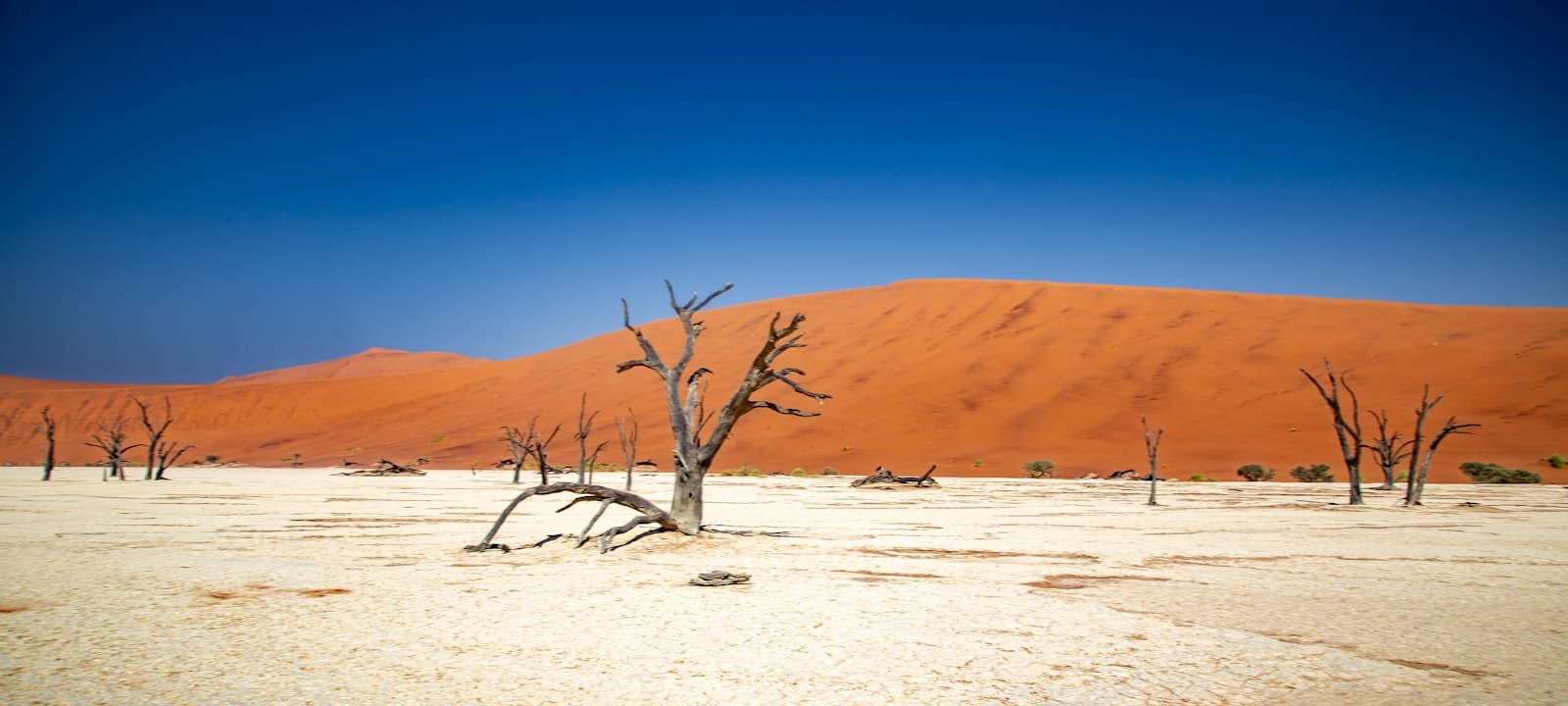
Sossusvlei is a clay pan (a vlei) at the heart of the Namib-Naukluft park, at the end of a 60 km road that plunges into the dune sea from the Sesriem gate. It is the country's most photogenic stop: dunes of 200 to 300 metres, raking morning light, lone oryx on the crests.
All the logistics revolve around one simple fact: the magic light lasts from gate-opening to mid-morning, after which heat and vertical sun flatten the landscape. Sleeping at Sesriem itself (or just outside) and entering at opening changes the experience completely.
The internal road is tarred for 60 km, but the final 5 kilometres run through deep sand: committed 4x4 driving (deflated tyres, low range) or a paid shuttle from the 2x4 car park. It is the only real sandy passage of a classic self-drive.
What to see and do
1.Dune 45
Namibia's most-climbed dune, at kilometre 45 of the internal road. Around 30 to 45 minutes up the crest, with a circular view over the dune sea. Being there at sunrise is a justified classic: arrive as the gates open.
2.Sossusvlei and Big Daddy
At the end of the road, the Sossusvlei pan is dominated by Big Daddy (~325 m), one of the tallest accessible dunes. Allow 1 h 30 to 2 h of demanding climbing, rewarded by the full-slope descent to Deadvlei. Avoid after 10 am in summer.
3.Deadvlei
The white pan of centuries-dead acacias, about 1.1 km on foot from the 4x4 car park. It is the country's most famous landscape — covered in detail on its own page, because it deserves its half-day.
4.Sesriem Canyon
A small canyon 30 m deep carved by the Tsauchab river, 4 km from the park gate. Perfect in the late afternoon when the dunes are crushed by heat: shade, relative cool and a pleasant hour's walk.
5.Elim Dune
An isolated dune 5 km from Sesriem, reachable without a 4x4. The evening tip: guests of the NWR campsite can climb it for sunset while the internal road is already closed to outside visitors.
Where to stay
By category — the guide covers how to choose and when to book.
NWR campsite inside the gate at Sesriem
The only accommodation inside the gate: its guests enter the dune road about an hour before everyone else — a decisive advantage for the light. Decent ablutions, pitches shaded by camelthorns. Book very early in high season (roughly €20-30 per person).
Lodges and campsites outside the park
Along the C19 and around Sesriem, a full range: well-equipped private campsites, mid-range lodges (€120-250 per room) and high-end addresses with views of the Naukluft mountains. Allow 10 to 30 minutes' drive to the gate.
Solitaire and around
An hour north, the road oasis of Solitaire (fuel station, a bakery famous for its apple pie) and a few farm-lodges. Practical as a connecting stop towards Swakopmund, too far for sunrise at the dunes.
Driving advice
- The final 5 km past the 2x4 car park are deep sand: engage low range (4L), deflate to around 1.4-1.6 bar and don't stop in the soft sections. If in doubt, take the shuttle — getting bogged down costs hours.
- Reinflate at the Sesriem station compressor before returning to gravel: running underinflated at 80 km/h damages the sidewalls.
- Fill up at Sesriem or Solitaire: the next station towards the coast is over 100 km away.
- Park hours follow the sun (gates open sunrise to sunset): check them the evening before at reception and don't get locked onto the internal road.
Distances to neighbouring stops
| To | Distance | Driving time | Road |
|---|---|---|---|
| Deadvlei | 65 km | 1 h + a 1.1 km walk | Tarred internal park road then 5 km of sand |
| Swakopmund | 350 km | 4 h 30 – 5 h | C19 then C14 via Solitaire and the Gaub and Kuiseb passes, gravel |
| Windhoek | 320 km | 4 h 30 | C24/C14 via Rehoboth or C26, mostly gravel |
| Lüderitz / Kolmanskop | 500 km | 6 h 30 – 7 h | C14 then C13 via Helmeringhausen and Aus, gravel then tar |
This stop in our itineraries
These stops link together in our three day-by-day circuits:
Our flagship guide — €44
Plan this trip without leaving anything to chance
The “Namibia on your own” guide covers this stop and everything else: renting the 4x4 without the insurance traps, 10/15/21-day itineraries day by day, the Etosha strategy, a full budget and checklists. Now available in English.
Instant download · 14-day money-back guarantee
No time to do it yourself?
A professional can take care of it: tailor-made trip, equipped 4x4 rental or a local guide. Describe your plans and, with your consent, we pass them on to partner professionals.
1. What you need
Before you go
Readers' questions about Sossusvlei
Do you need a 4x4 for Sossusvlei?
For the first 60 kilometres, no: the internal road is tarred. The final 5 kilometres to the last car park are deep sand and reserved for 4x4s driven in low range. Without a 4x4 (or without the appetite), a paid shuttle runs from the 2x4 car park.
What time should you enter the park?
At gate-opening, at sunrise. It then takes about an hour to reach the far end of the park: guests of the inside-the-gate camp at Sesriem, who leave earlier, are the only ones to watch the sun rise from the dunes themselves. The light stays superb until 9–10 am.
How much is the park entrance?
The permit is bought at the Sesriem gate: on MEFT's latest official schedule (in force since 1 January 2021), 150 NAD per non-SADC foreign adult per day, plus 50 NAD per vehicle of 10 seats or fewer; new fees have been announced for 2026 and are awaiting official publication by MEFT, so check the amount at the gate. Cash or card accepted, but keep backup cash.
How many nights should you plan at Sossusvlei?
Two nights are ideal: arrive in the afternoon (Sesriem Canyon, Elim Dune at sunset), then a full day in the dunes from opening. One night is doable but frustrating — you'll see the dunes only once, racing the heat.