Namibia · Route no. 21
Namibia in 21 days: the grand tour, canyon to Etosha
Three weeks for the complete loop: the mineral deep south (canyon, ghost town), the dunes, the wild coast up to Cape Cross, Damaraland and four nights in Etosha. The trip of a lifetime, no helicopter and no compromise.
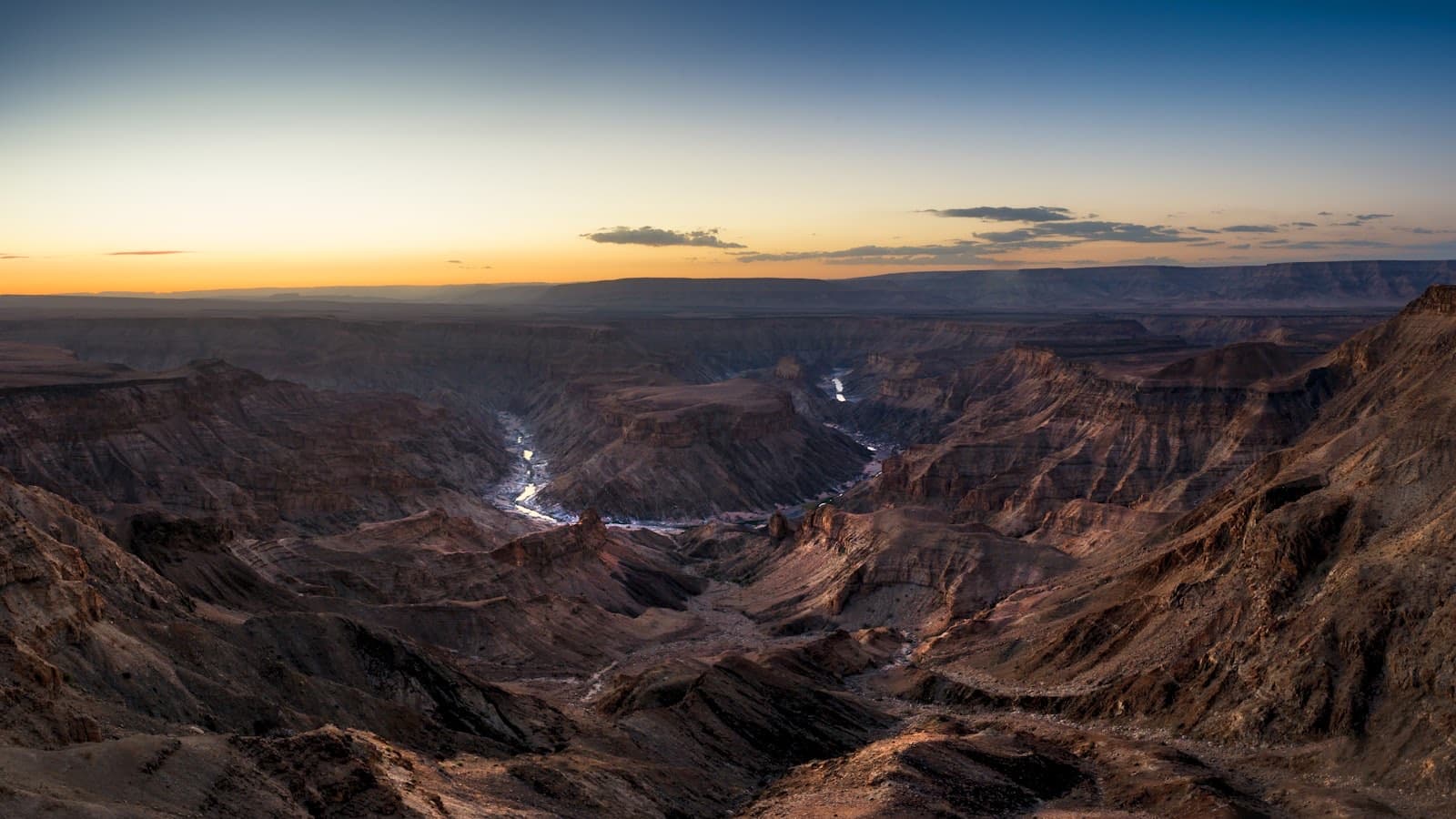
The grand tour adds what 15 days cannot: the Fish River Canyon at sunset, the crossing of the Sperrgebiet to Lüderitz and the sand-swallowed ghost town of Kolmanskop, the wild horses of Aus — then climbs back through Sossusvlei, the coast (with the Cape Cross option), Damaraland, and treats itself to four nights in Etosha, including its quieter western reaches.
It's a ~4,050 km itinerary, roughly half on gravel: it assumes you accept two or three solid connecting days, richly rewarded. The guide devotes a full chapter to this route, with variants (clockwise, a Caprivi extension instead of the south) and accommodation detail by category.
The route, day by day
Arrival in Windhoek → Kalahari
270 km · 3 h
4x4, briefing, groceries, then the B1 south and a first night among the red dunes. The opening ritual doesn't change: it works.
Kalahari → Fish River Canyon
450 km · 5 h 30
The long run south on the B1 then the C37: Keetmanshoop, the quiver tree forest for lunch, arriving at Hobas for sunset on the rim of Africa's greatest canyon after the Rift.
Canyon at sunrise → Aus
330 km · 4 h
Back to the viewpoints in morning light, then west on the C12 and B4. Night in the granite hills of Aus; at the Garub waterhole, your first wild horses of the Namib.
Kolmanskop and Lüderitz
250 km · 3 h (with the peninsula loop)
The B4 crosses the diamond zone to the ghost town: guided morning tour then free photography in the sand-filled houses. Afternoon in Lüderitz — Felsenkirche, the peninsula, Diaz Point — and oysters facing the harbour.
Lüderitz → Helmeringhausen area
330 km · 4 h 30
North on the C13 then the C14: a day of pure gravel through increasingly lunar country. Night at a farm-lodge or bush campsite around Helmeringhausen or Duwisib.
Arrival at Sesriem
170 km · 2 h 30
A short leg to Sesriem: set up, permit, Sesriem Canyon and Elim Dune at sundown. Early night — tomorrow the gates open with the sun.
Sossusvlei and Deadvlei
130 km · 2 h (inside the park)
Dune 45 or Big Daddy at dawn, Deadvlei before the heat, siesta, then a second entry late in the day if energy allows. Two nights on site: the queen of days is not negotiable.
Sesriem → Swakopmund
350 km · 5 h
Solitaire, the Gaub and Kuiseb passes, the Tropic of Capricorn, then Atlantic cool. A real room, laundry, a fish dinner.
A day in Swakopmund
Sandwich Harbour or a Walvis Bay cruise in the morning, German flânerie and resupply in the afternoon. The trip's big pause, earned after the southern marathon.
Swakopmund → Cape Cross → Spitzkoppe
290 km · 4 h
The salt road due north: the Zeila wreck, then the din and the smell of tens of thousands of Cape fur seals at Cape Cross. In the afternoon, inland to the Spitzkoppe granite via Henties Bay.
Spitzkoppe
A morning scrambling on the slabs, Bushman's Paradise with a local guide, the arch at sundown and a night under the stars. The stop every traveller ranks in their top three.
Spitzkoppe → Damaraland (Twyfelfontein)
200 km · 3 h
Up through Uis beneath the Brandberg. The Twyfelfontein rock engravings in the late afternoon, the basalt Organ Pipes as a bonus.
Damaraland: desert elephants
A guided outing in the Huab riverbed after the desert elephants, a contemplative afternoon in Damaraland's reds. Optional walk to the Brandberg's White Lady for the motivated.
Damaraland → western Etosha (Okaukuejo)
330 km · 4 h 30
Via Khorixas and Outjo, in through Anderson Gate, first sits. Evening vigil at the Okaukuejo waterhole: in the dry season the nightly parade — elephants, giraffes, black rhinos — runs like clockwork.
Etosha: the western plains
100 km · day in the park
A day in the Okaukuejo sector and out to Okondeka on the pan's edge — lion country. A second night at the same camp: you refine your waterhole knowledge and return at the right hours.
Etosha: to Halali
80 km · day in the park
Eastward via Rietfontein and the salt pan viewpoint. Night at Halali, the amphitheatre waterhole at dusk — the park's best leopard spot.
Etosha: eastern sector → Namutoni
70 km · day in the park
Goas, Klein Namutoni and the giraffe thickets, Fisher's Pan in season. A fourth night in the park, at the fort of Namutoni: the full west-east crossing without ever repeating a track.
Etosha → Waterberg plateau
320 km · 4 h
Out through Von Lindequist Gate and tar south. Base trails and the climb to the plateau rim for sunset over the Kalahari savanna.
Waterberg
An early guided drive on the plateau (white rhinos, buffalo), free walks, the memory of the 1904 battle at the small cemetery. A day without a steering wheel — the trip's final breath.
Waterberg → Windhoek
290 km · 3 h 30
Back via Okahandja and its craft market. Afternoon in town: Independence Museum, fuel, photo triage, a game dinner to close.
Drop-off and flight home
45 km · 45 min
A calm inspection, airport transfer (45 min). 4,000 km of gravel in your legs and only one possible regret: not having taken a few more days for the Caprivi Strip.
Our advice for this length
- Days 2 and 5 are the two real connecting legs (450 and 330 km of gravel): leave at 8 am with a picnic on board and they pass easily. Never place them at the end of the trip — fatigue accumulates.
- Check that your rental contract includes unlimited mileage: at 4,000 km, a capped plan would cost a fortune.
- In July-August, book 4 to 6 months ahead: this circuit depends on two bottlenecks (Sesriem and the Etosha camps) and on Lüderitz's small hotel capacity.
- Wildlife-lovers' alternative: replace days 2-5 (deep south) with a Caprivi Strip extension after Etosha — allow 22-23 days; the guide compares both options in detail.
Free excerpt
The 7 mistakes to avoid on a first Namibia road trip
A real excerpt from our Namibia expertise: 4x4 insurance, gravel speed, NWR bookings, season, fuel, Etosha… The 7 costly mistakes, and the right reflex for each. Instant access, with the current promo code.
Our flagship guide — €44
The detailed 21-day version is in the guide
Here, the skeleton; in the guide, the flesh: departure times, accommodation by category and budget, variants, and the method chapters (4x4, gravel, Etosha, budget) that make each day succeed. Now available in English.
Instant download · 14-day money-back guarantee
No time to do it yourself?
A professional can take care of it: tailor-made trip, equipped 4x4 rental or a local guide. Describe your plans and, with your consent, we pass them on to partner professionals.
1. What you need
Before you go
Readers' questions
Is this grand tour tiring?
Less than you'd think: over 21 days, only three days exceed 4 h 30 of driving, and six days have no leg at all. The key is the direction — the demanding south early, while energy is high, and a downhill finish (Etosha, Waterberg) where you barely drive.
What budget for 21 days as a couple?
Excluding international flights, as a 2026 order of magnitude: €3,800-4,600 for two camping most nights, €7,500-10,000 in mid-range lodges. Fuel alone represents €550-650 (~4,050 km). Our Budget Kit adjusts the calculation to your days and party size.
Do you need two spare wheels for this circuit?
Yes, without hesitation: the southern C13/C14 legs and Damaraland string together hundreds of kilometres far from any workshop. Two full spares (not space-savers), a compressor and a plug kit are standard equipment with good rental companies — check at booking, not at the counter.
Can the circuit be reversed?
Yes, clockwise (Etosha first) also works, notably in November-December to enjoy the park before the first rains. The downside: you open with the biggest wildlife days before you're gravel-hardened, and finish with the long southern legs. For a first trip we recommend the direction described here.