Damaraland (Kunene) · Stop 04
Damaraland & Twyfelfontein
Red mountains to the horizon, valleys where desert-adapted elephants survive, and southern Africa's greatest rock-engraving site: Damaraland is wild Namibia at its purest.
Between the Skeleton Coast and the Etosha plains stretches a region of table mountains, dry riverbeds and scattered villages: Damaraland, today part of the Kunene region. It is the most "adventure" portion of a classic self-drive — slower tracks, scarcer services, immense landscapes.
Twyfelfontein is its tourist heart: more than 2,000 rock engravings made by San hunter-gatherers, listed as UNESCO World Heritage — Namibia's first site to be so. Around it, basalt organ pipes, a petrified forest and the silhouette of the Brandberg, the country's highest point (2,573 m).
The other reason to come: the desert-adapted elephants that roam the Huab and Ugab riverbeds. You search for them on guided outings from the lodges or, with luck and caution, meet them yourself in the sandy riverbeds.
What to see and do
1.The Twyfelfontein engravings
A compulsory guided visit (local guides at the entrance, about an hour's walk) among thousands of engravings: lions, giraffes, seals — proof the San travelled to the coast. Go early morning or late in the day; the site bakes at noon.
2.Organ Pipes and Burnt Mountain
A few kilometres from the main site, columns of dolerite standing like organ pipes and a hill of blackened purple shale that looks charred. Two quick, free stops that round off the engravings visit.
3.The desert elephants
Herds of savanna elephants adapted to aridity roam the region's dry rivers. Guided outings from the lodges maximise the odds; if you meet them on your own, keep a very respectful distance and never block their path — engine running, reverse gear ready.
4.The Brandberg and the White Lady
Namibia's highest granite massif shelters the famous "White Lady" rock painting, reached by a 45-minute to 1-hour guided walk up the Tsisab gorge from Uis. An early start is imperative: the gorge becomes an oven.
5.The petrified forest
Fossilised trunks some 280 million years old, carried here by a prehistoric flood, surrounded by welwitschias. A short guided visit (30-45 min) on the C39 — a connecting stop more than a destination.
Where to stay
By category — the guide covers how to choose and when to book.
Community and private campsites
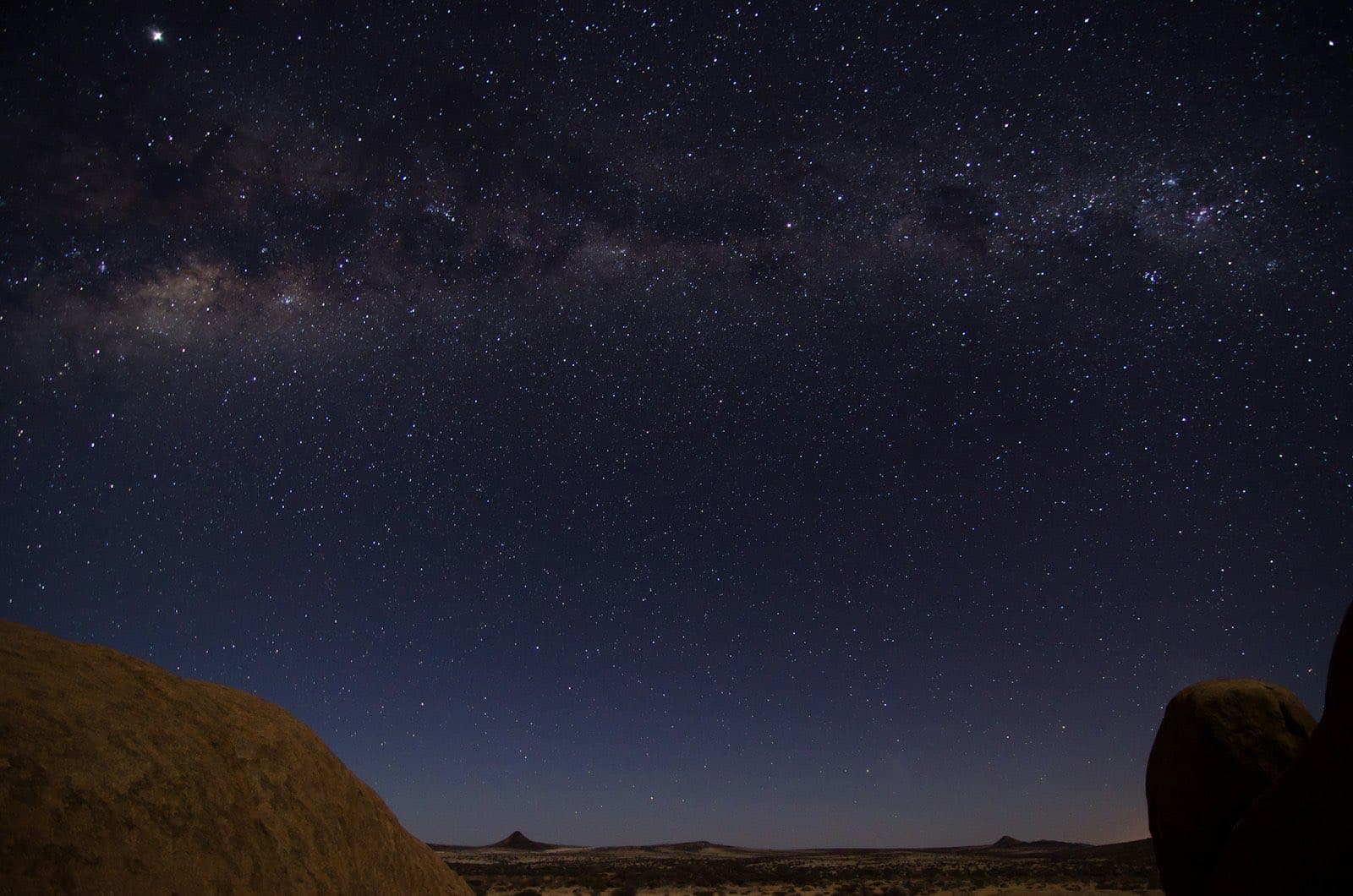
Damaraland has beautiful campsites along the dry rivers or backed against the rocks, often run with local communities: widely spaced pitches, simple ablutions, unforgettable starry nights (€15-25 per person).
Lodges of character
The region concentrates some of the country's most spectacular lodges, set into the red rocks (€150 to €400 and well beyond). Many include desert-elephant outings or offer them as extras.
Driving advice
- The C39, C35 and local D tracks are slower than the southern gravel: dips, rocky stretches, sandy riverbeds. Plan on an average of 50-60 km/h.
- Fill up at Uis or Khorixas: stations are rare and sometimes dry — never drop below half a tank in this region.
- In sandy riverbeds, keep moving and watch for fresh elephant tracks; never wild-camp in a riverbed.
- Mobile coverage is very patchy: tell your accommodation your estimated arrival time.
Distances to neighbouring stops
| To | Distance | Driving time | Road |
|---|---|---|---|
| Swakopmund | 290 km | 4 h | C35 via Uis then coastal C34, gravel then salt |
| Spitzkoppe | 200 km | 2 h 30 – 3 h | C35 via Uis then D1918/D3716, gravel |
| Etosha (Okaukuejo) | 330 km | 4 h 30 | C39 via Khorixas then C40/C38 via Outjo, gravel then tar |
| Cape Cross | 220 km | 3 h | C35 towards Henties Bay then C34, gravel then salt road |
This stop in our itineraries
These stops link together in our three day-by-day circuits:
Our flagship guide — €44
Plan this trip without leaving anything to chance
The “Namibia on your own” guide covers this stop and everything else: renting the 4x4 without the insurance traps, 10/15/21-day itineraries day by day, the Etosha strategy, a full budget and checklists. Now available in English.
Instant download · 14-day money-back guarantee
No time to do it yourself?
A professional can take care of it: tailor-made trip, equipped 4x4 rental or a local guide. Describe your plans and, with your consent, we pass them on to partner professionals.
1. What you need
Before you go
Readers' questions about Damaraland & Twyfelfontein
Can Twyfelfontein be visited without a guide?
No: the engravings are visited only with a local guide, included in the ticket. That's a good thing — the guides spot engravings you would never see alone and explain their likely function (waterhole maps, rain rituals). Allow about an hour of easy walking.
Are the chances of seeing desert elephants real?
Yes, but nothing is guaranteed: the herds cover dozens of kilometres along the Huab and Ugab rivers. Lodge-guided outings, which share sightings by radio, offer the best odds (often above 70 % over a half-day). On your own, it's a happy lottery.
Is Damaraland feasible in a sedan?
Not recommended. The main axes (C39, C35) pass in a high-clearance car in dry weather, but the secondary tracks, riverbeds and isolation argue strongly for a 4x4 with two spare wheels. This is typically the region that justifies the 4x4 premium.
How long should you stay?
One night covers Twyfelfontein and its satellite sites; two nights add a desert-elephant outing or the Brandberg's White Lady. Solitude lovers would spend a week — it is the most frequent "favourite region" among travellers.