Northern Namibia · Stop 05
Etosha National Park
An immense white salt pan, dozens of waterholes and one of Africa's highest densities of large mammals: Etosha is the continent's only great park truly designed for self-drive safari.
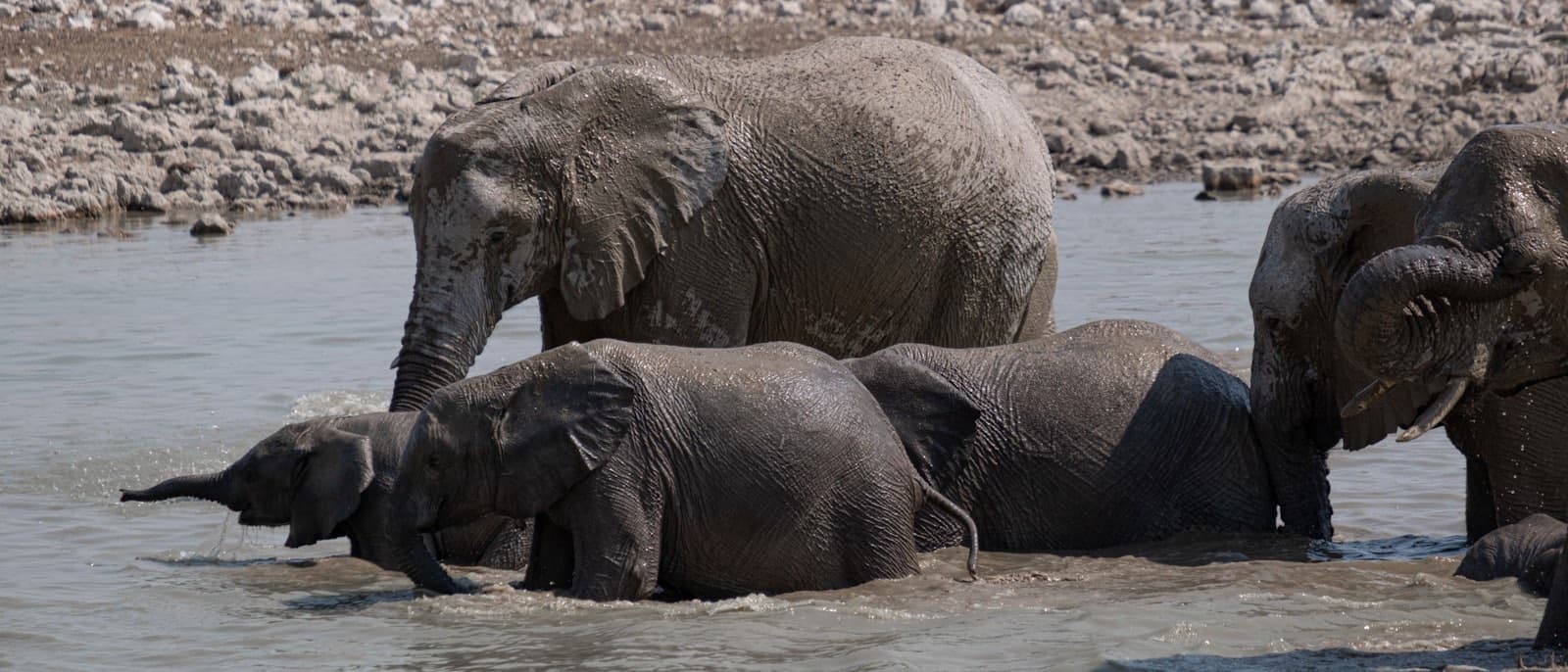
Etosha ("the great white place") is organised around a salt pan of nearly 5,000 km², the remnant of a dried lake, visible from space. All around, savanna and mopane woodland are dotted with natural and artificial waterholes: that is where the safari plays out, especially in the dry season when all wildlife converges on water.
The park's genius for self-drive: a network of flat tracks linking mapped waterholes, three historic camps (Okaukuejo, Halali, Namutoni) equipped with fuel stations, shops and above all floodlit waterholes at night, and simple rules — stay in your vehicle, respect gate hours, 60 km/h maximum.
You routinely see elephants, giraffes, zebras, springboks, oryx, wildebeest, lions — and Etosha remains one of Africa's best places for black rhino, notably at the Okaukuejo waterhole after dark. No buffalo or crocodiles; leopards and cheetahs must be earned.
What to see and do
1.Okaukuejo and its floodlit waterhole
The main camp, near the southern (Anderson) gate. Its floodlit waterhole is legendary: elephants, giraffes and, very regularly, black rhinos succeed one another at dusk. Even if you don't sleep there, a stop is mandatory; if you do, plan a vigil.
2.Halali and its surroundings
The middle camp, at the foot of one of the park's rare hills. Its waterhole below a rocky amphitheatre is famed for leopards and rhinos in the evening. The nearby waterholes (Goas, Rietfontein) rank among the park's most productive.
3.Namutoni and Fisher's Pan
To the east, a white former German fort turned camp, near the Von Lindequist gate. The sector is more wooded: good for giraffes, rock hyraxes, birds, and the pretty Klein Namutoni waterhole. The ideal base for the eastern park.
4.The pan viewpoint
A few tracks lead to the edge of the salt pan, a white immensity shimmering with mirages; in very wet years it floods and draws thousands of flamingos. The "Etosha Lookout" stop, out on the pan, is a strangely unreal moment.
5.The western waterholes (Okondeka, Nebrownii)
North of Okaukuejo, Okondeka on the pan's edge is a famed lion spot; Nebrownii, ten minutes from camp, almost always has traffic. In the dry season, 45 patient minutes at a good waterhole beat any amount of mileage.
Where to stay
By category — the guide covers how to choose and when to book.
NWR camps inside the park
Okaukuejo, Halali and Namutoni combine campsites and rooms/chalets. Comfort is simple and prices higher than outside, but sleeping in the park gives access to the floodlit waterholes at night and the first hours of the morning — an enormous advantage. Book far ahead in the dry season.
Lodges and campsites at the park gates
Around the Anderson and Von Lindequist gates, an abundant offering of lodges (€120-300) and private campsites often more comfortable than the NWR camps. The constraint: entering at gate-opening means an early start, and no nocturnal waterhole.
Relay stop at Outjo
The small town of Outjo, an hour south of Anderson Gate, serves as a logistics relay: supermarkets, bakeries, fuel stations. Handy for the last night before the park if everything else is full.
Driving advice
- 60 km/h maximum in the park, and an absolute ban on leaving the vehicle outside fenced areas (camps, signed toilets). Animals always have right of way.
- Gates and camps open and close at sun hours: arriving late at the camp gate costs a fine — keep a 45-minute margin in the evening.
- Etosha's calcrete tracks are flat but dusty and sometimes corrugated: 50-60 km/h is plenty, and it's the right speed for spotting wildlife anyway.
- Fill up in the camps (Okaukuejo, Halali and Namutoni have stations) and carry a picnic and water: you can't step out just anywhere.
Distances to neighbouring stops
| To | Distance | Driving time | Road |
|---|---|---|---|
| Damaraland / Twyfelfontein | 330 km | 4 h 30 | C38 via Outjo then C39 via Khorixas, tar then gravel |
| Waterberg | 300 km | 3 h 30 – 4 h | C38 then B1 via Otjiwarongo, mostly tar |
| Windhoek | 400 km | 4 h 30 | C38 then B1 via Otjiwarongo and Okahandja, tar |
| Caprivi Strip (Rundu) | 520 km | 6 h from Namutoni | B1 to Tsumeb then B8, tar |
This stop in our itineraries
These stops link together in our three day-by-day circuits:
Our flagship guide — €44
Plan this trip without leaving anything to chance
The “Namibia on your own” guide covers this stop and everything else: renting the 4x4 without the insurance traps, 10/15/21-day itineraries day by day, the Etosha strategy, a full budget and checklists. Now available in English.
Instant download · 14-day money-back guarantee
No time to do it yourself?
A professional can take care of it: tailor-made trip, equipped 4x4 rental or a local guide. Describe your plans and, with your consent, we pass them on to partner professionals.
1. What you need
Before you go
Readers' questions about Etosha National Park
How much does Etosha cost?
The permit is paid at the gates or at camp: on MEFT's latest official schedule (in force since 1 January 2021), 150 NAD per non-SADC foreign adult per day, plus 50 NAD per vehicle of 10 seats or fewer; new fees have been announced for 2026 and are awaiting official publication by MEFT, so check the amount at the gate. You pay for each day of presence; keep the receipt, it's checked on exit.
Do you need a 4x4 for Etosha?
No: the park's tracks are flat and passable — a sedan copes in the dry season. But a 4x4's high seating position transforms viewing comfort, and the rest of your itinerary (Damaraland, gravel) justifies it anyway. In the rains some secondary tracks close or turn muddy.
What's the best strategy for seeing animals?
In the dry season: choose two or three waterholes and stake them out from the car, engine off, 30 to 60 minutes each, early morning and late afternoon. The wildlife comes to the water, not to moving cars. Midday is for the camp — or the camp's own waterhole.
Are two nights enough?
Two nights give a good first experience (one full day + two half-days). Three nights let you cross the park west to east sleeping in two different camps — the ideal formula, which also avoids driving the same tracks twice.