From our field notes
Baja California Sur Road Trip: Gray Whales, Deserts and the Sea of Cortez
Published 28 July 2026 · updated 28 July 2026 · 8 min read
By Clément Lacaille, publisher · our method
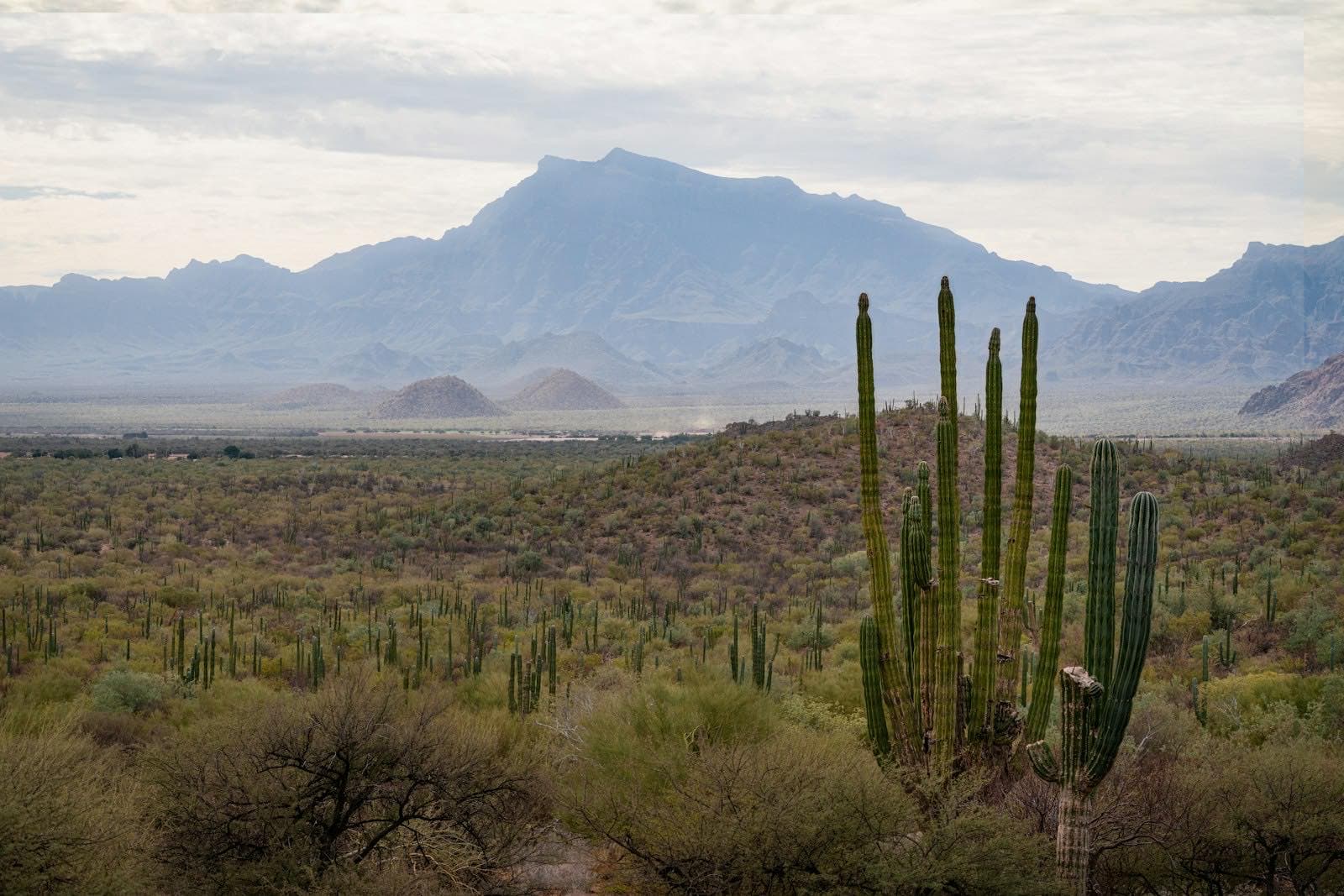
A desert peninsula wedged between the Pacific and the Sea of Cortez, lagoons where gray whales come of their own accord to rub against the boats, missionary villages and one of the best-preserved coral reefs in the eastern Pacific: Baja California Sur packs the most spectacular side of Mexico into a few hundred kilometres, all within reach of travellers in a car. The classic loop starts from La Paz or Los Cabos, on paved roads that an ordinary saloon car handles without difficulty. All that's left is to learn the local rules of the game — the narrow Mex 1, the military checkpoints, the widely spaced petrol stations — to turn this end of the world into a stress-free road trip. Here is our itinerary and our advice.
Why Baja California Sur is an ideal playground by car
Baja California Sur occupies the southern half of the long peninsula that extends American California southwards. Two international airports serve the classic loop: La Paz, the laid-back capital on the Sea of Cortez, and Los Cabos, at the southern tip of the peninsula. From either one, you can string together Todos Santos, the whale lagoons of the Pacific, Loreto and Cabo Pulmo along main roads that are paved and reasonably well maintained.
An important point for the budget: a saloon car is enough for most of the itinerary. A 4x4 only becomes useful for reaching certain remote beaches or venturing onto the tracks that head deep into the desert — an extra comfort, not a necessity. More good news: geographically cut off from the mainland, Baja California Sur is far removed from the difficult areas of continental Mexico and ranks among the most peaceful regions of the country, which makes it an excellent gateway for a first Mexican road trip.
Mex 1, the backbone of the peninsula: the golden rule
The transpeninsular highway Mex 1 links the stops on the loop and sets the pace of the trip. It is paved along the entire classic route, but remains narrow, often without a shoulder, and crosses desert expanses where livestock roams free: cows, goats and donkeys regularly wander onto the road, especially at dusk. Hence the absolute golden rule of any Baja road trip: never drive at night. Plan your stages to arrive before sunset, no exceptions.
On Mex 1 you will also come across routine military checkpoints: perfectly normal in the region, where soldiers glance over the vehicle and sometimes ask a few questions about your route. Stay courteous, keep your documents within reach, and the stop takes only a few minutes. These checks are as much a part of the local scenery as the cardón cacti — there is no reason for them to worry you.
Gray whales: the great rendezvous of the Pacific lagoons
This is THE spectacle that justifies the trip in winter all on its own. From January to March, peaking in February, gray whales come to give birth and nurse their calves in the shallow lagoons of the Pacific coast. Two major sites are reachable by car from the classic loop: Laguna San Ignacio, and Bahía Magdalena with its embarkation ports of Puerto López Mateos and Puerto San Carlos. Trips go out in a panga — the local fishing skiff — with the fishermen's cooperatives, as part of a strictly regulated activity that limits the number of boats around the animals.
The phenomenon that made these lagoons famous worldwide: the "friendly whales", females that deliberately approach the pangas, sometimes nudge their calf towards the boats and let passengers touch them. This behaviour has long been documented scientifically: the work of Steven Swartz and Mary Lou Jones, who launched the gray whale research programme at Laguna San Ignacio in the late 1970s — annual population censuses and studies of the behaviour of these whales that approach the boats — has been published in numerous scientific journals and reports since (research). Book your trip with the local cooperatives: they hold the permits, and your pesos directly fund the protection of the lagoon.
La Paz: whale sharks, Balandra and easy living
La Paz deserves far more than an overnight stop between two stages. From roughly October to April, its bay hosts whale sharks, the largest fish in the world, which you can swim alongside on supervised trips — as with the gray whales, the activity is regulated and should be booked with authorised operators. The malecón, the seafront promenade, sets the tone of the city: relaxed, family-friendly, a world away from the resort atmosphere of Los Cabos.
A few kilometres north of the city, Balandra beach spreads its shallow turquoise waters against a backdrop of desert hills: it is one of the most beautiful beaches in Mexico, and one of the essential photo stops of the road trip. Arrive early in the morning — access may be regulated at busy times — and take the opportunity to walk up to the viewpoints overlooking the bay.
Todos Santos, Loreto, Cabo Pulmo: the stops that give the loop its soul
Between La Paz and Cabo, on the Pacific coast, Todos Santos cultivates its status as an artists' town: galleries, cafés, restored colonial houses and surf beaches a few minutes from the centre. Further north on the Sea of Cortez, Loreto tells another story: its Jesuit mission, the first mission in California, founded at the end of the 17th century, made it the starting point for the colonisation of all the Californias. The waterfront facing the islands of the neighbouring marine park ranks among the finest panoramas on the peninsula.
To the southeast, Cabo Pulmo National Marine Park protects one of the oldest coral reefs in the eastern Pacific. Its story has become a textbook case in marine conservation: after the reserve was created and fishing stopped, fish biomass staged a spectacular recovery, and divers today swim among dense schools of jacks and large groupers. The final approach is on a dirt track — one of the rare stretches of the itinerary where a high-clearance vehicle brings real comfort.
| Stop | What you come for | Best time | Vehicle |
|---|---|---|---|
| La Paz and Balandra | Whale sharks, malecón, turquoise beach | Whale sharks roughly October to April | Saloon car |
| Todos Santos | Artists' town, galleries, surf beaches | Year-round | Saloon car |
| Bahía Magdalena (López Mateos, San Carlos) | Gray whales by panga | January to March, peaking in February | Saloon car |
| Laguna San Ignacio | "Friendly" gray whales | January to March, peaking in February | Saloon car; check the condition of the final access road |
| Loreto | Historic Jesuit mission, Sea of Cortez | Year-round | Saloon car |
| Cabo Pulmo | Coral reef, snorkelling, diving | Year-round, depending on sea conditions | Access track: 4x4 or high-clearance vehicle recommended |
Fuel, cash, insurance: the logistics that change everything
The desert imposes its own logistics. On some stretches of Mex 1, petrol stations are more than 100 km apart: fill up whenever the opportunity arises, without waiting for the gauge to drop. Bring a sufficient supply of cash — paying in cash remains preferable at the stations, and ATMs become scarce outside the main towns.
On the rental side, one non-negotiable point: Mexican third-party liability insurance is mandatory with a rental car, and foreign policies do not replace it. This item, sometimes presented as an option when booking online, will in every case be required at the counter — better to build it into the budget from the start. We break down how it works, and how it interacts with your credit card insurance, in our dedicated articles on renting in Mexico.
- Never drive at night on Mex 1: free-roaming livestock, narrow road with no shoulder.
- Fill up at every opportunity: more than 100 km can separate two petrol stations.
- Pay for fuel in cash where possible and keep a reserve of pesos in notes.
- Stay courteous and patient at military checkpoints: routine checks, documents within reach.
- Take out Mexican third-party liability insurance, mandatory with any rental vehicle.
Which itinerary, and how long?
The most common format is a loop from La Paz or Los Cabos: Todos Santos, La Paz, up the Sea of Cortez coast to Loreto, across to the Pacific whale lagoons in winter, then back along Mex 1. Allow plenty of time: the distances are real, the "no night driving" rule shortens the driving days, and the best moments of the trip — a whale outing that runs long, a fishing village where you linger — cannot be scheduled.
In winter, build the itinerary around the whales: a night on site at Puerto López Mateos, Puerto San Carlos or near Laguna San Ignacio lets you board the first pangas of the morning, when the light is beautiful and the water calm. Outside whale season, the southern loop — La Paz, Todos Santos, Cabo Pulmo, Balandra — is more than enough on its own and pairs well with the whale shark trips of autumn and spring.
What our guide covers
Our guide «Mexique en autonomie» devotes an entire chapter to Baja California Sur: detailed stage-by-stage itineraries, recommended cooperatives for whale trips, and a full breakdown of Mexican rental insurance. Before booking your vehicle, check two things: that Mexican third-party liability insurance is actually included in the advertised rate, and that your schedule never forces a night drive on Mex 1 — those are the two most common mistakes on a first trip to the peninsula.
Free decoder
The Mexico & Costa Rica car rental insurance decoder
TPL / seguro obligatorio no counter can remove, CDW-LDW, the deducible, the blocked deposit, comparison-site teaser rates: our decoder goes through the Mexican or Costa Rican quote line by line, with the check-out checklist and the 5 questions to ask before paying. Instant access, with the current promo code.
No time to do it yourself?
A professional can take care of it: tailor-made trip, equipped 4x4 rental or a local guide. Describe your plans and, with your consent, we pass them on to partner professionals.
1. What you need
Before you go
Readers' questions
Do you need a 4x4 for a road trip in Baja California Sur?
No, a saloon car is enough for most of the classic loop: the main roads, including Mex 1, are paved. A 4x4 only adds real value for certain remote beaches, the desert tracks and the final approach to Cabo Pulmo.
When can you see gray whales in Baja California?
From January to March, peaking in February, in the lagoons of the Pacific coast: Laguna San Ignacio and Bahía Magdalena (Puerto López Mateos, Puerto San Carlos). Trips go out by panga with the local cooperatives, as part of a regulated activity.
Is Baja California Sur safe for a road trip?
Geographically cut off from the mainland, Baja California Sur is far removed from the difficult areas of continental Mexico and ranks among the most peaceful regions of the country. The military checkpoints on Mex 1 are routine checks: stay courteous and the stop takes only a few minutes.
Can you drive at night on Mex 1?
It is strongly discouraged — it is in fact the golden rule of travel on the peninsula. The road is narrow, often without a shoulder, and livestock roams freely on the carriageway. Plan all your stages to arrive before sunset.