From our field notes
Driving Botswana in the wet season: what becomes impassable, what becomes magnificent
Published 26 August 2026 · updated 26 August 2026 · 8 min read
By Clément Lacaille, publisher · our method
Plenty of travellers stumble into Botswana's green season by accident: it was cheaper, and there was still space at Third Bridge. Then they spend four hours digging in a black paste that clings to the tyres. The wet season doesn't make Botswana inaccessible — it makes it selective. Some areas become the finest they will be all year; others shut down completely. Here is what the rain actually changes for a self-drive trip: passability, closures, kit, rental small print, and how to tell whether it suits you.
The real rainfall calendar: thunderstorms, not a monsoon
Botswana's wet season runs roughly from November to March, with a tail that sometimes spills into April. It is not continuous rain: most of it falls as convective thunderstorms in the late afternoon or overnight — violent, spectacular, and usually over within an hour or two. A typical January day means a dry, easy-driving morning, then a sky that turns black around 3 p.m. By African standards the volumes are modest: Maun averages around 550 mm a year, Kasane and the north-east about 700 mm, while the south-western Kalahari gets under 250 mm. January is the wettest month, roughly 150 mm in Maun.
What matters to a driver is not the average but the variability. The same calendar dates can hand you a dusty track one year and a quagmire the next; the first rains sometimes arrive in mid-November, sometimes only in late December. An itinerary pinned to the day six months in advance will not survive that lottery. Build in slack and fallback stops rather than a timetable.
One final point, and it is the one people get wrong: rain and flood are not the same thing here. The rain hitting your windscreen is local. The water that swells the Okavango Delta comes from the Angolan highlands and takes months to travel down: it reaches the Panhandle around April and the far reaches of the delta in June or July, by which time not a drop is falling locally. Driving in the wet season is therefore not driving "during the flood" — the two events are a good six months apart.
Black cotton soil, water crossings and ruts: what really stops you
Start with the good news: much of Botswana sits on Kalahari sand, which drains remarkably well. A soaked sandy track is often easier to drive than a dry one, because compacted sand carries better. The trap lies elsewhere — in the clay depressions, the notorious black cotton soil of old floodplains. Dry, it sets like concrete and holds deep, axle-jarring ruts. Wet, it turns into a greasy paste that sticks to the tyres, packs the tread solid within three metres and kills traction outright. A loaded 4x4 can settle onto its diffs with no warning at all.
The problem areas are well known to regulars: the ground around Xakanaxa and Third Bridge in Moremi, the Savuti Marsh, and the fringes of the Makgadikgadi pans. Add to that the water crossings and seasonal rivers. A dry crossing on the way out can be running on the way back after one night-time storm, and Moremi's log bridges — demanding even in the dry season — are sometimes half submerged. On Savuti, the ruts carved by bogged-down vehicles then bake hard and leave the track punishing for months.
Translate all of this into journey times and keep it simple: double them. From Mababe Gate to Savuti, the Sand Ridge Road covers 65 km and already takes 3 to 4 hours in the dry, through deep sand. In January, with detours around standing water and two recoveries, the same leg can eat an entire day. In the wet season you plan in driving hours, never in kilometres.
Area by area: where it works and where it doesn't
There is no single "Botswana in the rain" — different ground reacts in opposite ways to the same downpour. The table below summarises what the rain changes in the areas most used by self-drivers. Treat it as an order of magnitude: the real state of a track is confirmed at the entrance gate, on the morning itself, with the rangers.
| Area | What the rain changes | Doable self-drive? |
|---|---|---|
| Moremi (Third Bridge, Xakanaxa) | Saturated black cotton soil, submerged log bridges, unpredictable crossings | Hard; temporary closures possible |
| Savuti (Chobe) | Waterlogged marsh, muddy Marsh Road, very deep Sand Ridge Road | Possible but slow; two vehicles advised |
| Chobe riverfront and Kasane | Wettest corner of the country, slippery banks and tracks | Generally passable if you take your time |
| Makgadikgadi pans and Kubu Island | Soaked salt crust, flooded pans, bottomless mud | No: do not venture onto the pans |
| Nxai Pan and Baines' Baobabs | Sandy tracks turned muddy, Kudiakam Pan often under water | Nxai Pan yes with care; the baobabs often not |
| Central Kalahari (Deception Valley) | Free-draining sand, filled pans, best wildlife of the year | Yes, this is the season — but full self-sufficiency required |
Closures: nobody publishes a calendar
There is no official schedule of seasonal closures in Botswana, and that matters when you are building an itinerary. The Department of Wildlife and National Parks (DWNP) closes sections case by case, when they become dangerous or when vehicle traffic would wreck the track for good. The public campsites inside the parks, meanwhile, are run by private concessionaires who can suspend bookings on their own account. That leaves you with two parties to ask — and neither commits months ahead.
The most recent episode illustrates the principle neatly: in early 2026, prolonged rains led to road access being suspended to parts of Moremi, with reopening pushed back several times. This is neither rare nor predictable. The method that works: email the campsite operator two to three weeks before, reconfirm the day before, ask at the gate which route is open that morning, and keep a fallback that doesn't require a committing crossing. Park fees and access rules change regularly, so check them with the DWNP before you leave rather than on a dated blog post.
What the rain gives, and what it takes away
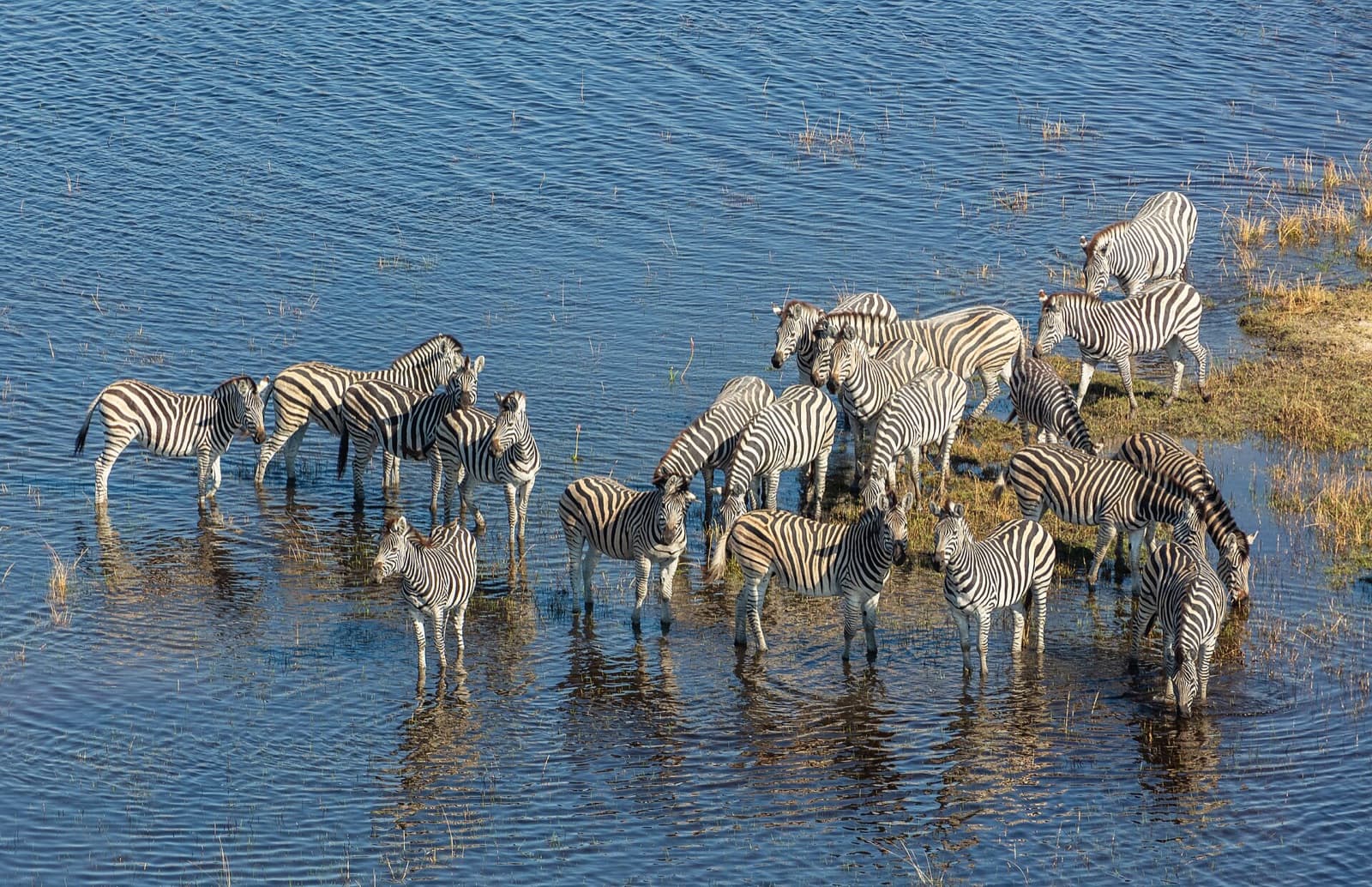
The bright side is genuine. The rains trigger calving in most herbivores: impala, wildebeest and springbok drop young en masse between November and January, and the predators follow — this is the period with the most action. Africa's longest land migration happens at the same time: zebra leave the delta fringes after the first rains for the grasslands of Nxai Pan and the Makgadikgadi, where they spend December, January and February. Add the return of the migrant birds, saturated green everywhere, storm skies you simply cannot photograph in July, and rental and accommodation rates that are markedly lower.
A study by H. L. A. Bartlam-Brooks, M. C. Bonyongo and S. Harris, published in 2011 in the journal Oryx, tracked GPS-collared zebra on the fringes of the Okavango Delta and documented a 588 km round trip to the Makgadikgadi grasslands, starting in November right after the first rains and completed by around May. In other words, the spectacle doesn't start on a fixed date: it follows the rain, exactly as your itinerary will have to.
The trade-off is just as real, and it is the part the brochures skip. Water is everywhere: seasonal pools, filled pans, puddles in every hollow. Animals no longer depend on permanent waterholes, so the old tactic of parking by the river and waiting stops working. At the same time the grass grows to bonnet height and the bush closes in on the tracks: a leopard fifteen metres away becomes invisible. You see fewer animals, and you see them less clearly — but the ones you do see are often doing something.
Kit and driving technique: the list that changes everything
The dry-season kit is not enough. On black cotton soil it is not power that gets a vehicle out, it is preparation and patience. Two non-negotiable rules before you even talk equipment: never enter a water crossing without walking it first with a stick, and never cross a black cotton section on your own if you can avoid it.
- All-terrain tyres in good condition: in sticky mud the tread packs solid within a few metres, and a worn tyre stands no chance at all.
- A pressure gauge and a compressor: air down in deep sand (roughly 1.2 to 1.4 bar), but only slightly in mud with a firm base, where near-road pressure gives better bite.
- Two recovery boards, a proper shovel and gloves: this is what gets you out nine times in ten.
- A kinetic recovery rope with shackles and rated recovery points — useless without a second vehicle.
- A winch if the vehicle has one, plus something to anchor it to: a tree strap or a ground anchor, because a pan offers no fixed point whatsoever.
- Two vehicles in convoy across black cotton areas: Moremi, the Savuti Marsh, the edges of the Makgadikgadi.
- Communications independent of the mobile network: VHF between vehicles, plus a beacon or satellite phone for emergencies.
- A tarp and long pegs: in a storm a roof tent catches the wind broadside, so park nose into the wind and fold the awning away before dark.
- DEET repellent, a spare mosquito net and long clothing for dusk.
- A way to dry things: nothing dries in the wet season, so pack double the technical clothing rather than cotton.
Mosquitoes, malaria and the rental small print
Northern Botswana — the Okavango Delta, Chobe, Kasane, Ngamiland — is a malaria transmission zone, and the wet season is the highest-risk period of the year. The mechanism is straightforward: rain creates breeding sites, and cases follow with a lag of about a month. A study by E. Chirebvu, M. J. Chimbari, B. N. Ngwenya and B. Sartorius, published in 2016 in PLoS ONE and based on Tubu village in the Okavango Delta, measured exactly that: a clear correlation between rainfall and clinical malaria cases at a one-month lag (r = 0.417). Talk to a doctor about prophylaxis at least a month before departure.
On the rental side, read the exclusions before you sign. Almost every southern African 4x4 hire company excludes water damage: river crossings, flooded pans, deep puddles, submersion, hydrolocked engines. None of it is covered by any package, even with the excess bought down to zero. Check the scope of roadside assistance too: in several contracts, recovery from a national park and extraction of a bogged vehicle remain the renter's responsibility — and a tow truck coming up from Maun to Savuti is expensive. Ask in writing at the booking stage, not at the counter on collection day.
The verdict: who the green season actually suits
Botswana's wet season is not a discount season, but it is not for everyone either. It suits you if you have already driven a 4x4 in difficult terrain, if you are travelling in two vehicles or accept restricting yourself to sandy areas, if your priority is photography, birds, young animals and predators rather than ticking off a species list, and if your schedule can absorb losing a whole day to a recovery without the rest of the trip collapsing.
It does not suit a first safari, a short and tightly timed trip, a group determined to see the Big Five, or anyone planning to reach Kubu Island or cross the pans. There is an honest compromise, though: aim for the shoulders — late November and early December, before the ground saturates, or late March and April, when things are drying out but everything is still green and rates haven't climbed back. That is where the green season gives its best without demanding an expedition convoy.
Travel tips
Get our independent-travel tips by email
The house methods — costed budgets, driving, itineraries — straight to your inbox. Instant bonus: our free excerpt “The 7 mistakes to avoid on a first Namibia road trip” and the current promo code.
No time to do it yourself?
A professional can take care of it: tailor-made trip, equipped 4x4 rental or a local guide. Describe your plans and, with your consent, we pass them on to partner professionals.
1. What you need
Before you go
Readers' questions
Can you self-drive in Botswana during the wet season?
Yes, but not everywhere and not as casually as in July. The Central Kalahari, Nxai Pan and the Chobe riverfront stay accessible with care. Moremi and Savuti become a gamble, and the Makgadikgadi pans are simply off-limits. The rules: two vehicles across black cotton areas, slack in the schedule, and track conditions checked at the gate on the morning itself.
Which is the wettest month in Botswana?
January, with roughly 150 mm in Maun. The north-east around Kasane is the wettest part of the country at about 700 mm a year, against roughly 550 mm in Maun and under 250 mm in the south-western Kalahari. Rain falls mainly as late-afternoon or overnight thunderstorms rather than full days of drizzle.
Is Kubu Island accessible in the rainy season?
In practice, no. The Makgadikgadi salt crust softens and the pans fill with water: the island cannot be reached without crossing water and bottomless mud, and a vehicle that breaks through the crust can sit there for days. Access usually returns from April, sometimes only in May. Confirm with the campsite operator before committing.
Do Botswana's parks close during the rainy season?
The parks stay open, but tracks, campsites and sometimes whole sections become inaccessible or are temporarily closed by the DWNP after heavy rain. There is no calendar published in advance — decisions are made case by case. Email the campsite operator before departure, reconfirm the day before, and keep a fallback route in mind.
Do I need malaria prophylaxis for a wet-season road trip in Botswana?
The north of the country is a transmission zone and the wet season is the highest-risk period. Prophylaxis should be discussed with a doctor based on your route, trip length and medical history; it does not replace bite prevention (repellent, long clothing at dusk, a net). Book that consultation at least a month before you leave.
Is the wet season cheaper in Botswana?
Yes for 4x4 hire and accommodation: low-season rates are well below July and August levels, and park campsites are far easier to book, sometimes only weeks ahead. Park entry fees, however, do not vary by season and are revised periodically, so check them with the DWNP before departure.