From our field notes
Fuel in Namibia: where and when to fill up so you never run dry on the tracks
Published 17 July 2026 · updated 17 July 2026 · 8 min read
By Clément Lacaille, publisher · our method
On Namibia's tarred roads, fuel is never a problem. On some tracks in Kaokoland or along the Skeleton Coast, though, the question "where will I fill up next?" needs answering before departure, not once the gauge drops below a quarter. Here's where fuel supply is guaranteed, where it isn't, and how to plan your fill-ups without thinking about it at every stop.
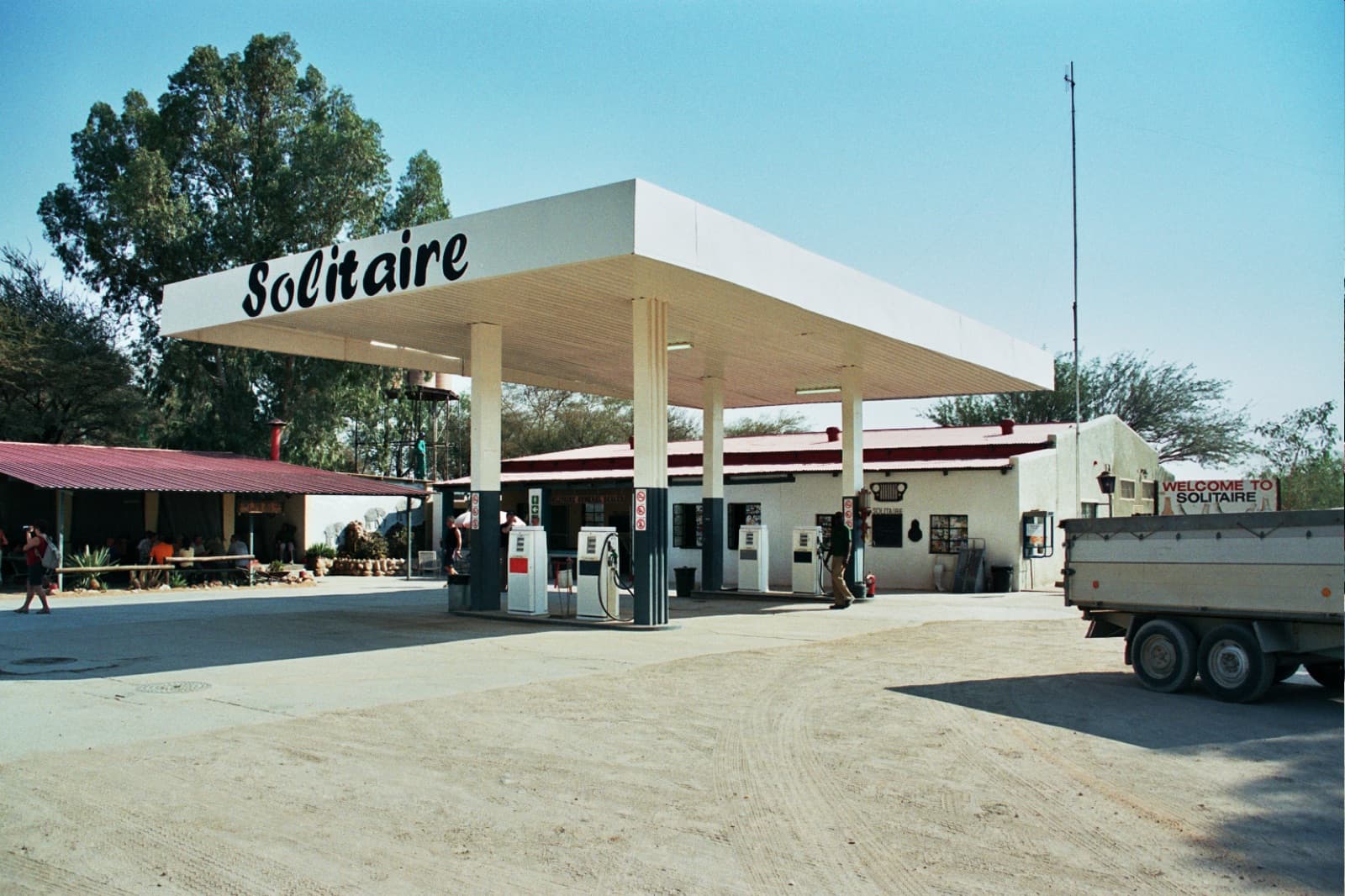
A country where fuel is a logistics question, not a comfort one
Namibia is vast — twice the size of France for under three million people — and its network of filling stations follows population density, not tourist traffic. On the main route (Windhoek, Swakopmund, Walvis Bay, Otjiwarongo, Outjo, Tsumeb, Keetmanshoop, Mariental), stations are frequent, open late, and take cards without any trouble. So the topic barely comes up for a trip that stays on the main tarred roads and the classic park gates.
It changes shape the moment your route heads into Kaokoland, along the Skeleton Coast north of Henties Bay, or on certain loops through the Caprivi Strip: there, stations can be counted on one hand, supply isn't guaranteed, and running dry 150 km from the nearest track isn't a forum anecdote — it's a real risk worth planning around.
The areas where filling up becomes a strategic call
Three regions account for most of the legitimate worry among self-drive travellers. The table below sums up where to take your last reliable fill-up before committing, and what to keep in mind.
| Area | Last reliable fill-up | What to watch for |
|---|---|---|
| Kaokoland (towards Opuwo, Sesfontein, Purros) | Sesfontein or Palmwag | Irregular supply beyond this point, up to 400 km with no guarantee; no cards accepted, carry cash and a jerry can |
| Skeleton Coast Park (Torra Bay, Terrace Bay) | Henties Bay | Torra Bay's station only opens in December-January; Terrace Bay's isn't reliable year-round — fill up before entering the park, no exceptions |
| Caprivi Strip / Zambezi route | Rundu or Divundu | Stations exist along the B8 up to Katima Mulilo, but spaced tens to a hundred kilometres apart: don't let the tank drop below half |
The jerry can: when you actually need one
On a classic circuit — Sossusvlei, Swakopmund, Damaraland, Etosha, back to Windhoek — a jerry can isn't essential: distances between reliable stations stay reasonable. It becomes one the moment your route includes deep Kaokoland (beyond Opuwo), the more remote Skeleton Coast tracks, or a Damaraland loop that avoids the main roads.
Most equipped 4x4 rental companies offer one or two metal jerry cans mounted on the roof or rear bumper, usually optional or included depending on the equipment tier — check this at booking rather than at the counter. Plan for a 20 to 40 litre reserve to secure an isolated leg, keeping in mind that driving on deep sand can push consumption up 20 to 40% compared with tarmac: a fill-up that looked generous on paper can shrink fast once the tyres are deflated in the dunes.
Cash or card: what an isolated station actually accepts
On the main roads and in the larger towns, cards are accepted almost everywhere, fuel included. That stops being true the moment you head off the beaten track: Kaokoland's stations and informal fuel points run on cash only, in Namibian dollars (NAD). Keep a few hundred NAD on hand as soon as your route leaves the tarred roads — the same logic applies to community campsites, which often don't take cards either.
Fuel prices in 2026: what to know before budgeting
Petrol and diesel prices are regulated by the Namibian government and reviewed monthly by the Ministry of Mines and Energy, which makes them more predictable than elsewhere — but not fixed: through 2026 they've swung noticeably month to month, roughly between N$20 and N$28 per litre depending on the fuel and the period. Diesel, pricier per litre in some months, remains the default choice for most equipped 4x4 rentals thanks to its wider availability on remote tracks.
For a reliable budget on the date of your departure, check the current rate on NAMCOR's website (the national oil company) rather than trusting a figure from a months-old forum post. Our Budget & Prep Kit includes an adjustable fuel line for exactly this kind of variation, with consumption worked out for the vehicle you've chosen.
The fill-up checklist for every isolated leg
A few simple habits remove almost all the risk, whichever region you're driving through.
- Fill up as soon as the tank drops below half, without waiting for the reserve, once your route leaves a main road.
- Check the jerry can(s) are present and in good condition when you collect the vehicle, and fill them before entering Kaokoland or Skeleton Coast Park.
- Always carry 300 to 500 NAD in cash for stations and fuel points that don't take cards.
- Ask your accommodation or rental company the day before about the real state of isolated stations: a broken pump is known locally long before it shows up on a map.
- Never treat a station shown on an offline map as a guarantee it's working — always check a recent source.
A question to settle before choosing your vehicle, not after
Fuel range ties directly into two other decisions: the type of 4x4 (a diesel generally uses less and finds fuel more easily on remote tracks than petrol) and the route itself, which determines whether a jerry can is a comfort item or a necessity. That's why the vehicle chapter of our Namibia self-drive guide covers fuel range alongside choosing the 4x4 and the pitfalls of renting, rather than treating it as a separate topic.
Free checklist
The Namibia self-drive GPS & waypoints checklist
The full navigation kit (Tracks4Africa, offline apps, the rental GPS), the Google Maps time-correction table, the last reliable fuel stops zone by zone and the every-morning reflexes on gravel — on one printable page to keep in the 4x4. Instant access, with the current promo code.
No time to do it yourself?
A professional can take care of it: tailor-made trip, equipped 4x4 rental or a local guide. Describe your plans and, with your consent, we pass them on to partner professionals.
1. What you need
Before you go
Readers' questions
Do you really need a jerry can for a self-drive trip in Namibia?
Not for a classic circuit on the main roads (Sossusvlei, Swakopmund, Etosha). It becomes advisable, even necessary, as soon as your route includes Kaokoland beyond Opuwo, the remote Skeleton Coast tracks, or long loops off the main roads in Damaraland.
Can you pay for fuel by card in Namibia?
On the main roads and in the larger towns, yes, almost everywhere. In Kaokoland and at some informal fuel points, only cash in Namibian dollars (NAD) is accepted: keep a few hundred NAD on you as soon as you leave the tarred roads.
How much does a fill-up cost for a 4x4 in Namibia in 2026?
Prices are regulated and reviewed monthly, with noticeable swings through 2026 (roughly N$20 to N$28 per litre depending on the fuel and the period). Check the current rate on NAMCOR's website before finalising your budget rather than relying on an old figure.