From our field notes
Chobe Riverfront as a day trip from Kasane: Sedudu Gate, the river loops and the elephant tide
Published 26 August 2026 · updated 26 August 2026 · 8 min read
By Clément Lacaille, publisher · our method
From Kasane, Sedudu Gate is less than ten minutes away by road, and behind it lies the densest stretch of wildlife in Botswana: the Chobe National Park Riverfront. You do not need to camp inside the park or book a pitch six months ahead to see it — one day in a 4x4, in at opening, out before closing, is plenty. What you do need is the gate’s real opening hours, current entry fees, a sense of how far to push along the river loops and, above all, when to turn back. Here is how to plan that day.
Why the Riverfront works so well as a single day
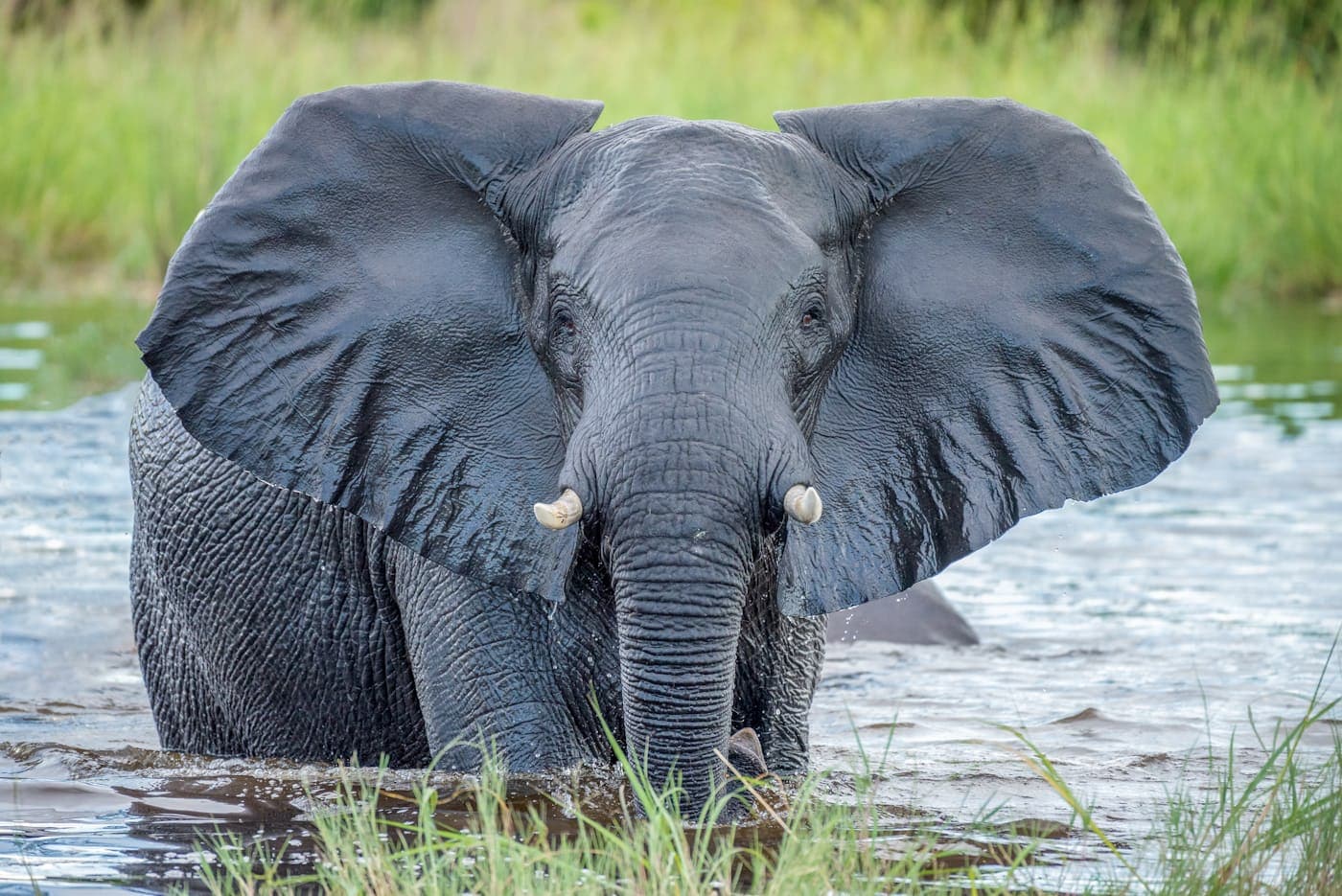
In the dry season, roughly May to October, the inland pans dry out one by one and the Chobe River becomes the only permanent water for tens of kilometres in any direction. Everything converges on it: elephant herds coming down to drink late in the day, buffalo in their hundreds on the floodplain, impala, kudu, giraffe, puku, hippo and crocodile. All of it is compressed into a narrow band — roughly forty kilometres of bank between Sedudu Gate and Ngoma Gate, only a few kilometres deep. That compression is what makes the place extraordinary: you do not go looking for animals, you drive into them.
The concentration is well documented. A study by Christina Skarpe and co-authors, published in 2004 in the journal Ambio, shows that the riverine vegetation along the Chobe has been transformed over half a century by a rapidly growing elephant population, with the acacia woodland on the alluvial terraces largely giving way to open shrubland (study: doi.org/10.1639/0044-7447(2004)033[0276:trotge]2.0.co;2). For a visitor, that opening up of the landscape has a very practical consequence: visibility from the track is excellent, you can see a long way across the floodplain, and a herd 400 m out needs no binoculars.
Add the fact that Sedudu Gate sits about ten minutes drive from central Kasane and the arithmetic is straightforward: sleep in town, leave twenty minutes before opening, and be on the first river loop while the light is still low. No camp to pitch, no pitch booked six months ahead — this is the simplest version of an independent safari in Botswana.
Sedudu Gate: hours, paperwork and entry fees
Sedudu is the park’s main gate and handles the large majority of day visitors. It sits west of Kasane on the road that follows the river, just past the last lodges. Hours follow the season: April to September the gate opens at 06:00 and closes at 18:30; October to March it opens at 05:30 and closes at 19:00. Those times frame both entry and exit — you must be through a gate before closing unless you are sleeping at a licensed campsite inside the park. Night driving inside Chobe is prohibited, with no exceptions.
At the window you fill in a register: names and nationalities of everyone in the vehicle, passport numbers, registration plate, entry time and intended exit gate. It is also how staff check that everyone has come out in the evening, so give a realistic exit time. Payment is in cash, in pula: bring the exact amount in small notes, drawn in Kasane the day before. Check the time-slot question too. A system reserving the early morning and late afternoon for licensed operators, and confining self-drivers based outside the park to a midday window, has been announced and enforced inconsistently depending on how busy the park is. Ask at the window rather than discovering the rule at the barrier.
Department of Wildlife and National Parks tariffs charge separately for people and vehicles, and are levied per calendar day. For Chobe and Moremi, expect around P270 per non-resident adult per day, roughly P205 for a resident of a SADC country, half price for children aged 8 to 17 and free below that. On the vehicle side, a 4x4 registered in Botswana — almost every rental picked up in Kasane or Maun — costs around thirty pula a day, against roughly P115 for a foreign-registered vehicle under 3.5 t. Two adults in a locally registered 4x4 therefore come to some P570 for the day, about £37 at 2026 rates. A general increase announced for 1 April 2026 was postponed after pushback from the industry, and rules change regularly, so check the official DWNP tariff before you set off.
Do you need a 4x4? Yes, and it is not negotiable
Riverfront tracks alternate between two surfaces, and both rule out a two-wheel-drive car. First, sand: along the main track that parallels the bank, and especially as you approach Ihaha, you cross ridges of deep, soft sand where a vehicle without four-wheel drive buries itself within a few metres — usually in the worst possible spot, which is the middle of a stretch full of elephants. Second, the river-edge loops, which drop onto clay terraces: after rain they turn greasy, deeply rutted and half flooded. During the rainy season some loops close to the water are simply closed or impassable.
Park regulations require a 4x4 on the tracks in any case. What the vehicle needs: proper four-wheel drive with low range, genuine ground clearance, all-terrain tyres in good condition, and the means to deflate and reinflate. Dropping to around 1.4 bar before tackling the sand ridges changes everything, provided you can pump back up before returning to tar. Carry recovery kit too: sand ladders, a shovel, a tow strap. Being stuck in sand 30 km from the gate at six in the evening is not a minor inconvenience in a park where you are not allowed out of the vehicle.
The loops: how far to go, when to turn back
The layout is simple. A tarred road, the A33, crosses the park from Sedudu to Ngoma: it serves as a transit route and can be driven without paying park fees, but leaving it for the tracks without first clearing a gate is illegal. The game driving itself happens on the sandy track that follows the bank, doubled by a series of short loops that drop to the water’s edge and climb back. Those loops are the whole point of the day: they are where elephants cross, where hippos come out to graze and where buffalo herds settle in late afternoon.
Use landmarks rather than misleading distances. The Serondela picnic site is roughly 17 km from Sedudu, and the open Puku Flats floodplain spreads out in that same sector. Ihaha campsite is about 43 km away, an hour and a quarter of driving without stopping — so considerably more at game-viewing pace. In practice, an out-and-back to Ihaha with real stops fills the day. A safe rule: note the closing time as you enter, and turn around no later than halfway through your available window, plus an hour of margin for unplanned stops and herds blocking the track.
| Sector | Time from Sedudu, game-viewing pace | Vehicle | What you see |
|---|---|---|---|
| First river loops (0 to 10 km) | 45 min to 1 h 30 one way | 4x4, moderate sand | Elephants drinking, hippo, crocodile, kingfishers |
| Serondela and Puku Flats (approx. 17 km) | 1 h 30 to 2 h 30 one way | 4x4, sand ridges | Open floodplain, buffalo, puku, impala, giraffe |
| Ihaha (approx. 43 km) | 2 h 30 to 4 h one way | 4x4 essential, deep sand and ruts | Big herds, lion, long views along the bank |
| Quick return on the tarred A33 | 45 min to 1 h | Any vehicle, transit only | Nothing: it is a link road, not a game drive |
The right window: first hour, midday lull, late afternoon
Two windows are worth the effort. The first hour after opening: the air is cold, predators are finishing their night, tracks are fresh in the sand and elephants are leaving the thickets. Then, from around 10:00 or 11:00, everything stops. Animals move into the shade, the light flattens the landscape and you can drive for two hours seeing almost nothing. That is the moment to head back to Kasane for lunch or settle at a designated picnic site. The second window opens around 15:30 and peaks in the last hour before closing, when the herds come down to drink.
A study by Uyapo J. Omphile and Jeff Powell, published in 2002 in the Journal of Range Management, counted 909 herds of large ungulates along the tourist routes of Chobe National Park over twenty-four months. It shows that observation frequency is strongly correlated with proximity to the river — floodplain grassland and alkali flats far ahead of the inland woodland — and that in the dry season all the large herbivores monitored were seen more often on the floodplain in the afternoon than in the morning (study: doi.org/10.2458/azu_jrm_v55i4_omphile). The practical translation: if you have to sacrifice one of the two drives, keep the late afternoon by the water.
The afternoon cruise: what the car never shows you
From the track you look at the bank from behind, through the bush, and part of the scene stays out of frame: the islands mid-channel, the sandbanks where crocodiles haul out, hippo pods, elephants crossing the channel in single file with trunks up like periscopes, bee-eater colonies in the earth banks. The Chobe River cruise, leaving from Kasane, typically runs three hours and works its way upstream inside the park boundary. Expect roughly US$40 to US$65 per person in 2026 depending on the boat and the package, to be confirmed with the operator.
The two do not compete, they complement each other, and the ideal day strings them together: Sedudu Gate at opening, river loops until mid-morning, out for lunch in Kasane, board in the early afternoon for the cruise, back at sunset. You pay park entry once for the day, you avoid driving sand during the dead hours, and you see the river from both sides. If you only have one full day in Kasane, this is the combination that delivers most.
Safety: distance, the herd heading for water, and staying in the car
The Riverfront is dense in large herbivores, and the main risk here is not lion but a jumpy elephant, a hippo cut off from the water and a lone buffalo in the reeds. The rules below are not comfort measures: they are what keeps a charge from happening. They are posted at the gate and repeated on the entry receipt, and traffic offences — off-road driving above all — carry fines running from a few hundred to several thousand pula, and can extend to impounding the vehicle.
- Keep at least 10 m from elephants, and considerably more from a herd with calves or a bull in musth.
- Never drive through a herd moving down to water: stop, switch off the engine and let it pass, even if that takes twenty minutes.
- Never place yourself between a hippo and the river; it is the animal that kills the most people in southern Africa.
- Treat a lone buffalo in the reeds with respect: it will not move aside and it charges without warning.
- Stay in the vehicle at all times except at signposted picnic sites and toilets.
- Observe the 40 km/h limit, 30 km/h in high-density wildlife areas, and crawl on the loops.
- No off-road driving and no shortcuts across the floodplain: tracks last for years and the fine is immediate.
- No drone without written DWNP permission, no feeding wildlife, no litter left behind.
- Note the closing time as you enter and keep a margin: being held up behind a herd 30 km from the gate is a routine occurrence.
Kasane as a base: fuel, shopping, signal, and what comes next
Kasane is a functioning service town, not a bush village. There are several filling stations — Engen, Shell, Puma — but diesel does run out, particularly when heavy trucks top up before crossing into Zimbabwe or Zambia. Fill up the evening before rather than on the morning itself, and enter the park with a full tank. For supplies, Choppies, Spar and Shoprite easily cover a day’s picnic and a full restock before a more isolated leg. Draw cash in pula for Sedudu Gate; cards are not a reliable fallback. Mobile coverage is decent in town and becomes patchy from the first loops inside the park.
Kasane is also a crossroads. The Kazungula bridge opens onto Zambia, and Victoria Falls town, on the Zimbabwean side, is about 80 km away: a quarter of an hour to the Kazungula border post, then under an hour of tar, queues excluded. Plenty of travellers pair a Riverfront day with a day at the falls. If your route instead heads south, towards Savuti and the heart of the park, that is a different trip altogether — deep sand and campsites booked well in advance — and we cover it in a separate article.
Travel tips
Get our independent-travel tips by email
The house methods — costed budgets, driving, itineraries — straight to your inbox. Instant bonus: our free excerpt “The 7 mistakes to avoid on a first Namibia road trip” and the current promo code.
No time to do it yourself?
A professional can take care of it: tailor-made trip, equipped 4x4 rental or a local guide. Describe your plans and, with your consent, we pass them on to partner professionals.
1. What you need
Before you go
Readers' questions
Can you visit the Chobe Riverfront on a day trip from Kasane without a guide?
Yes. Self-driving is permitted in the park and Sedudu Gate is less than 10 km from Kasane. You enter in the morning, work the river loops and exit before closing, without sleeping inside the park. You need a 4x4, cash in pula for the entry fees, and passport details for everyone in the vehicle to fill in the register at the gate.
Do you really need a 4x4 for the Chobe Riverfront loops?
Yes, and park regulations require one anyway. The tracks alternate between ridges of deep sand, especially towards Ihaha, and clay terraces by the water that become impassable after rain. A two-wheel-drive car has no place here: getting bogged 30 km from the gate, in a park where you cannot step out of the vehicle, turns a minor incident into a real problem.
What are the Sedudu Gate opening hours?
April to September the gate opens at 06:00 and closes at 18:30; October to March it opens at 05:30 and closes at 19:00. You must be out of the park before closing unless you are staying at a licensed campsite inside. Night driving is prohibited. Confirm the hours in force at the window the day before, as they can change.
How much does it cost to enter Chobe National Park in 2026?
On the schedule in force for Chobe and Moremi, expect around P270 per non-resident adult per day, plus the vehicle: roughly thirty pula for a Botswana-registered 4x4, or about P115 for a foreign-registered vehicle under 3.5 t. An increase announced for April 2026 was postponed, so check the official DWNP tariff before you travel.
What time of day is best for elephants on the Chobe Riverfront?
The first hour after opening, and above all the two hours before closing, when herds come down to drink. Midday is dead: animals move into the shade. A twenty-four-month study in the park found that in the dry season large herbivores were seen on the floodplain more often in the afternoon than in the morning, which matches what most self-drivers report.
Chobe river cruise or game drive by car: which should you choose?
Both, in the same day if you can. The car gives you the river loops and the inland tracks; the boat shows you the islands, crocodile sandbanks, hippo pods and elephants swimming the channel, none of which you see from the track. A three-hour cruise from Kasane costs roughly US$40 to US$65 per person in 2026.