From our field notes
Driving on the Left in Ireland: The Complete Guide to a Stress-Free Road Trip
Published 24 July 2026 · updated 24 July 2026 · 7 min read
By Clément Lacaille, publisher · our method
"I've never driven on the left, will I manage?" It's the question that comes up most before a first road trip in Ireland — and the good news, confirmed by rental companies on the ground, is that the reflex usually sets in within half a day of driving. The real risk isn't the open road but the moments of transition: pulling out of the airport car park, the first roundabout after a long flight, an empty country road where old habits slip back in unnoticed. A landmark Australian study even found that drivers from right-hand-drive countries are over-represented in crashes caused by "failing to keep left". A national licence that's valid as-is, an insurance excess worth planning for, the M50's barrier-free toll and the single-track boreens of Connemara: here's what to know before taking the wheel — on the left — for the Wild Atlantic Way.
A national EU licence is enough: no international permit needed
France and Ireland are both EU member states: a valid French driving licence is all it takes to rent and drive a car in the Republic of Ireland, with no International Driving Permit (IDP) and no translation required. The physical card has to be carried — a phone app version won't do at the counter — along with photo ID. Rental companies generally ask for a licence held for at least one or two years and a minimum age of 23 to 25 to avoid a young-driver surcharge, plus a credit card in the driver's own name for the deposit: debit cards are turned away by nearly every agency.
The same rule applies in Northern Ireland, part of the United Kingdom: a French licence remains valid without an IDP for a tourist visit, and the border with the Republic is entirely invisible on the road — no checkpoint, no crossing formality. The one thing worth checking beforehand is the rental agreement itself: some agencies charge a surcharge or require advance notice to drive into Northern Ireland, mainly for insurance reasons. A quick phone call or a line in the contract settles the question before heading up toward the Causeway Coast.
The reflex comes fast — but stay alert at these specific moments
Most travellers who've never driven on the left adjust within a few kilometres: surrounding traffic, road markings and simply following the car ahead are usually enough to correct the instinct. The danger isn't continuous driving but a handful of specific situations where the brain reverts to old habits — pulling out of a car park or petrol station (where the natural turn goes the wrong way), setting off again after a lunch stop, or driving alone on a country road with no other vehicle to use as a reference.
A landmark study by Jeffrey Wilks, Barry Watson and Ian Faulks, published in 1999 in the journal Tourism Management, analysed crashes involving international drivers in Australia — a left-hand-traffic country like Ireland. It found that visitors from right-hand-drive countries were over-represented in crashes linked to "failure to keep left" and in head-on collisions, more so than in crashes linked to speeding or alcohol (study: doi.org/10.1016/s0261-5177(99)00034-5). In practical terms, that justifies a few simple habits: a "LEFT" sticky note on the dashboard for the first few days, a passenger acting as lookout at roundabouts and car park exits, and a longer-than-usual break after the flight before taking the wheel tired.
Roundabouts, R-roads and boreens: the real challenge isn't the left-hand side
On an Irish roundabout, you give way to vehicles already on it and to traffic arriving from the right, then travel clockwise — the mirror image of a French roundabout. For one of the first two exits, stay in the left lane; beyond that, move into the right lane on approach. It's a habit that forms quickly, but it demands concentration in the first few days, especially on the large multi-lane roundabouts around Dublin, Cork or Galway.
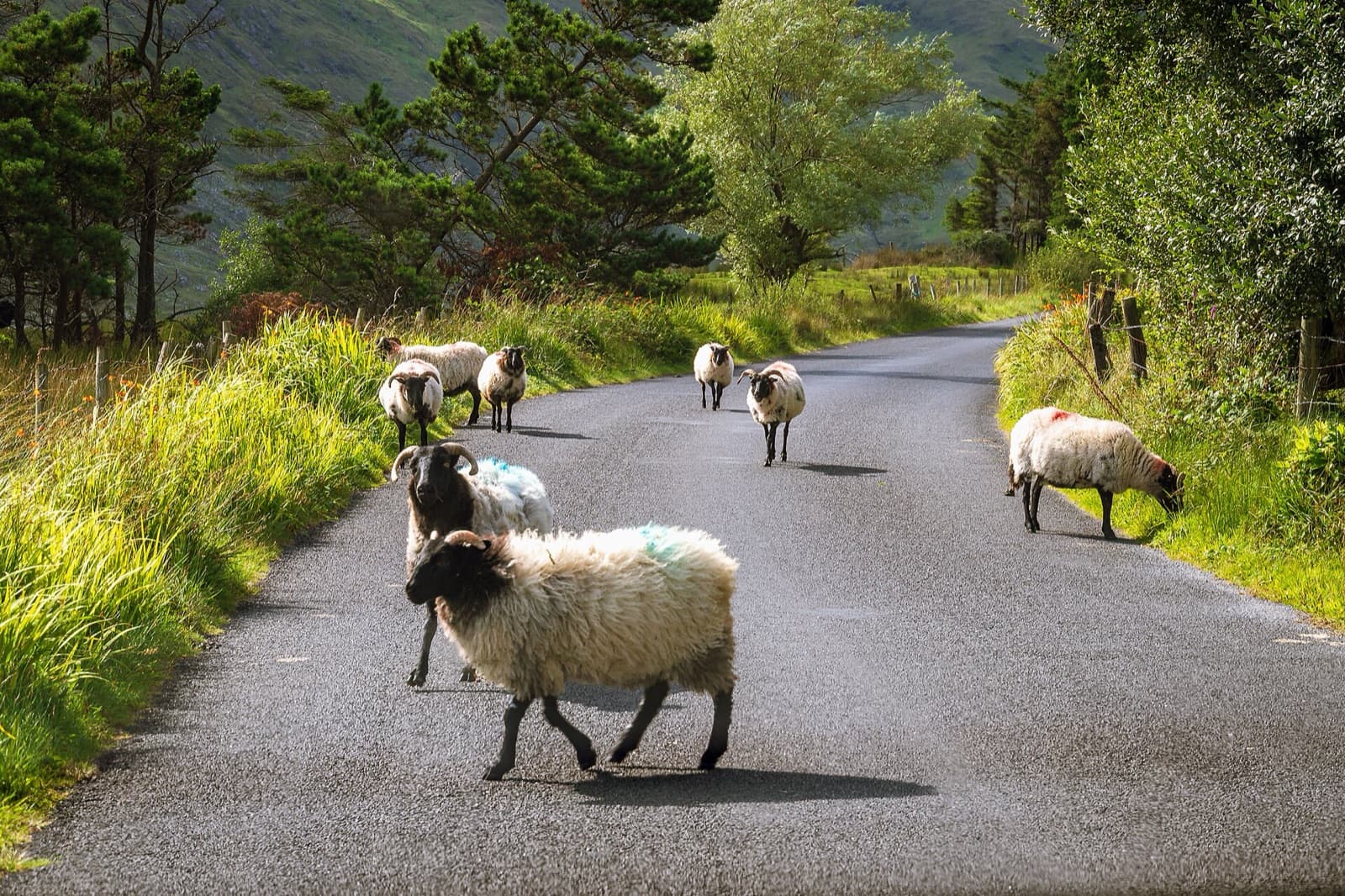
Ireland's real challenge lies elsewhere: the regional "R-roads" and, above all, the "boreens" — narrow local lanes barely wider than a car, hemmed in by dry-stone walls or fuchsia hedges, common throughout Connemara, the Dingle Peninsula and Donegal. When two cars meet on one, someone reverses or pulls into a passing place — a wave of the hand is the thank-you, not the horn. The left-hand mirror is in constant danger from the hedges: it's worth renting the smallest car available and never planning more than 150 to 200 km a day on this kind of road, a constraint that echoes, in a different form, Scotland's famous single-track roads.
Insurance and excess: what a scrape can really cost
The insurance bundled into the base rate covers third-party liability and damage, but with an excess (CDW) that catches out many first-time drivers in Ireland: expect €2,000 to €3,000 left for you to cover after any claim, even a minor one — among the highest excess figures in Europe, a reflection of how many mirrors and undersides get scraped each year on boreens and stone walls.
Two options cut that risk: full excess buy-down through the rental company ("super CDW", typically €15 to €25 a day), or an independent third-party insurance policy taken out before departure, often two to three times cheaper for equivalent cover. Before paying the surcharge at the desk, it's worth checking a premium bank card (Visa Premier, Gold Mastercard...): several include rental car insurance abroad that covers part or all of this excess, provided the rental was paid with that same card and the rental company's own buy-down was declined.
| Insurance tier | Excess after an accident | Typical surcharge | Good to know |
|---|---|---|---|
| Base cover (included in the rate) | €2,000 to €3,000 | None | Among the highest excess figures in Europe |
| Rental company buy-down ("super CDW") | €0 to €200 | +€15 to €25/day | Easy to activate, but often pricier than a third-party insurer |
| Independent third-party insurance | €0 to €200 | €3 to €8/day on average | Buy before departure; check cover for undersides and mirrors |
The M50 toll in Dublin: no barrier, pay within 24 hours
Around Dublin, the M50 is the country's only "barrier-free" toll road: no barrier, no ticket, just cameras reading the plate on the way through. Payment is then made online at eflow.ie or at a partner shop (Payzone, Circle K), before 8pm the day after the trip — miss that window and late fees stack up quickly. Expect €3.80 for a one-off payment, €3.20 with a prepaid eFlow account, or €2.60 with an electronic tag rented locally, rates updated at the start of 2026.
Many rental companies offer an automatic toll package that bills the M50 afterwards, with daily admin fees that add up fast for anyone who only crosses it once: paying it yourself on eflow.ie straight away is usually cheaper. In the south and west of the country, a handful of motorways still use classic barrier tolling — the M1 north of Dublin, the M7/M8 toward Cork, the N25 near Waterford — with cash or card paid directly at the barrier, roughly €2 to €4 depending on the stretch.
Drink-driving, speed and units: what changes between the Republic and Northern Ireland
The drink-driving limit is 50mg of alcohol per 100ml of blood for a full licence, dropping to 20mg — close to zero tolerance — for provisional/novice drivers (the first two years) and professional drivers. Random breath-test checkpoints are common, especially at night and around bank holiday weekends: the safest approach is not drinking at all before driving, given how little margin that leaves.
Another trap worth knowing before heading north: speed limits switch from the Republic's kilometres per hour (120 on motorways, 100 on national roads, 80 on regional roads, 50 in towns) to Northern Ireland's miles per hour (roughly 70, 60 and 30 mph for the equivalent categories), with no border post to flag the change — just a small "speed limits in mph" sign marking the switch. GPS units and navigation apps adjust automatically, but a car's own speedometer doesn't change units on its own — worth double-checking before crossing.
Travel tips
Get our independent-travel tips by email
The house methods — costed budgets, driving, itineraries — straight to your inbox. Instant bonus: our free excerpt “The 7 mistakes to avoid on a first Namibia road trip” and the current promo code.
No time to do it yourself?
A professional can take care of it: tailor-made trip, equipped 4x4 rental or a local guide. Describe your plans and, with your consent, we pass them on to partner professionals.
1. What you need
Before you go
Readers' questions
Do you need an international driving permit to drive in Ireland with a French licence?
No. Since France and Ireland are both EU member states, a valid French licence is enough, with no international permit and no translation required — including in Northern Ireland, which applies the same rule to European visitors.
Is the left-hand driving reflex really that easy to pick up?
For most travellers, yes: a few kilometres following the surrounding traffic are usually enough to adjust. Vigilance mainly needs to stay high at specific moments — leaving a car park, setting off again after a break, empty country roads — where instinct can take over, as shown by a landmark Australian study on international drivers.
How does the M50 toll in Dublin work?
The M50 has no barrier: cameras read the number plate, and payment is made online at eflow.ie or at a partner shop before 8pm the day after the crossing, costing between €2.60 and €3.80 depending on the payment method. Late fees apply if it isn't settled in time.
What excess applies after a scrape with a rental car in Ireland?
Base insurance usually leaves an excess of €2,000 to €3,000 on you, among the highest in Europe. A rental company buy-down (€15 to €25/day) or an independent policy taken out before departure (often cheaper) can reduce it significantly.