From our field notes
Single Track Roads in Scotland: Passing Places, Priority and the Rules Before You Get Honked At
Published 22 July 2026 · updated 22 July 2026 · 8 min read
By Clément Lacaille, publisher · our method
On the map, the road running along the loch or climbing toward Applecross looks like any other country lane. On the ground, it turns out to be one car wide, with pull-ins spaced every few hundred metres: welcome to a single track road, the most common road format across the Highlands, the Isle of Skye and the entire North Coast 500. Nothing quite prepares you for this style of driving beforehand — just a set of precise rules, and a local etiquette worth knowing before you set off.
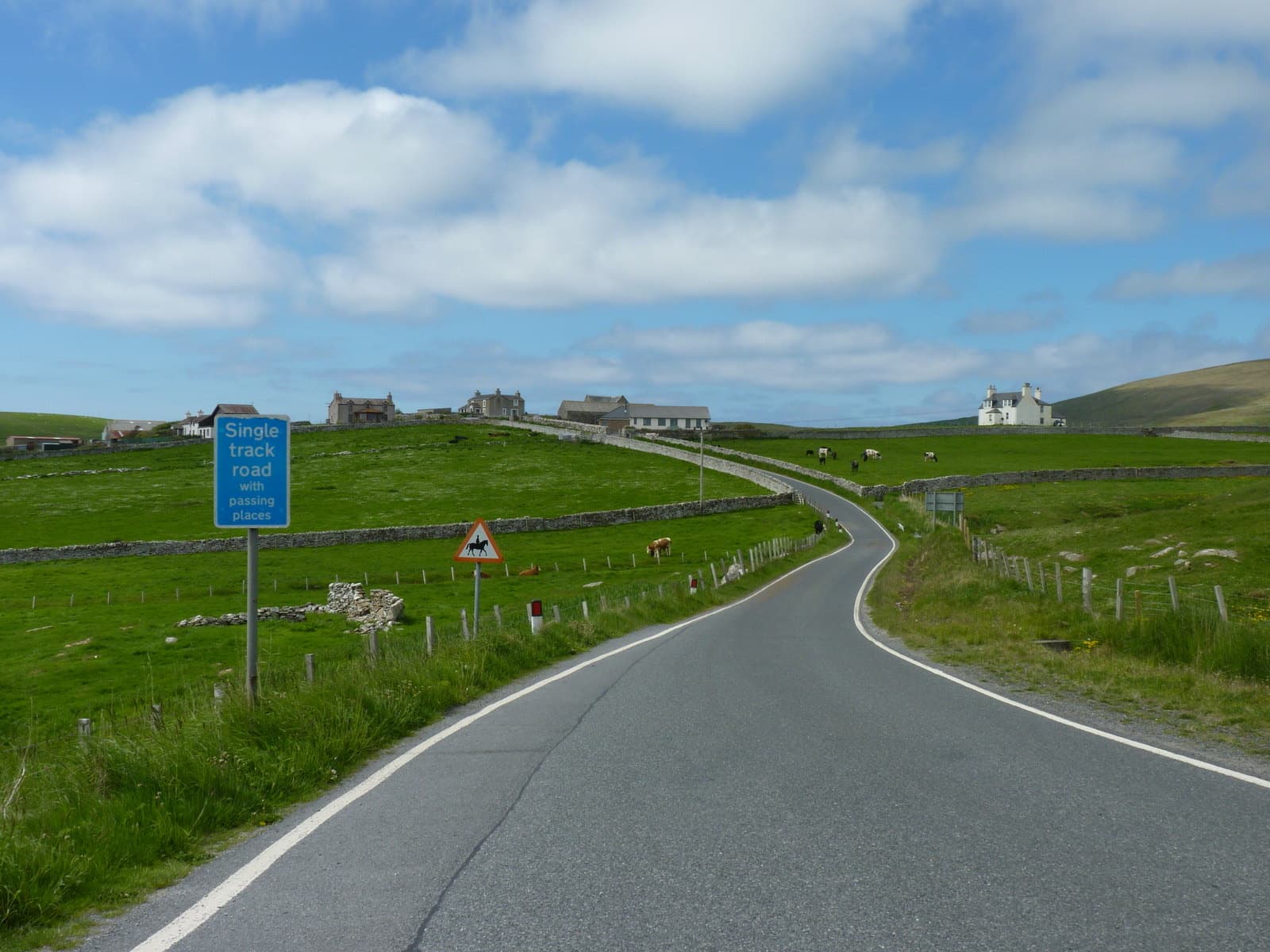
What a single track road is, and where you'll meet one
A single track road runs both ways but is only wide enough for one vehicle, punctuated by passing places — pull-ins marked by a black-and-white square sign or simple black-and-white poles at the roadside. This format dominates as soon as you leave the Highlands' main routes: almost every secondary road on the Isle of Skye, the western half of the North Coast 500 (including the Bealach na Bà pass above Applecross, the steepest road climb in Britain), the roads around Torridon, Assynt and the Outer Hebrides (Harris and Lewis) all work this way.
The most concrete consequence for a road trip: average speed collapses. Expect roughly 1.5 hours for 60 km on these stretches, about half the speed of a normal road — a ratio worth building into your itinerary from the start, or you'll routinely arrive late at the B&B or the ferry.
The two official Highway Code rules
The UK Highway Code covers these roads precisely in two rules, which apply across the country but are especially enforced in Scotland. Rule 155 sets out what to do when meeting or being overtaken: if a vehicle is coming towards you, or the one behind wants to pass, pull into a passing place on your left, or stop opposite one on your right to let it through. Priority goes to the vehicle travelling uphill wherever the road climbs — it's easier to reverse downhill than uphill. If no passing place is in sight in time, reverse to the last one rather than forcing your way through.
Rule 156 is shorter but just as serious: never park in a passing place, not even for two minutes to take a photo. These pull-ins are sometimes the only place to pass for kilometres, and a badly parked car can block an ambulance, a farm vehicle or a school bus just as easily as a tourist.
The local etiquette, unwritten but universally observed
Beyond the official rules, a handful of local habits avoid a lot of friction. A wave of thanks to whoever pulled in is close to mandatory — skipping it reads as noticeably rude in the Highlands. A local vehicle clearly in a hurry (a delivery van, a tractor, the post) should be able to pass or overtake without waiting: pulling in early and generously prevents a single vehicle from causing a queue. And sheep cross or stand on the road without warning, including on blind bends — speed needs to stay moderate even on clear stretches.
Traffic on the North Coast 500 has boomed
Since its launch in 2015, the North Coast 500 has turned once-quiet roads into a major tourist route, with direct consequences for safety. A study by Andy Ruck focused on the NC500 case, published in 2020 in the edited volume Overtourism: Causes, Implications and Solutions (Palgrave Macmillan), documents accelerated deterioration of road surfaces and verges alongside 'poor or inexperienced' driver behaviour among many visitors, particularly on the single tracks of the west coast (study available online: doi.org/10.1007/978-3-030-42458-9_13).
In practice, that means queues of vehicles refusing to pull in, risky overtaking on the rare two-lane stretches, and mounting pressure on viewpoint car parks. Driving slowly, pulling in without hesitation and accepting being overtaken by a local isn't just politeness — it's what keeps these roads usable for everyone, residents included.
Renting a car in Scotland: left-hand driving and excess
For a French driver, the first adjustment is still driving on the left, combined with the narrowness of single track roads: it's worth allowing half a day to get used to it on a wider road before tackling the trickiest stretches (Bealach na Bà, the Assynt roads). On the rental side, the thresholds are close to the rest of the UK: minimum age generally set at 21 (23-25 for some categories, notably SUVs and premium vehicles), a licence held for at least a year, and a young-driver surcharge of around £25 a day (roughly €29) under 25.
| Item | What to expect |
|---|---|
| Standard excess (city car/sedan) | £800 to over £2,000 depending on the rental company and category |
| 'Full coverage' / reduced-excess option | Brings the excess down to £0 or close to it, for a daily surcharge |
| Minimum age | 21 generally, 23-25 for SUVs and premium categories |
| Licence seniority required | At least 1 year, proof sometimes requested |
| Young-driver surcharge (under 25) | Around £25/day (≈ €29/day) |
A French licence is enough, no international permit needed
Good news for a Scottish road trip: a valid French driving licence can be used as-is for a tourist visit, with no translation and no International Driving Permit to apply for. The UK still accepts licences issued by an EU member state until their expiry date for a visitor, a provision that survived Brexit. Only switching to resident status changes things — a case that doesn't apply to a stay of a few weeks.
What our guide covers
The 'Self-Drive Scotland' guide breaks down, region by region, the single track stretches to plan for on the North Coast 500, the Isle of Skye or the Outer Hebrides, with a realistic driving schedule so no leg of the trip turns into a race against the clock.
Travel tips
Get our independent-travel tips by email
The house methods — costed budgets, driving, itineraries — straight to your inbox. Instant bonus: our free excerpt “The 7 mistakes to avoid on a first Namibia road trip” and the current promo code.
No time to do it yourself?
A professional can take care of it: tailor-made trip, equipped 4x4 rental or a local guide. Describe your plans and, with your consent, we pass them on to partner professionals.
1. What you need
Before you go
Readers' questions
What if no vehicle pulls in on a Scottish single track road?
Priority goes to the vehicle travelling uphill wherever the road climbs. If you're heading downhill or no passing place is visible ahead, reverse to the last one rather than forcing your way through: that's Rule 155 of the UK Highway Code.
Can you park in a passing place to take a photo?
No, never, not even for a few minutes: Rule 156 of the Highway Code strictly forbids it, since these pull-ins need to stay available at all times for vehicles to pass, including emergency and farm vehicles.
Do you need an International Driving Permit to drive in Scotland on a French licence?
No: a valid French licence, issued by an EU member state, remains valid for a tourist stay in the UK until its expiry date, with no translation and no international permit required.