From our field notes
Driving Namibia's gravel roads: the essential safety guide
Published 17 July 2026 · updated 17 July 2026 · 9 min read
By Clément Lacaille, publisher · our method
In Namibia, it isn't crime that threatens the independent traveller — it's the road itself. Local rental companies have said it for years: almost every accident involving tourists in a rented 4x4 is a single-vehicle rollover on gravel, with no collision and no animal involved. The good news: this risk is almost entirely manageable with a handful of driving habits. Here they are.
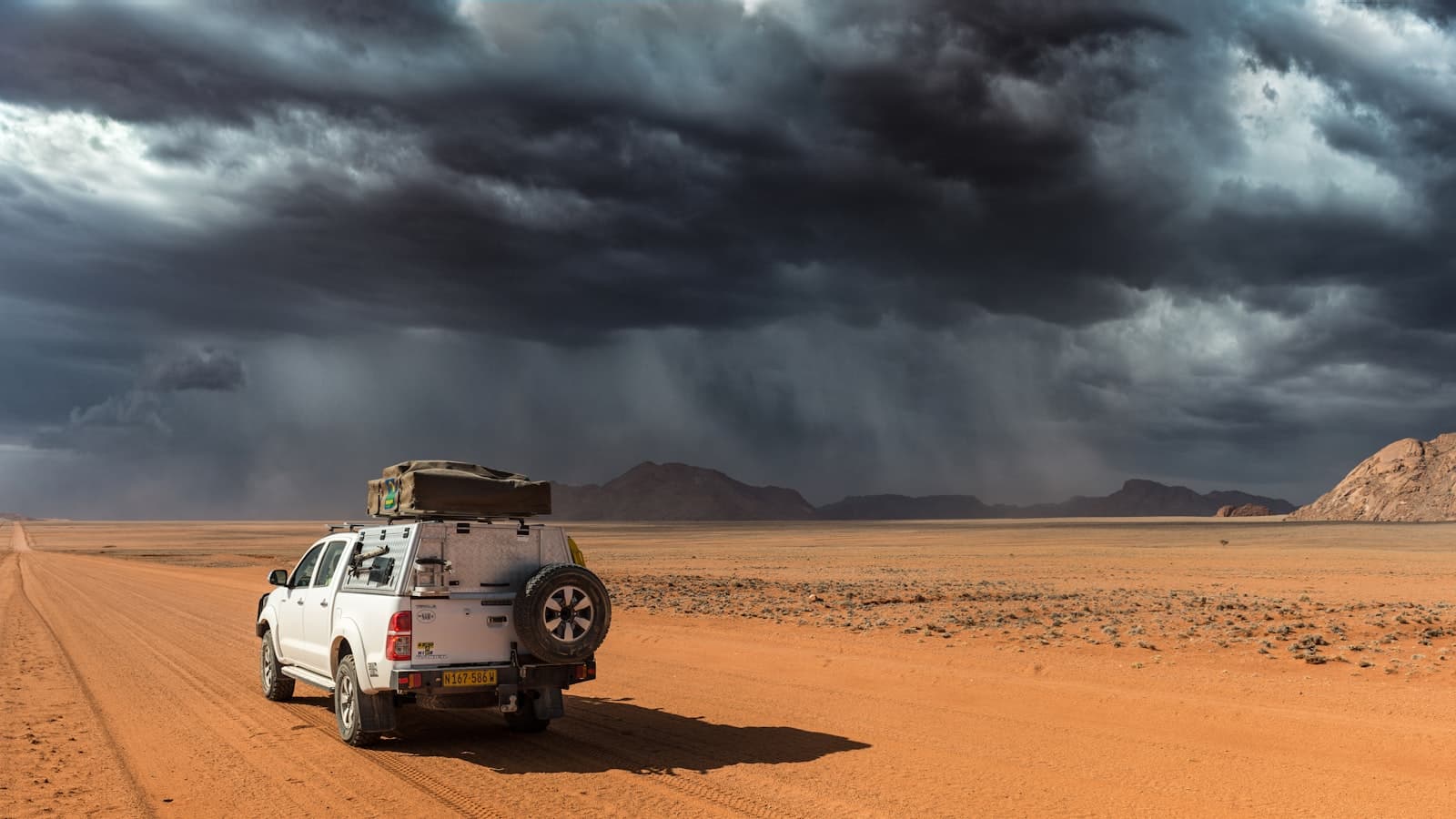
The real Namibian risk: the road, not crime
It's a figure every Namibian 4x4 rental company knows by heart: roughly one self-drive tourist in ten experiences some kind of road incident during their trip, from a flat tyre to a full rollover. And among the accidents recorded by the big rental agencies' insurers, more than nine in ten are so-called 'single-vehicle' accidents — no collision with another car, no animal struck, just a loss of control on gravel, most often linked to excessive speed or heavy braking mid-corner.
The country also has a road fatality rate well above European standards, with several hundred deaths on the roads every year in a population of under three million. That's not a reason to skip self-drive — tens of thousands of travellers do it every year without incident — but it is a reason to take the gravel seriously from kilometre one, including on the stretches that look the easiest.
Legal limit vs safe speed: the two numbers to remember
Namibia runs on three simple legal limits: 60 km/h in towns, 100 km/h on gravel roads outside built-up areas, and 120 km/h on tar. The trap is that this 100 km/h legal limit on gravel was never designed as a safe speed — it's a regulatory ceiling, not a recommendation. Rental companies, guides and insurers all agree: above 80 km/h on gravel, your margin for the unexpected (a pothole, a patch of sand, an animal) becomes too thin.
Another point most travellers miss: an accident that happens above the speed an insurer considers reasonable can void your cover, reduced excess or not — see our article on the traps of renting a 4x4. Keeping to 80 km/h maximum on gravel isn't just personal caution, then; it's also an unwritten condition of your insurance.
| Road type | Legal limit | Recommended speed |
|---|---|---|
| Towns and village outskirts | 60 km/h | 60 km/h or less (pedestrians, livestock) |
| Gravel roads outside towns | 100 km/h | 80 km/h max, less on corrugations or in poor visibility |
| Tar roads | 120 km/h | 120 km/h by day; slow down sharply at dusk (wildlife risk) |
Corrugations, corners, sand: gravel's classic traps
Corrugations — the regular ripples that build up on well-used gravel roads — are the first trap: too slow, and they shake and tire you out; too fast, and the wheels start skipping from ridge to ridge and lose grip. Each stretch has its own relatively comfortable speed, usually around 60-70 km/h, best found gradually rather than guessed upfront.
A gravel corner is handled before it, never during it: brake in a straight line, ease off the accelerator ahead of the bend, then take it gently, with no sudden input on the wheel or the brake. Braking hard mid-corner — a natural reflex when something unexpected happens — remains the number one cause of spin-outs.
Loose sand patches, common right after a stretch of compact gravel, catch drivers out with a sudden change in grip: keep a firm hand on the wheel, avoid any hard braking, and let the vehicle cross the patch at a steady speed rather than slowing down inside it. Finally, dust thrown up by an oncoming or overtaken vehicle can hide the road for several seconds: slow down, keep your distance, and drive with headlights on at all times, day and night — a legal requirement in Namibia, not just advice.
Tyre pressure: the variable almost nobody adjusts
This is the cheapest, least-known trick in the book: slightly deflating your tyres before a long gravel stretch noticeably improves grip and comfort, turning the tyre into an extra shock absorber. On a 4x4 that normally runs at 2.2-2.4 bar on tar, aim for around 1.8 bar on standard gravel, and down to 1.2-1.4 bar on deep soft-sand stretches (the Kalahari, some Damaraland tracks, or the Caprivi Strip).
The non-negotiable part: re-inflate as soon as you're back on tar. Driving on sealed roads with under-inflated tyres builds up heat fast and sharply increases the risk of a blowout at speed. Most serious rental companies supply an electric compressor with the vehicle — check it's there at handover, just like the two spare wheels.
Dusk and wildlife: the rule with no exceptions
A collision with an animal — kudu or oryx above all, but also free-roaming livestock near villages — is one of the most feared accidents in the country, and one of the easiest to avoid: never drive between sunset and sunrise outside built-up areas. Wild animals cross without warning, often in groups, and their dark silhouette is barely visible on an unlit road.
The fix is a simple habit: plan every leg of the day to arrive at least an hour before sunset, even if that means stopping earlier than planned when the road turns out longer than expected. It's more constraining for your itinerary, but it's the single most effective safety measure in this whole guide.
Breakdown or getting stuck: the right reflexes when you're alone
Namibia's secondary roads (the D and C routes) can sit empty for hours at a time, well outside mobile coverage. Three habits cut the risk: tell both your starting and destination accommodation your route for the day, always carry several litres of water per person beyond your immediate needs, and stay with the vehicle if you break down instead of walking off for help — a stationary 4x4 is far easier to spot than a lone walker in 35°C heat.
If you get lightly stuck in sand, drop the tyre pressure further, engage 4x4 mode, and move off gently without spinning the wheels — spinning digs the sand deeper and worsens the problem. Save the rental company's assistance number, usually available 24/7, on your phone before you leave, with a paper copy in the glovebox in case your battery dies.
Eight golden rules, worth re-reading before your first drive
They fit on a single page, but they set the tone for the whole trip: nobody enjoys Etosha or Damaraland with a cracked windscreen or a flat tyre on an isolated track.
- 80 km/h maximum on gravel, even though the legal limit allows 100 km/h.
- Brake before the corner, never inside it.
- Headlights on at all times, day and night.
- Never drive between sunset and sunrise outside built-up areas.
- Tyre pressure matched to the terrain, always re-inflated on returning to tar.
- Double your following distance behind any vehicle throwing up dust.
- Share your route for the day with your accommodation, both ends.
- If you break down somewhere isolated: stay with the vehicle, don't set off on foot.
This memo lives in the guide too
The 'Driving and safety' chapter of our 'Namibia self-drive' guide walks through these techniques point by point, with a printable memo to keep in the glovebox and pointers on the toughest stretches of the classic itinerary — so you drive with peace of mind instead of improvising at the first corner.
Free checklist
The Namibia self-drive GPS & waypoints checklist
The full navigation kit (Tracks4Africa, offline apps, the rental GPS), the Google Maps time-correction table, the last reliable fuel stops zone by zone and the every-morning reflexes on gravel — on one printable page to keep in the 4x4. Instant access, with the current promo code.
No time to do it yourself?
A professional can take care of it: tailor-made trip, equipped 4x4 rental or a local guide. Describe your plans and, with your consent, we pass them on to partner professionals.
1. What you need
Before you go
Readers' questions
Is a regular car enough on Namibia's gravel roads, or do I really need a 4x4?
Technically, a low-clearance car can handle most well-maintained main gravel roads in the dry season — but it copes badly with corrugations, wears out faster, and is barred from certain stretches, such as the final kilometres to Sossusvlei. A 4x4 doesn't remove the risk of an accident — driving does that — but it does give you a valuable safety margin (ground clearance, four-wheel drive) when something unexpected happens.
Do GPS and navigation apps work on remote tracks?
Namibia's mobile coverage is good along main roads and around towns, but drops to zero on long stretches of secondary track. Download offline maps before you leave (Maps.me or offline Google Maps), and always carry a paper map or your rental company's road book as backup: a GPS that loses signal at an unmarked fork is a classic way to get lost.
Do I really need to slow down on tar roads too?
Yes, especially at sunrise and sunset: it's on tar, where the speed limit climbs to 120 km/h, that wildlife collisions (kudu, oryx, livestock) are most violent. An animal crossing at that speed leaves you a fraction of a second to react — many travellers ease off to around 100-110 km/h of their own accord as daylight fades.