From our field notes
Visiting the Cliffs of Moher: access, parking, timed ticket and safety
Published 29 July 2026 · updated 19 August 2026 · 8 min read
By Clément Lacaille, publisher · our method
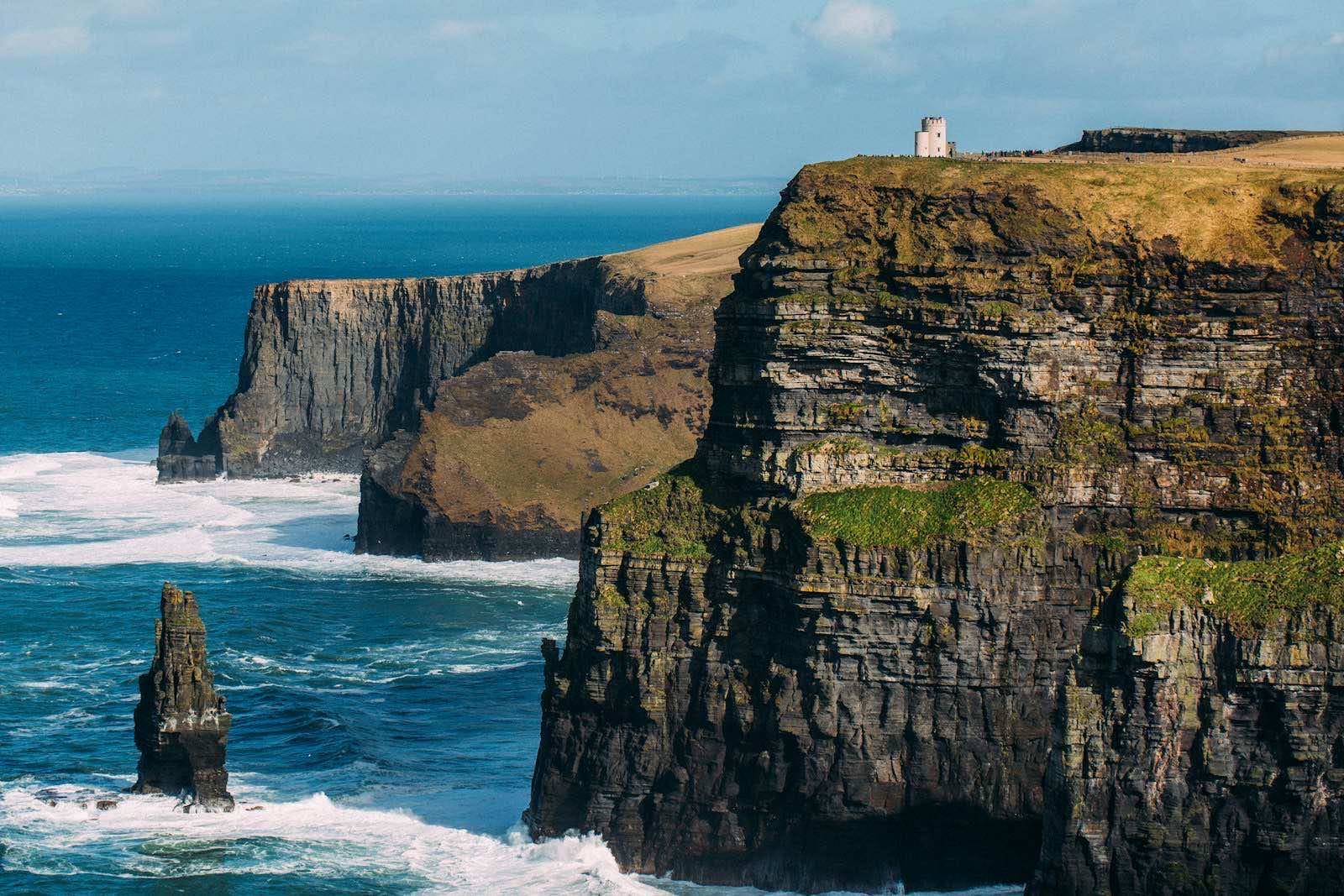
Sentinels of the Wild Atlantic Way, the Cliffs of Moher rise more than 200 metres of sandstone and shale above the Atlantic, in County Clare. This is one of Ireland's most visited sites, and one of the most exposed to wind, mist and shifting light. Preparing your visit makes all the difference: choosing your starting point, booking a timed ticket that includes parking, aiming for a favourable time slot and, above all, following safety rules that are far more than a formality. This practical guide covers driving access, how the visitor centre works, the coastal trails and how to behave at the edge of a cliff that is, quite literally, retreating.
Where the cliffs are and how to reach them by car
The Cliffs of Moher lie on Ireland's west coast, in County Clare, between the villages of Doolin and Liscannor, at the heart of the Wild Atlantic Way. On a road trip, the car remains the most flexible way to get there: the region is best explored by combining the Burren, Doolin and the Clare coast in a single day. The minor roads are often narrow and lined with stone walls, and driving is on the left, so allow generous time margins and take it slowly.
From Galway, expect around 1h15 of driving via the N67 and the secondary roads crossing the Burren. From Doolin, the nearest village, it is just a few minutes by car, which makes it an ideal base for an end-of-day visit. From Ennis, the county town, access takes about an hour. Organised parking is at the visitor centre, the only official car park on the site.
| Starting point | Approximate distance | Estimated driving time | Why it's useful |
|---|---|---|---|
| Galway | ~70 km | ~1h15 | Handy base to combine the Burren and the cliffs |
| Doolin | ~10 km | ~10-15 min | Nearest village, ideal for an end-of-day visit |
| Ennis | ~40 km | ~1h | County town of Clare, on the route from the south |
Parking and timed ticket: book before you set off
Access to the site is through the visitor centre, where the official car park is located. The system is based on a timed ticket: you book an arrival slot online, and parking is included in that ticket. This setup is designed to spread visitor numbers across the day and to avoid overwhelming the car park, which is heavily used in high season. In practice, it is strongly recommended to book in advance, especially in summer and during the holidays, rather than relying on a last-minute entry.
Exact prices and terms change over time: rather than a specific amount, remember the principle of a timed ticket to be booked online, with parking included. Plan to arrive within your chosen time window, and keep a margin if you are coming from far away or via slow roads. The visitor centre, set partly into the hillside, houses an exhibition area, toilets and food outlets: somewhere to wait or take shelter if the weather turns.
When to come: seasons, opening hours and light
The site is open all year round, with hours that vary by season: the opening window widens in spring and summer and narrows in winter when it gets dark early. Visitor numbers follow the tour coaches: the middle of the day is often the busiest, particularly from late morning to early afternoon. Checking the day's hours before setting off avoids nasty surprises, especially out of season.
For both light and calm, late afternoon is often recommended: the coaches leave, the crowds thin out and, in clear weather, the low sun brings out the relief of the cliffs and O'Brien's Tower. In summer, the long Irish evenings offer plenty of leeway. Bear in mind, though, that weather beats timing: a clear sky at a given hour is worth more than a theoretically perfect slot lost in the mist.
O'Brien's Tower and coastal trails: north to Doolin, south to Hag's Head
The landmark of the site is O'Brien's Tower, a stone observation tower built in the 19th century on the highest point of the cliffs. It marks the centre of the panorama and serves as a reference point for orienting yourself between the two directions of the coastal trail. From the main platform, you can take in the whole line of cliffs at a glance and, in clear weather, the Aran Islands offshore.
Two directions are open to walkers along the Cliff Walk. To the north, the trail descends towards Doolin along the coast: this is the most popular route, with fine perspectives on the cliffs. To the south, you reach Hag's Head, a point offering a lengthwise view of the whole cliff face, generally quieter. These trails are not laid out like urban promenades: uneven ground, exposed sections and steady wind call for suitable footwear and caution.
| Direction | Destination | Atmosphere | What to bring |
|---|---|---|---|
| North trail | Towards Doolin | Busiest, close-up views of the cliffs | Walking shoes, windbreaker |
| South trail | Towards Hag's Head | Quieter, overall view of the cliff face | Uneven ground, allow more time |
Safety: stay on the marked trails
The beauty of the cliffs must not make you forget how genuinely dangerous they are. The wind can rise suddenly and throw a walker off balance, the rock is damp and slippery in places, and the edge is anything but a stable line. First rule: stay behind the barriers and on the marked trails. Crossing the protections for a photo or approaching the drop exposes you to a risk of fatal fall, and also leaves rescuers with nothing to work with.
This is not a mere matter of principle. Coastal cliffs retreat under the effect of erosion, and blocks can break away: a study by Prémaillon and colleagues published in 2018 in Earth Surface Dynamics, based on the GlobR2C2 database ("Global Recession Rates of Coastal Cliffs"), documents these recession rates and the erosion of rocky coastal cliffs (see doi.org/10.5194/esurf-6-651-2018). In other words, the edge you believe to be solid may be a weakened overhang. Hold children and pets firmly, never sit at the edge and keep a safe distance from the drop.
- Stay on the marked trails and behind the barriers.
- Never approach the edge or sit on it for a photo.
- Keep a close eye on children and pets, especially in strong wind.
- Check the weather and turn back if the wind is too strong or the mist too thick.
- Bring suitable footwear and windproof, waterproof clothing.
Extending your visit along the west coast
The Cliffs of Moher fit naturally into a wider itinerary along the Wild Atlantic Way. To the north, the Burren unfolds its lunar limestone landscapes; to the south, the Clare coast and County Kerry carry the road on towards other iconic sites. Planning the day around the cliffs, rather than a quick stop, lets you enjoy the trails and adjust your timing to the light and the weather.
To build a coherent road trip along the west coast, it helps to link the cliffs with the Ring of Kerry and the stages of the Wild Atlantic Way, factoring in driving times and left-hand driving. The resources below cover the site itself, how to chain together the great panoramas, and the practical basics for getting behind the wheel with confidence in Ireland.
Travel tips
Get our independent-travel tips by email
The house methods — costed budgets, driving, itineraries — straight to your inbox. Instant bonus: our free excerpt “The 7 mistakes to avoid on a first Namibia road trip” and the current promo code.
No time to do it yourself?
A professional can take care of it: tailor-made trip, equipped 4x4 rental or a local guide. Describe your plans and, with your consent, we pass them on to partner professionals.
1. What you need
Before you go
Readers' questions
Do you need to book to visit the Cliffs of Moher?
It is strongly recommended to book a timed ticket online, especially in summer and during the holidays. Parking at the visitor centre is included in the ticket, and booking an arrival slot avoids disappointment when the car park is full.
How do you get to the Cliffs of Moher by car?
Allow around 1h15 from Galway, about an hour from Ennis and roughly ten minutes from Doolin, the nearest village. The roads are often narrow and driving is on the left, so allow time margins and drive without rushing.
What is the best time of day to visit?
Late afternoon is often recommended: the coaches leave, the crowds thin out and, in clear weather, the low light brings out the relief. The middle of the day is generally the busiest. Weather beats timing, though: a clear sky is worth more than a slot lost in the mist.
Are the Cliffs of Moher dangerous?
The site is safe if you stay on the marked trails and behind the barriers. The danger comes from the wind, the slippery rock and the natural retreat of the cliff, with possible rockfalls. Never cross the protections and do not approach the edge, especially with children or in strong wind.