From our field notes
Driving to Ordesa y Monte Perdido: the Torla shuttle, the car parks and the four valleys
Published 26 August 2026 · updated 26 August 2026 · 8 min read
By Clément Lacaille, publisher · our method
Ordesa is the best-known valley in the Aragonese Pyrenees — and one of the few places in Spain where your hire car will not take you all the way. For much of the year the road linking Torla to the Pradera de Ordesa is closed to private vehicles and access is by shuttle bus only. The rest of the time you can drive up, but the car park fills before 9am. Here is how the system works in 2026, where to park, what the park’s three other valleys are worth, and how to plan a day’s walking around the last bus.
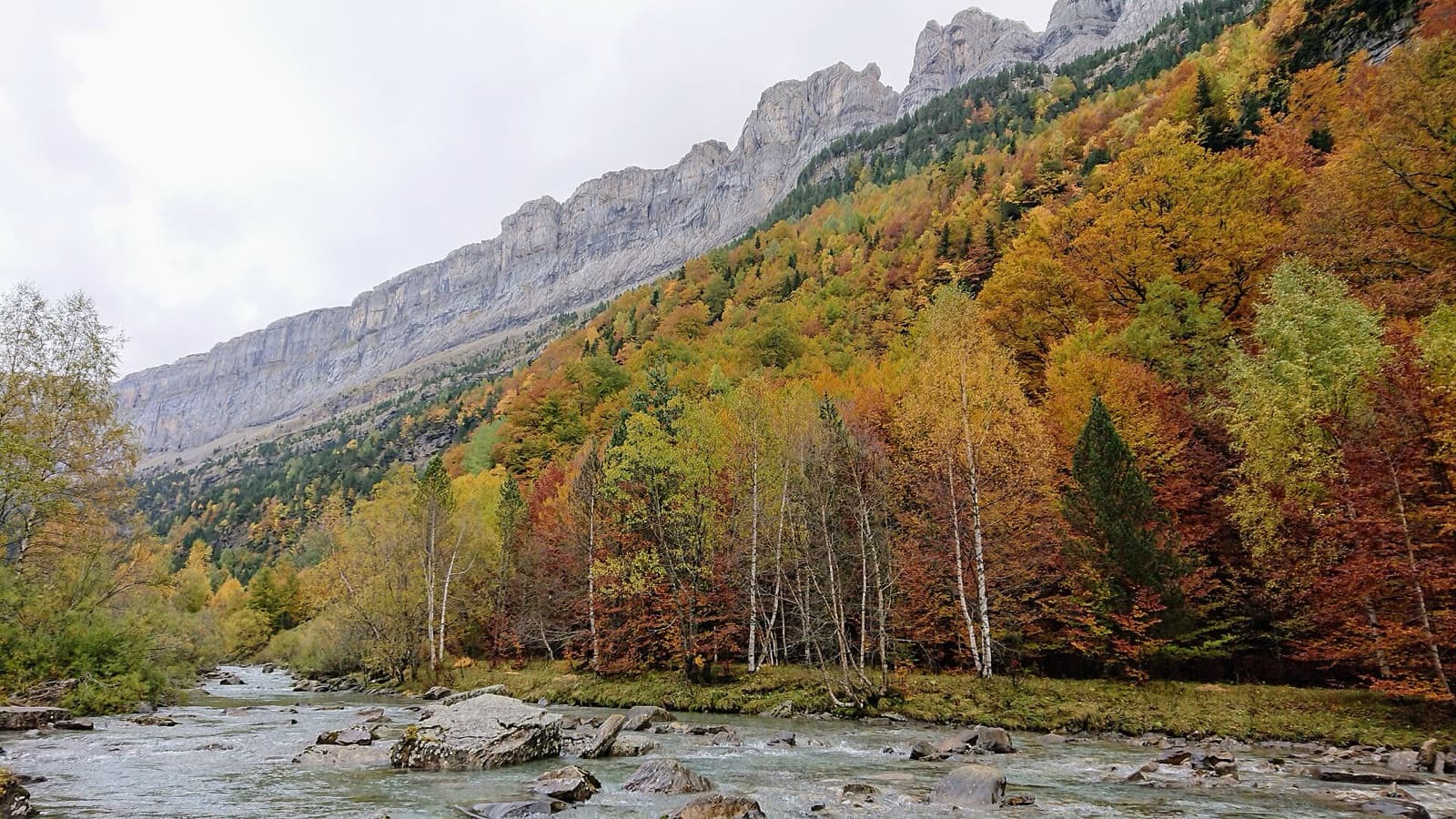
Where the park is, and how to drive there
Ordesa y Monte Perdido National Park sits at the heart of the Aragonese Pyrenees, in the province of Huesca and mostly within the Sobrarbe district. Its gateway village is Torla-Ordesa: this is where you will find the visitor centre, the large free car park and the shuttle bus terminus. From Huesca, allow roughly 120 km and 1 hr 30 to 1 hr 45 via Sabiñánigo and then the N-260. From Zaragoza, reckon on something like 200 km and two and a half hours. From Aínsa, the medieval hill town of the Sobrarbe, it is only 44 km and about forty minutes of winding road.
Coming from France, there are two main gateways. The Bielsa-Aragnouet tunnel, 3,070 m long from the Vallée d’Aure, emerges at Bielsa and puts you a little over an hour from Torla via Aínsa; it is also the natural way into the Pineta valley. Note that it closes overnight, from midnight to 6am, and can be shut in winter because of avalanche risk. The alternative is the Col du Pourtalet, from the Vallée d’Ossau, dropping down to Biescas and then Torla; it is normally passable in winter but closes occasionally during heavy snowfall. Check both crossings on the morning you travel.
The key rule: the compulsory shuttle bus from Torla
This is the point many travellers discover too late. During busy periods, the 8 km of road climbing from Torla to the Pradera de Ordesa is closed to private cars: a control point at the Puente de los Navarros filters vehicles, and access is by shuttle bus from the Torla car park only. The service is not a convenience but a management tool: it keeps visitor numbers within the carrying capacity set by the park, namely 1,800 people in the valley at any one time. Once that threshold is reached, the buses stop running uphill until people come back down.
Here is what the operator, OrdesaBus (ordesabus.com), announces for the 2026 season.
The approach is far from unusual: most saturated sites end up there, and research shows that visitor acceptance depends above all on frequency and waiting times. A study by Yoram Shiftan, Donald Vary and Dorothy Geyer, published in 2006 in the Journal of Transport Geography, shows that the choice between private car and shuttle in a park hinges first on travel and waiting times, with visitors proving more sensitive to in-vehicle time than to out-of-vehicle time (study: doi.org/10.1016/j.jtrangeo.2004.12.005). That is precisely the logic behind departures every fifteen minutes at Torla.
- Compulsory shuttle periods: Easter week from 1 to 6 April, the May bank holiday from 1 to 3 May, summer from 19 June to 20 September, then autumn weekends and public holidays through to 2 November.
- Frequency: one departure every 30 minutes between 6am and 8am, then every 15 to 20 minutes depending on demand.
- First bus up: 6am as a rule, 5.45am during the May bank holiday.
- Last bus down from the Pradera: late in the evening at the height of summer, considerably earlier in spring and autumn — the exact time varies by period, and it is the figure to check before setting off on foot.
- Fares: €6 adult return, €4 single, €5 and €3.50 for over-65s and disabled visitors, free for under-10s, €2 for a dog.
- Tickets: sold in person only, at the kiosk in the Torla-Ordesa car park (cards accepted) and at the Pradera for the return leg (cash). No online booking.
Outside shuttle season: driving up to the Pradera
Outside the dates above, the road is open to private vehicles and you can park directly at the Pradera de Ordesa, at the foot of the trails. The park lists 410 spaces, free of charge. That sounds like plenty; in practice, on a fine late-September Saturday or a holiday that falls outside the shuttle calendar, they go quickly. As soon as the car park is full, the barrier at the Puente de los Navarros closes and you stay down in the valley. In winter, snow further reduces the usable spaces and the road may be shut while it is cleared.
The practical rule is simple: if you are driving up, be at the Puente de los Navarros before 9am, and preferably earlier. Otherwise, have a plan B. The best one is to leave the car in Torla and walk up on the old Turieto Bajo or Turieto Alto paths, open all year: about an hour and a half to the Pradera on modest gradients. It adds close to three hours to the day, but it settles the parking question for good.
The park’s four sectors, and what your car can do with them
Ordesa is only a quarter of the park. Three other valleys give access to it, far less busy and, crucially, with no shuttle: you drive in, but each has its constraints. The Añisclo canyon is reached on a narrow road that climbs the gorge of the río Bellós from Escalona, one-way uphill: you enter from the south and come out via Buerba or Fanlo. Caravans and motorhomes are barred for lack of room, and the road can be closed at the height of summer, so check before committing to it.
Escuaín is the park’s quiet corner: a minor road from Puértolas leads to the hamlet of Escuaín, with a municipal car park of around forty spaces, while at Revilla you simply park on the verge. Pineta, finally, is reached from Bielsa on the HU-V-6402: at the head of the valley, facing the north wall of Monte Perdido, a car park run by Bielsa town council offers 500 spaces, charged at €3 per vehicle per day in high season. There is no access restriction here, which makes it the easiest sector to slot into a road trip.
| Sector | Access by car | Shuttle compulsory? | Who it suits |
|---|---|---|---|
| Ordesa (Pradera) | 8 km of road from Torla | Yes, high season and weekends | First visit, Cola de Caballo |
| Añisclo | Narrow one-way road from Escalona | No | Confident drivers, no motorhomes |
| Escuaín | Minor road from Puértolas, about 40 spaces | No | Anyone after peace and quiet |
| Pineta | HU-V-6402 from Bielsa, 500 spaces, €3/day | No | Families, north face of Monte Perdido |
The walks from the Pradera, and the last-bus clock
The signature walk starts at the Pradera and follows the valley floor up to the Cola de Caballo waterfall via the Gradas de Soaso: roughly 17 km there and back, 500 to 550 m of ascent, 6 to 7 hours with stops and photographs. The path is wide, well graded and technically easy — but it is a full day on foot, not a stroll. The strenuous variant climbs the Senda de los Cazadores, a steep forest ascent of about 600 m, then follows the Faja de Pelay, a long horizontal ledge suspended above the valley: reckon on 19 to 20 km, 700 to 800 m of ascent and 7 to 8 hours.
In both cases the binding constraint is not distance but the time of the last bus. Set your turnaround time by it, and aim to be back at the Pradera at least an hour early: queues lengthen at the end of the day, and missing the final departure means walking down to Torla. If you do the loop, climb the Senda de los Cazadores and descend the valley floor: going down the hunters’ path, steep and slippery, accounts for most of the sprained ankles in the valley.
These heavily used paths pay a measurable price. A study by Bodoque, Ballesteros-Cánovas, Rubiales, Perucha, Nadal-Romero and Stoffel, published in 2017 in Land Degradation & Development, reconstructed the soil erosion caused by walkers on trails in Ordesa y Monte Perdido National Park using the exposed roots of mountain pine and beech: measured rates run from 3.1 to 8.9 mm of soil lost per year depending on the section (study: doi.org/10.1002/ldr.2755). It explains why the park caps visitor numbers and asks walkers not to cut corners on the switchbacks.
Weather and season: the constraint nobody plans for
At roughly 1,300 m at the Pradera and 1,760 m at the Cola de Caballo, winter lingers. In June there are commonly snow patches on the Gradas de Soaso and along the Faja de Pelay; the exposed ledge is awkward to cross until the snow has gone, and that is where early-season accidents cluster. Ask at the Torla visitor centre on the morning itself rather than trusting a GPS track downloaded in February.
In July and August the problem reverses: convective thunderstorms often break in the early afternoon. That is the best argument for taking the 6am shuttle — you walk in the cool, you are back down before the storm, and you miss the 10am crush. Autumn brings the finest colour in the beech woods, but days shorten and the shuttle runs only at weekends and on public holidays. In winter everything quietens: driving up becomes possible again once the road is cleared, but both the Bielsa tunnel and the Pourtalet can close at short notice.
Where to stay and where to park
Torla is the most practical base: you are a few minutes’ walk from the car park and the shuttle kiosk, and some village accommodation sells tickets. The village itself is old, though, and its lanes are not made for parking — the standard move is to leave the car at the visitor centre car park and finish on foot. Broto and Sarvisé, a few kilometres down the valley, offer more choice and are easier to park in.
Aínsa, 44 km away, is an elegant base if you want to combine the park with the Sobrarbe, Añisclo and Escuaín: park in the lower town and walk up to the old town, whose medieval square was never designed for cars. Bielsa is the logical choice for Pineta and for heading back into France through the tunnel. Motorhome drivers should note that overnight stays are prohibited in the park’s car parks: there are dedicated aires in the valley, worth identifying before you arrive.
The mistakes that ruin the day
Bad days at Ordesa all look alike, and every one of them is avoidable.
One last reminder, valid every year: shuttle periods, timetables, fares and access rules are reviewed by the Gobierno de Aragón and the operator ahead of each season. The figures given here are those announced for 2026; check them on ordesabus.com and on the park’s official website in the days before you travel, then again the evening before if you are visiting in spring or autumn, when the calendar shifts most.
- Turning up at midday in peak season: the Torla car park is full, the queue is long, and the valley’s capacity may already have been reached.
- Cutting the last shuttle too fine: fifteen minutes late and you are walking back to Torla.
- Underestimating the climb on the Faja de Pelay: 700 to 800 m of ascent, in full sun towards the end, is no longer the valley-floor stroll.
- Setting off without water or sun protection: beyond the Pradera there is nothing to buy.
- Taking a motorhome into the Añisclo canyon: the road is narrow, one-way, and there is nowhere to turn round.
- Counting on a booking or online payment: the shuttle is paid for on the spot, and the return ticket is sometimes cash only.
Travel tips
Get our independent-travel tips by email
The house methods — costed budgets, driving, itineraries — straight to your inbox. Instant bonus: our free excerpt “The 7 mistakes to avoid on a first Namibia road trip” and the current promo code.
No time to do it yourself?
A professional can take care of it: tailor-made trip, equipped 4x4 rental or a local guide. Describe your plans and, with your consent, we pass them on to partner professionals.
1. What you need
Before you go
Readers' questions
Can you drive up to the Pradera de Ordesa?
Yes, but only when the shuttle is not running. During Easter week, the May bank holiday, the summer season and autumn weekends, the road from Torla to the Pradera is closed to private vehicles. Outside those periods the Pradera car park, free and with around 410 spaces, is open — arrive before 9am, because the barrier at the Puente de los Navarros closes as soon as it is full.
How much is the Torla to Ordesa shuttle bus, and where do you buy tickets?
For 2026 the operator lists €6 for an adult return and €4 single, with €5 and €3.50 for over-65s and disabled visitors, free travel for under-10s and €2 for a dog. Tickets are sold in person only: at the kiosk in the Torla-Ordesa car park, where cards are accepted, and at the Pradera for the return leg, often cash only.
Do you need to book the Ordesa shuttle in advance?
No, and you cannot: there is no online sale. You buy at the Torla car park kiosk on the day. The valley is capped at 1,800 people at any one time, however: once that threshold is hit, buses stop running uphill until visitors come back down. Arriving early is therefore the only reservation that actually works.
What time does the first bus to Ordesa leave?
Generally 6am, with a departure every thirty minutes until 8am and then every fifteen to twenty minutes depending on demand. During the May bank holiday the first departure is listed at 5.45am. The time of the last bus down from the Pradera varies a great deal by period, very late at the height of summer and considerably earlier in spring and autumn: that is the figure to confirm before you start walking.
Which walk should you choose from the Pradera if you only have one day?
The Cola de Caballo along the valley floor and the Gradas de Soaso: about 17 km there and back, 500 to 550 m of ascent, 6 to 7 hours with stops. If you are a strong walker and the snow has gone, the loop up the Senda de los Cazadores and along the Faja de Pelay adds spectacular views, for 19 to 20 km and 700 to 800 m of ascent.
Can you drive into the Añisclo canyon in a motorhome?
No. The road climbing the río Bellós gorge from Escalona is narrow, cut into the cliff and one-way uphill: caravans and motorhomes are banned for lack of room, and the road can be closed at the height of summer. If you are driving a long vehicle, head for the Pineta valley from Bielsa instead, where the 500-space car park takes all sizes.