From our field notes
The Picos de Europa by car: itinerary, Covadonga lakes and gorges
Published 27 July 2026 · updated 27 July 2026 · 7 min read
By Clément Lacaille, publisher · our method
An hour from the sea, limestone walls rising past 2,500 metres, gorges where the road threads beneath the cliff and glacial lakes above the clouds: the Picos de Europa concentrate, on a compact massif between Asturias, Cantabria and León, one of Spain's finest road trip playgrounds. The tour of the massif drives in three to five days, on spectacular but demanding roads — with one golden summer rule to know: access to the Covadonga lakes then happens by shuttle, not by car. Here is the full itinerary.
The loop of the massif: 200 km that must be earned
The classic Picos tour links Cangas de Onís (north-west, Asturias side), Arenas de Cabrales and Panes (north-east), Potes and Fuente Dé (south-east, Cantabria side), then the León flank via Riaño before returning through the Los Beyos gorge. About 200 kilometres on the clock — but narrow, winding mountain roads where the average rarely beats 40 km/h: the full loop comfortably fills three days, five with the hikes.
Counter-clockwise (Cangas de Onís to Potes along the coast, returning through the south) puts the two great gorges on descents and keeps the best — Fuente Dé and the climb to the Covadonga lakes — for morning slots, when light and crowds are at their most favourable.
Covadonga lakes: summer's mandatory shuttle
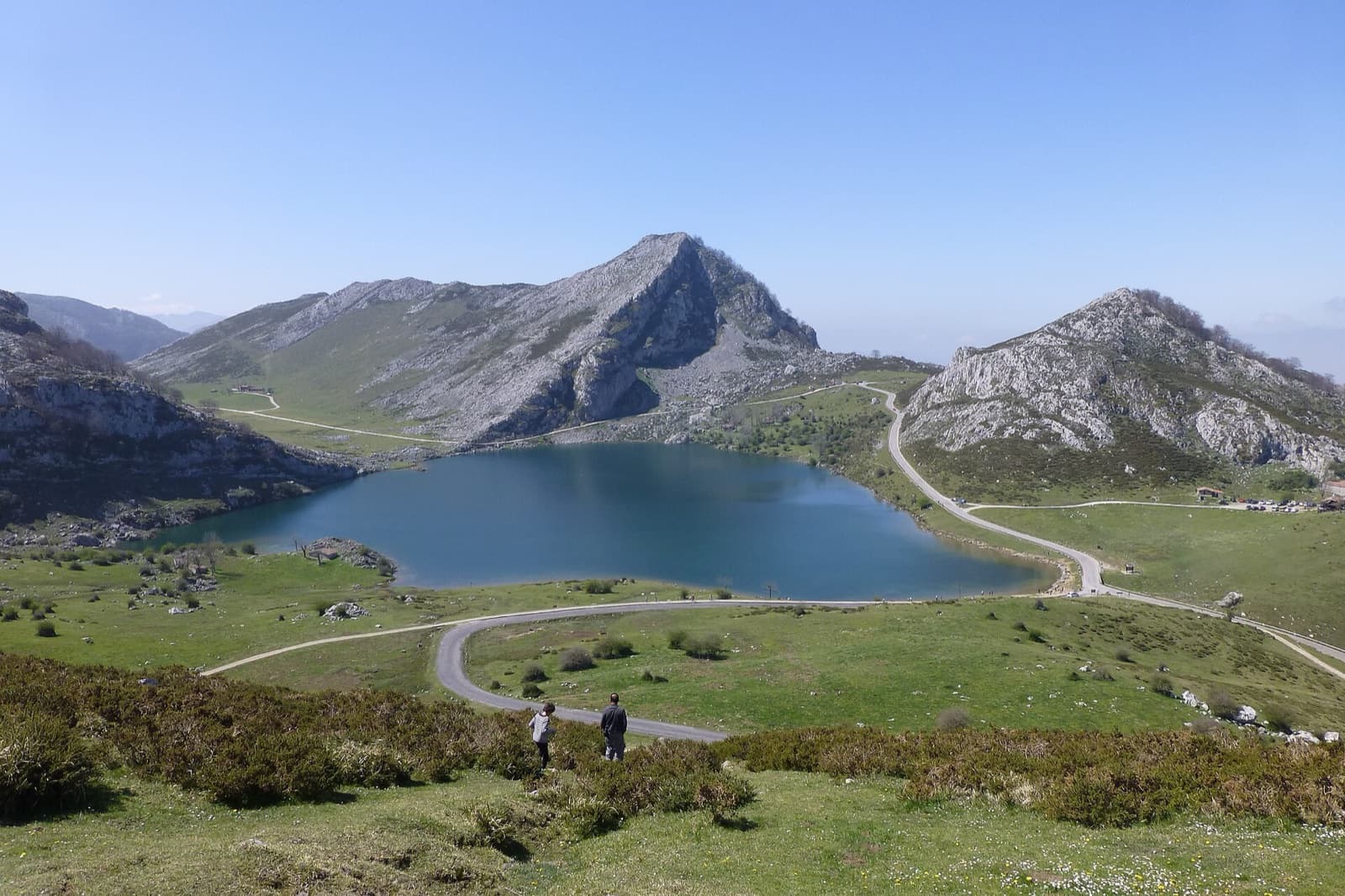
The little road climbing from the Covadonga sanctuary to lakes Enol and Ercina — 12 km of hairpins gaining over 1,000 metres — is one of the trip's summits, literally and figuratively. But in high season (summer, long weekends and spring holidays, with dates set each year by the park), it is closed to private cars for most of the day: you park below, in Cangas de Onís or at the sanctuary car parks, and ride up by shuttle bus or licensed taxi.
This switch to shuttles is no local quirk but a proven policy of Europe's mountain parks: a study by Francesco Orsi and Davide Geneletti published in 2014 in the Journal of Transport Geography on the effects of access policies in an Alpine tourist destination (the Dolomites) shows that regulating car access combined with a public transport offer effectively reorients visitors' mode choices, which are highly sensitive to site crowding (doi.org/10.1016/j.jtrangeo.2014.06.015). In practice: off season you savour the climb at the wheel; in summer you take the first shuttle of the morning and come out ahead — the lakes without the queues of cars.
The gorges: Los Beyos, La Hermida and the Poncebos road
Three gorges structure the tour of the massif. The Desfiladero de los Beyos (N-625, between Cangas de Onís and Riaño) threads the road through a limestone slot of startling depth; La Hermida (N-621, between Panes and Potes) strings together 20 km of bends between walls that barely let the light through; finally the little AS-264 climbs from Arenas de Cabrales to Poncebos, gateway to the legendary Ruta del Cares hike, the 'divine gorge' carved into the cliff face.
These roads are shared: plenty of cyclists, coaches in La Hermida, herds coming down from the summer pastures in late summer. Drive with the window down, give a short horn tap in the tightest blind bends as the locals do, and use the widenings to let others pass — the logic of Scottish passing places, limestone edition.
| Stage | Road | Not to be missed |
|---|---|---|
| Cangas de Onís → Covadonga and the lakes | AS-114 then CO-4 | Lakes Enol and Ercina — mandatory shuttle in high season |
| Arenas de Cabrales → Poncebos | AS-264 | Trailhead of the Ruta del Cares, Cabrales cheese in the village |
| Panes → Potes | N-621, La Hermida gorge | 20 km of gorge, stop at Santa María de Lebeña |
| Potes → Fuente Dé | CA-185 | Cable car to the 1,823 m balcony |
| Riaño → Cangas de Onís | N-625, Los Beyos gorge | One of Spain's finest gorge roads |
Fuente Dé and the drive-to hikes
A road dead-end at the head of the Liébana valley, Fuente Dé justifies the detour on its own: the cable car swallows 750 metres of wall in minutes and sets you down in the heart of the central massif, from which trails of every level radiate. First departure of the morning is imperative in summer — the queue grows fast — and bring a warm layer even in August: it is often 10°C colder at the top.
For walkers, the two drive-to classics remain the Ruta del Cares from Poncebos (12 km each way, vertiginous yet technically easy) and the loop of the Covadonga lakes (an easy 2-to-3-hour circuit). Start early, for the light as much as for the parking.
When to go, where to stay, which vehicle
The ideal window runs from May to October, with two caveats: Atlantic mist can drown the summits in any season — checking the lakes webcam before climbing spares disappointments — and August crowds saturate car parks and shuttles. June and September offer the best light-to-crowd ratio. In winter the massif is snowbound and some high roads close: the loop remains feasible, the lakes much less so.
No 4x4 is needed: every road described is paved. A compact is actually an advantage in the gorges and villages. The most convenient bases are Cangas de Onís and Arenas de Cabrales in the north, Potes in the south-east — book early in summer. The itinerary grafts naturally onto a green-Spain road trip between Bilbao and Galicia, to combine with our Spain guide.
Travel tips
Get our independent-travel tips by email
The house methods — costed budgets, driving, itineraries — straight to your inbox. Instant bonus: our free excerpt “The 7 mistakes to avoid on a first Namibia road trip” and the current promo code.
No time to do it yourself?
A professional can take care of it: tailor-made trip, equipped 4x4 rental or a local guide. Describe your plans and, with your consent, we pass them on to partner professionals.
1. What you need
Before you go
Readers' questions
Can you drive up to the Covadonga lakes?
Outside high season, yes: the road is open and spectacular. In summer and on long weekends it is closed to private cars for most of the day: you park in Cangas de Onís or at the sanctuary and ride up by shuttle or licensed taxi. The exact dates are published each year by the national park.
How many days to visit the Picos de Europa by car?
Three days for the loop of the massif with the Covadonga lakes, Fuente Dé and the great gorges; five days to add the Ruta del Cares and the León flank. On a single day from the coast, limit yourself to Covadonga and its lakes.
Do you need a 4x4 for the Picos de Europa?
No: every road of the classic itinerary is paved, including the climb to the lakes and Fuente Dé. Narrow and winding, they actually favour compact vehicles.
What is the most beautiful road in the Picos de Europa?
Three contenders share the title: the climb to the Covadonga lakes for the panoramas, the La Hermida gorge for the atmosphere, and the Desfiladero de los Beyos, often cited among Europe's finest gorge roads. Driving the loop, you get all three.