From our field notes
Peneda-Gerês by Car: Granite Villages, Waterfalls and Mountain Roads in Portugal's Only National Park
Published 28 July 2026 · updated 28 July 2026 · 8 min read
By Clément Lacaille, publisher · our method
In Portugal's far north, backed against the Galician border, Peneda-Gerês National Park is the country's only one — created in 1971, and still surprisingly untouched by the big tourist flows. About 1h30 by road from Porto, you'll find granite villages bristling with maize granaries on stilts, waterfalls with crystal-clear water, a Roman road lined with milestones, semi-wild horses on the high plateaus and even packs of Iberian wolves, invisible but very much present. It's a territory best discovered by car, along narrow hairpin roads where the mist often joins the drive. Here's how to plan a road trip through the Gerês, village by village.
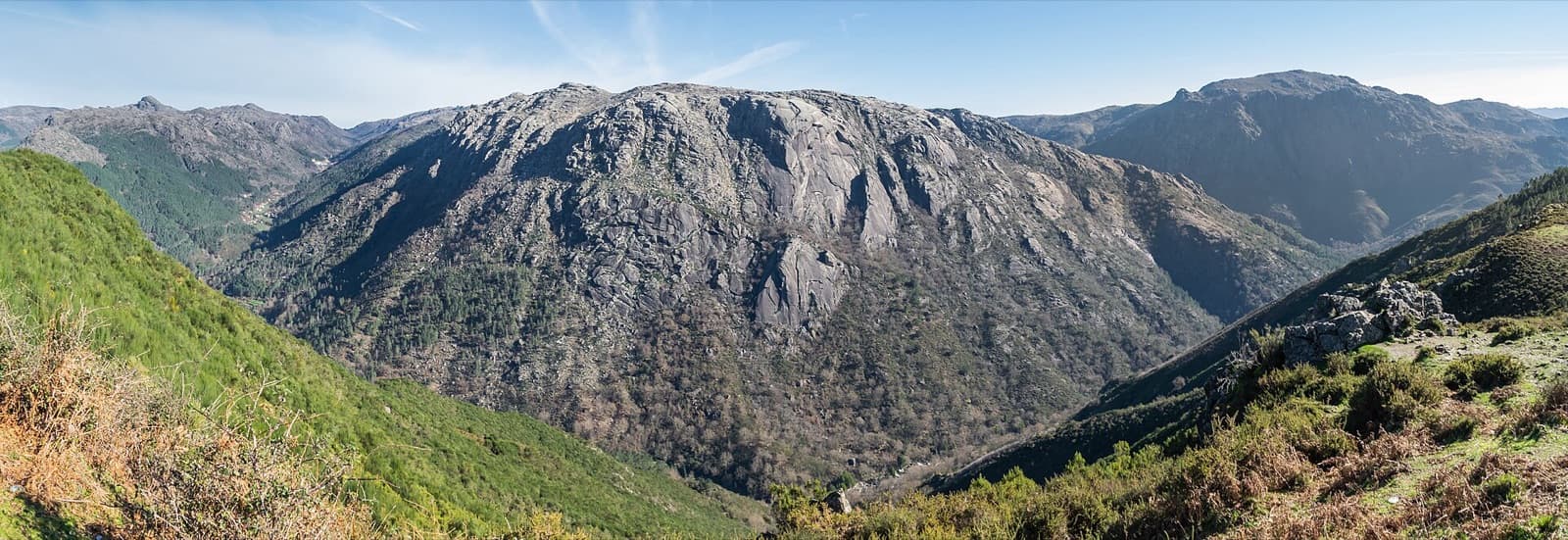
Portugal's only national park, on Porto's doorstep
Portugal has just one national park, and this is it: Peneda-Gerês, created in 1971, spreads its granite mountains across the far north of the country, along the Spanish border with Galicia. The park forms a vast horseshoe between the Peneda massif in the north and the Gerês massif in the south, cut by deep valleys where villages cling to the slopes as if nothing had moved in a century.
Getting there is disarmingly simple: about 1h30 by road from Porto, which makes it an ideal two- or three-day escape by rental car from the city — or a natural stage on a road trip heading up into Galicia. Once inside the park, however, forget motorway averages: the roads narrow, coil back on themselves, and every leg is measured in time rather than kilometres.
Soajo and Lindoso: the espigueiros, cathedrals of maize
The park's most singular sight is found in Soajo and Lindoso: rows of espigueiros, granite maize granaries perched on stilts, topped with crosses, packed tightly together on the old threshing floors. Built to keep the cobs safe from damp and rodents, they now form almost unreal ensembles, somewhere between necropolis and miniature village — and some are still used by local families.
Both villages are explored on foot, leaving the car at the entrance: the lanes are too narrow to venture into, and that is precisely their charm. In Lindoso, the cluster of espigueiros steps down below a medieval castle that once guarded the border; in Soajo, add a pillory on the square and houses of massive granite. Allow half a day for the pair, linked by a pretty valley road.
Peneda and Castro Laboreiro: the park's wild north
At the heart of the Peneda massif, the sanctuary of Nossa Senhora da Peneda rises at the foot of a granite wall, fronted by a monumental staircase that climbs the slope chapel by chapel. The ensemble, inspired by Bom Jesus in Braga, is all the more striking for the site's isolation — you reach it by a spectacular mountain road, and outside the September pilgrimage, you often share the steps with only the hamlet's residents.
Further north still, Castro Laboreiro watches over the border plateaus, with the ruins of its castle and its dark stone houses. The village gave its name to a breed of livestock guardian dog, raised here for centuries to face the wolf — one more sign that you are travelling through one of Portugal's last genuinely wild territories.
Waterfalls and natural pools: Arado, «Tahiti» and mandatory caution
The rivers of the Gerês tumble down the granite in a succession of natural pools and slides. Two sites draw most of the visits: the Arado waterfall, reached by a mountain road and then a short maintained trail, and Fecha de Barjas, nicknamed the «Tahiti waterfall» for its turquoise pools terraced into the pale rock. In summer the crowds are heavy — better to aim for early morning, or simply another pool further along the river.
A serious word on safety: the access trails are steep, sometimes slippery, and accidents happen regularly, particularly around the Tahiti waterfall. Swim with genuine caution — polished rocks, cold water even in summer, stronger currents after rain — and never jump from the rocks without knowing the depth. Good closed shoes beat sandals on these trails.
Mata da Albergaria and the Roman road: the regulated crossing
Between the spa village of Gerês and the border at Portela do Homem, the road crosses the Mata da Albergaria, a protected oak forest among the park's most precious. Driving through is regulated: transit is controlled by a barrier and time-stamped ticket system, and both stopping and parking are forbidden on the protected stretch — you drive through without stopping, within a set time, and check the current conditions on site before committing.
This valley is also where the Geira ran, the Roman road linking Braga to Astorga: several original milestones still stand by the roadside near the border, some carved with dedications to emperors. Few roads in Europe let you drive alongside two thousand years of history like this — on foot, waymarked trails follow the best-preserved sections, outside the stretch where stopping is forbidden.
Garranos and wolves: the wildlife of the high plateaus
On the park's high plateaus, you will often come across garranos, the small semi-wild horses that graze freely in family herds. Watch them from the road or the trails, without approaching or feeding them: they remain undomesticated animals, and their presence has shaped the park's open landscapes for centuries.
The Gerês is also home to packs of Iberian wolves — one of the species' last strongholds in Portugal. Studies by Francisco Álvares, a researcher at CIBIO (University of Porto), document the persistence of these packs in the mountains of the Minho and the Gerês and their long-standing coexistence with local pastoralism (research). Visitors can rest easy: the wolf is utterly discreet, and its presence poses no cause for concern to anyone hiking or driving in the park — actually seeing one would be a statistically improbable privilege.
Driving in the Gerês: hairpins, mist and tight villages
Good news: a standard car is entirely sufficient for the whole classic park itinerary — no need to rent a 4x4. The real vigilance lies elsewhere: narrow hairpin roads where you meet buses and tractors, frequent mist at altitude that can cut visibility in minutes, and villages with extremely tight lanes where it's far better to park at the entrance than to drive in. The best period runs from May to October; in winter, rain and fog make the driving distinctly less pleasant.
On the logistics side, the spa village of Gerês (Caldas do Gerês), a historic thermal resort tucked into the bottom of its valley, is the most convenient base for the south of the park: accommodation, restaurants and thermal baths are all concentrated there. For the north (Peneda, Castro Laboreiro), stay instead around Arcos de Valdevez or Melgaço. And if your route to the park uses the motorway, read up on Portugal's electronic toll system before setting off.
- Always park at the entrance to villages: the lanes of Soajo, Lindoso and Peneda show no mercy to wing mirrors.
- Fill the tank before entering the park: fuel stations are scarce inside.
- Allow generous time margins: 30 km of hairpins rarely take less than an hour.
- In mist, switch on dipped headlights and give up on the high viewpoints — they'll be back with the sun.
- Check the Mata da Albergaria transit conditions on site before heading for Portela do Homem.
- Don't approach or feed the garranos you meet along the road.
Suggested itinerary: a two- to three-day loop
In two full days, a coherent loop links the essentials: day one for the south — Caldas do Gerês, the Arado and Tahiti waterfalls early in the morning, then the crossing of the Mata da Albergaria towards Portela do Homem and its milestones. Day two in the north: Lindoso and its castle, Soajo and its espigueiros, the climb to the Peneda sanctuary and, time permitting, a push on to Castro Laboreiro. A third day relaxes the pace and makes room for a proper hike or the thermal baths.
The table below sums up the key stops. For more depth on each site, our destination page details access, trails and accommodation — and our guide «Portugal en autonomie» places the Gerês within a complete itinerary of the country's north.
| Stop | What to see | Suggested time |
|---|---|---|
| Caldas do Gerês | Historic spa village, southern base for the park | Evening + night |
| Arado and Tahiti waterfalls | Natural pools, cautious swimming | Half a day, early morning in summer |
| Mata da Albergaria – Portela do Homem | Protected oak forest, Geira Roman milestones | 1 to 2 h (regulated transit, no stopping on the stretch) |
| Lindoso | Espigueiros and border castle | 1 to 2 h |
| Soajo | Espigueiro threshing floor, granite village, pillory | 1 to 2 h |
| Peneda sanctuary | Monumental staircase beneath the granite wall | 1 to 2 h |
| Castro Laboreiro | High-altitude village, castle ruins, garrano plateaus | Half a day |
Travel tips
Get our independent-travel tips by email
The house methods — costed budgets, driving, itineraries — straight to your inbox. Instant bonus: our free excerpt “The 7 mistakes to avoid on a first Namibia road trip” and the current promo code.
No time to do it yourself?
A professional can take care of it: tailor-made trip, equipped 4x4 rental or a local guide. Describe your plans and, with your consent, we pass them on to partner professionals.
1. What you need
Before you go
Readers' questions
Do you need a 4x4 to visit Peneda-Gerês National Park?
No, a standard car is enough for the whole classic itinerary. The real challenges lie elsewhere: narrow hairpin roads, frequent mist at altitude and villages with very tight lanes, where you should park at the entrance rather than drive in.
Can you drive through the Mata da Albergaria?
Yes, but transit is regulated: a barrier and time-stamped ticket system controls the crossing, and both stopping and parking are forbidden on the protected stretch towards Portela do Homem. Check the current conditions on site before committing.
Is swimming allowed at the Gerês waterfalls?
Swimming is possible in several natural pools, notably at Arado and the «Tahiti» waterfall (Fecha de Barjas), but with genuine caution: steep trails, slippery rocks, cold water and regular accidents. Avoid jumping, watch the current after rain and wear closed shoes on the trails.
Are the wolves in the park a danger to visitors?
No. The park does hold packs of Iberian wolves, documented by the studies of Francisco Álvares (CIBIO, University of Porto), but the animal is extremely discreet and poses no cause for concern to visitors. Seeing one would be exceptional — the semi-wild garrano horses, on the other hand, are easy to spot on the high plateaus.