From our field notes
Wadi Rum by 4x4: Can You Visit the Desert Without a Bedouin Guide?
Published 30 July 2026 · updated 30 July 2026 · 9 min read
By Clément Lacaille, publisher · our method
Parking your rental car and climbing into the back of a Bedouin pickup: that's, in the vast majority of cases, the only legal way to move around inside Wadi Rum. This protected desert in southern Jordan, where Lawrence of Arabia left his name on the red dunes, isn't something you drive through solo behind the wheel of a rental sedan — or, most of the time, even a rental 4x4. Before heading off toward the sandstone arches and evening camps, here's what to know about the park's rules, the 4x4 tour formats with a guide, 2026 prices, and the best way to fit Wadi Rum into a Jordan road trip.
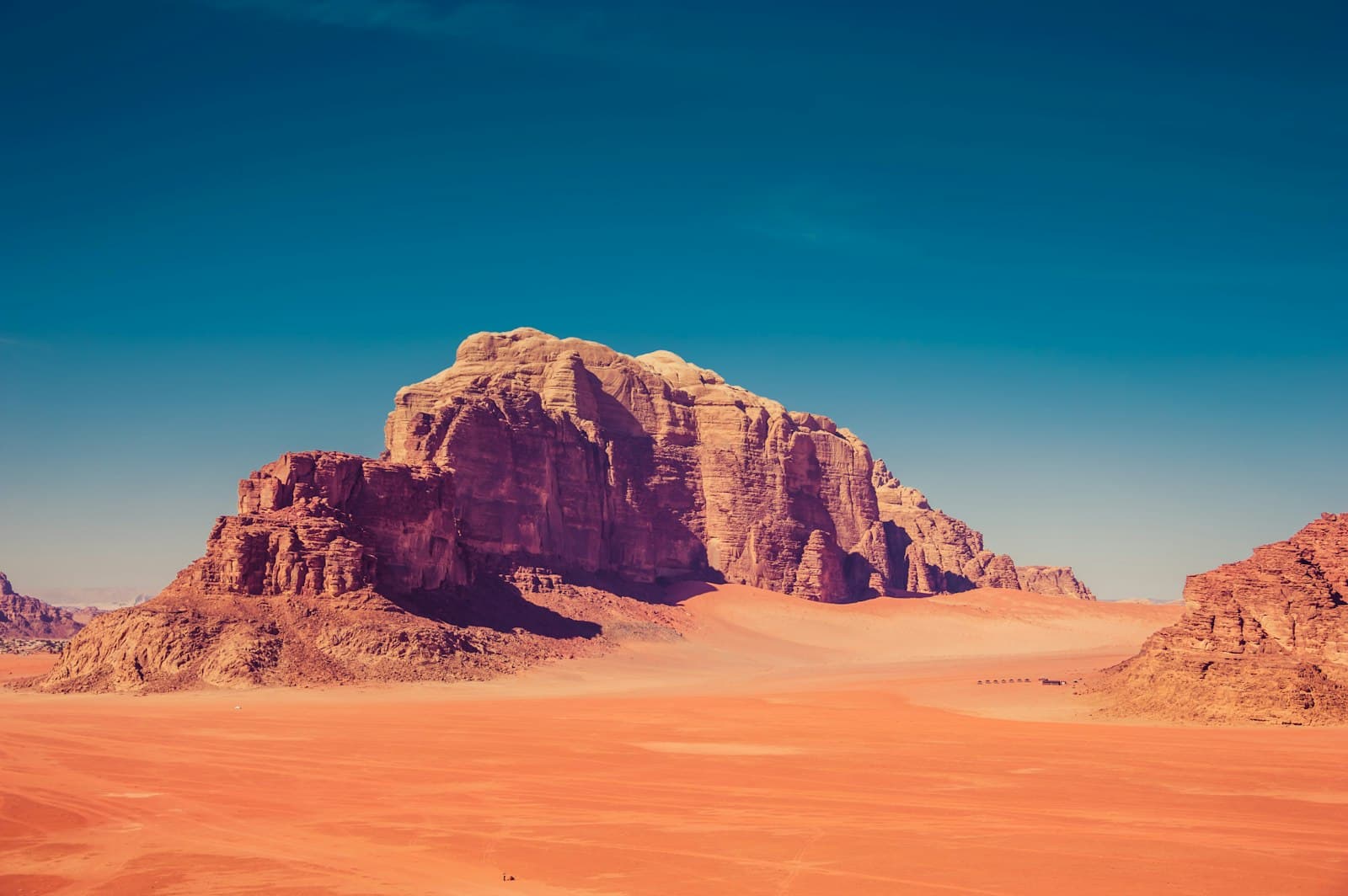
Wadi Rum, a protected desert you don't drive alone
Inscribed as a UNESCO World Heritage Site in 2011, the Wadi Rum Protected Area covers roughly 720 km² of sandstone canyons, dunes and mesas in southern Jordan. Its listing rests on both natural and cultural grounds: the site holds 12,000 years of human occupation, with close to 25,000 petroglyphs and 20,000 inscriptions carved in four North Arabian scripts (Thamudic, Nabataean, Islamic, Arabic) — one of the richest concentrations of rock art anywhere in the world.
That dual value explains the rule that surprises self-drive travellers the most: driving inside the protected zone is reserved for vehicles and drivers licensed by the park authority. You can't improvise as a Wadi Rum guide — reading the sand, avoiding soft patches and knowing where the most fragile carvings sit takes a familiarity that only locals from the area really have.
Your own 4x4, permit in hand: theory versus practice
On paper, driving yourself isn't entirely ruled out: a visitor with a capable 4x4 can apply for a permit at the visitor centre, declare their planned route to the Tourist Police and confirm their exit from the park on arrival. A vehicle fee is then added to the entrance ticket, in the order of 25 JOD for a privately owned vehicle and 35 JOD for a rental one — figures worth reconfirming on site, since rates change regularly.
In practice, this option remains marginal for a standard road trip rented in Amman, Aqaba or Petra. Jordanian rental contracts almost all exclude off-road driving (see our article on 4x4 rental insurance in Jordan), getting stuck in sand catches out even experienced drivers, and assistance is scarce once off the main tracks. The result: nearly all travellers — and rental companies themselves — stick to the standard routine of parking the car and letting a Bedouin driver take the wheel.
Where to leave your car and hop in with a guide
The routine is simple: drive your rental sedan or 4x4 (25-45 €/day, as everywhere else in Jordan) to the Wadi Rum Visitor Centre or Rum village, park it in the guarded lot, pay the site entrance fee, then climb aboard the pickup belonging to your guide or chosen camp.
It's worth booking your camp directly by WhatsApp rather than through a booking platform: rates are often better, and the driver running the 4x4 excursion usually belongs to the same family as the camp — so the day flows seamlessly from the tour into the overnight stay.
Which 4x4 format to choose: 2026 prices
Jeep tours come in four standard formats, from a quick highlights loop to a full circuit with an overnight camp stay. These per-person rates exclude the park entrance fee (5 JOD, included in the Jordan Pass) and vary with group size and the camp chosen.
| Format | Duration | Indicative price (JOD/pers.) | What's included |
|---|---|---|---|
| Taster tour | 2 hours | 15-20 JOD | Nearby dunes and one or two photo stops |
| Half-day | 3-4 hours | 25-35 JOD | 3 to 4 sites: dunes, arch, canyon |
| Full day | 7-8 hours | from 45 JOD | Dunes, arches, canyons, Bedouin tea, sunset |
| Full day + camp night | 24 hours | 50-70 JOD | Full circuit, zarb dinner, night at camp, sunrise |
What a Wadi Rum stopover really costs
For a couple staying one night: two park entries (5 JOD each, unless on a Jordan Pass), a day-plus-night package at 50-70 JOD per person including dinner and breakfast — roughly 110 to 150 JOD for two (140-190 €). The Jordan Pass saves the most on Petra; on the Wadi Rum side, it mainly saves you paying cash for the entrance ticket.
What really moves the total is the choice of accommodation, far more than the 4x4 itself: a classic Bedouin tent with shared bathrooms runs around 50-70 € half-board, a comfort camp with a private bathroom around 90-120 €, and panoramic bubble suites from 130 € and often well beyond. The starry sky, for its part, is exactly the same at every price point.
Why you don't drive just anywhere: fragile sand and ancient carvings
Beneath the sandy crust and among the canyons of Wadi Rum lie thousands of rock carvings, some several millennia old and still poorly mapped. Repeated off-track vehicle traffic doesn't just threaten this heritage: it durably damages desert soils whose recovery is measured in decades rather than seasons.
A study by Abood, Assaeed and co-authors, published in 2018 in the Saudi Journal of Biological Sciences, measured the impact of repeated off-road vehicle traffic in a neighbouring Saudi Arabian desert, ecologically close to Wadi Rum: soil compaction, a clear decline in vegetation cover, and very slow recovery once an area is left to wild tracks (study: doi.org/10.1016/j.sjbs.2018.05.001). It's this fragility, common to arid deserts across the region, that justifies reserving off-track driving for licensed Bedouin guides trained in the least damaging routes.
Fitting Wadi Rum into a Jordan road trip
Wadi Rum is easy to reach from the three anchors of a classic Jordan itinerary: roughly 4 hours and 320 km from Amman via the Desert Highway, 1.5 to 2 hours and about 100 km from Petra heading further south, or barely an hour and 60 km from Aqaba and the Red Sea — a feasible day trip for those short on time.
The logical place for the desert in an itinerary is after Petra and before Aqaba: one to two nights are enough to fit in the 4x4 excursion, a night at camp and sunrise, before heading back toward the coast. Our Jordan guide details how to work this stop into the rest of the route, camp bookings included.
Travel tips
Get our independent-travel tips by email
The house methods — costed budgets, driving, itineraries — straight to your inbox. Instant bonus: our free excerpt “The 7 mistakes to avoid on a first Namibia road trip” and the current promo code.
No time to do it yourself?
A professional can take care of it: tailor-made trip, equipped 4x4 rental or a local guide. Describe your plans and, with your consent, we pass them on to partner professionals.
1. What you need
Before you go
Readers' questions
Can you drive your own rental car into Wadi Rum?
Not freely: driving inside the protected zone is reserved for licensed Bedouin drivers. Entering with your own vehicle remains possible with a permit from the visitor centre and a route declaration to the Tourist Police, plus an extra vehicle fee, but Jordanian rental contracts almost all exclude off-road driving — making the option largely theoretical for a traveller in a rented 4x4.
How much does a 4x4 excursion in Wadi Rum cost?
From 15-20 JOD per person for a 2-hour taster tour up to 50-70 JOD for a full-day-plus-camp package including dinner and breakfast. These rates are on top of the park entrance fee (5 JOD per person), which is included in the Jordan Pass.
Does the Jordan Pass cover Wadi Rum?
The Jordan Pass includes the entrance fee to the protected area, but not the 4x4 tour, the camp stay or meals, which are paid separately on site or when booking the camp.
What's the best time to visit Wadi Rum?
Spring (March-May) and autumn (September-November), with daytime temperatures of 20-28°C and mild desert nights. Summer regularly tops 40°C, still bearable on an early-morning or evening excursion; winter remains doable but nights freeze regularly, a good reason to pack a light sleeping bag on top of the camp's blankets.