From our field notes
Park Fee Budget for a Self-Drive Safari in Tanzania: Serengeti, Ngorongoro, Tarangire
Published 23 July 2026 · updated 23 July 2026 · 8 min read
By Clément Lacaille, publisher · our method
In Tanzania, the line item that blows up a self-drive safari budget is almost never the 4x4 rental — it's the park fees. Daily per-person entrance charges, a separate vehicle fee, the Ngorongoro crater service fee, public campsites billed on top: it all adds up, it's all paid by card at the gate, and it's all calculated in entry hours rather than nights. Here's what a Tarangire-Ngorongoro-Serengeti loop actually costs, line by line, in 2026 — and how to plan for it before booking the vehicle.
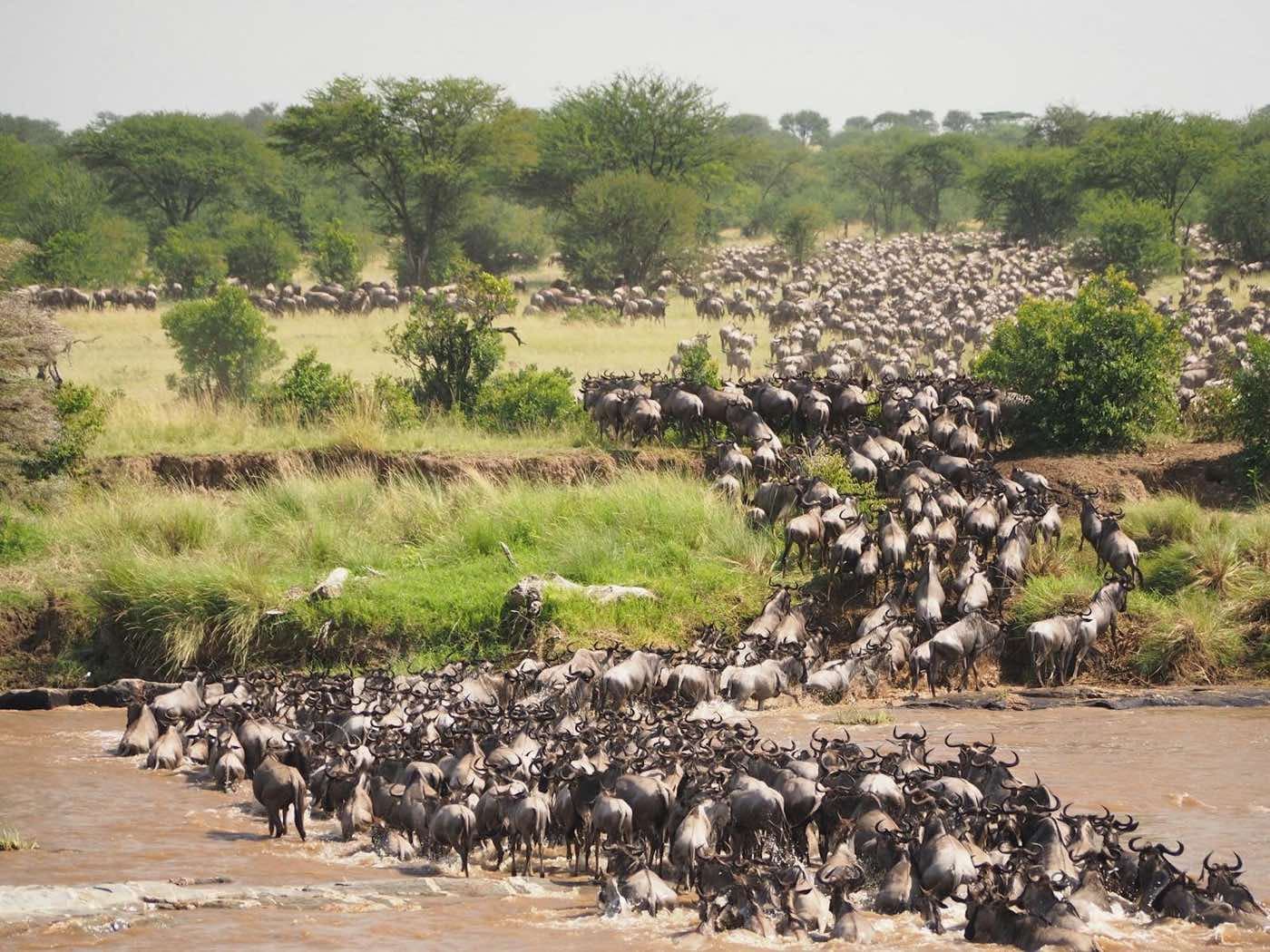
The line item that outweighs the car
On most self-drive destinations in this collection, the budget hinges on the vehicle, fuel and accommodation. In Tanzania the equation flips: a kitted-out 4x4 rents for €150 to €250 a day in Arusha, but park fees — charged in US dollars, per person, per day, plus a separate tax on the vehicle itself — outstrip that figure fast once you string together several parks on a classic northern circuit.
The reason: unlike an all-inclusive package billed by a tour operator, self-drivers pay full rate, gate by gate, with no pooling or group discount. That's the price of freedom to shape your own itinerary day by day — but it's also a budget line worth pricing out before you leave rather than discovering at the first gate.
How much each park costs, day by day
2025-2026 rates for non-resident foreign visitors, before VAT, sit roughly in these ranges. They're charged per person per 24-hour period — the entry time logged at the gate starts the clock, not the night spent on site.
An 18% VAT is added on top of every published rate: an adult listed at $70 USD actually pays around $82.60 USD once tax is included. Children under 5 are exempt everywhere; between 5 and 15, expect a reduced rate, with VAT added the same way.
| Park | Non-resident adult / 24h | Child 5-15 | VAT |
|---|---|---|---|
| Serengeti | ≈ $70 USD/day | ≈ $10 USD/day | + 18% |
| Tarangire | ≈ $59 USD/day | ≈ $18 USD/day | + 18% |
| Ngorongoro (conservation area) | ≈ $70 to $83 USD/24h | ≈ $15 to $24 USD | + 18% |
The extra fee everyone forgets: the Ngorongoro crater service fee
Paying to enter the Ngorongoro Conservation Area doesn't buy the right to drive down into the crater: the descent is subject to a separate crater service fee of $295 USD, charged per vehicle rather than per person, for a same-day round trip. The cap is six hours inside, checked at both access ramps.
It's a line you have to budget separately and deliberately: you can perfectly well sleep on the crater rim, enjoy the sunrise view and head on to the Serengeti without ever descending — saving $295 per vehicle in one stroke. Conversely, a last-minute vehicle swap sometimes means paying the service fee again, one more reason to keep the same 4x4 for the whole loop.
A fully cashless system: card required, cash refused
Tanzania's parks run on a near-cashless system: at the Serengeti, Ngorongoro or Tarangire gates, only Visa and Mastercard are accepted for entrance fees, the vehicle fee and the crater service fee. On a guided safari, the operator prepays everything in advance through an official control number; self-driving, it's on you to present your card directly at the checkpoint.
Network coverage can be patchy in these remote areas, and terminals occasionally go down. The most reliable safeguard is carrying two cards from different banks rather than relying on one — not something anyone wants to discover at the gate with a full car waiting behind.
Public camping over a lodge: the real cost lever
As in Namibia, the lever that swings the budget from single to triple isn't the park — it's the accommodation. A TANAPA public campsite inside the parks costs around $35 USD per person per night — a fraction of a lodge or serviced tented camp rate, for sleeping right in the heart of the park, hyenas included as ambient sound.
These public campsites can be booked ahead through the TANAPA portal, alongside entrance fees: paying in advance avoids the gate-side lottery for available pitches, especially in high season (June to October) when demand routinely outstrips the number of available spots.
Where the money actually goes, and why it's worth paying
A study by Anna Spenceley, Andrew Rylance and Sadiki Laiser, published in 2017 in the journal Koedoe, compared the fee structure of Tanzania's protected areas with that of competing African destinations and examined visitors' perceived value for money (study: doi.org/10.4102/koedoe.v59i1.1442). It notes that these fees, often seen by travellers as steep, remain the primary funding source for conservation in a country where safari tourism is a major share of the economy.
Another study, by Ashery Melita and Sonia Mendlinger, published in 2013 in the Journal of Service Science and Management, looked specifically at the Ngorongoro Conservation Area: it found that tourism revenue there directly funds local infrastructure — schools, health centres — benefiting the Maasai communities who continue to live there and graze their livestock among the wildlife (study: doi.org/10.4236/jssm.2013.61012). In practice, every fee paid at the gate funds part of what makes the park visible from the road in the first place: rangers, maintained tracks, anti-poaching patrols.
Sample budget: ten days, Tarangire-Ngorongoro-Serengeti, for two
For a sense of scale, take a classic ten-day northern loop for a couple: one day in Tarangire, one night on the Ngorongoro rim with a crater descent, then three days and two nights in the Serengeti at a public campsite. Park fees alone — entrance, conservation area, crater service fee, public camping, VAT included — typically come to between $1,300 and $1,800 USD for the two travellers, before the vehicle, fuel, food or a guide.
That figure alone explains why the budget for a self-drive safari in Tanzania (€6,000 to €8,500 for two over twelve to fifteen days with a Zanzibar extension, per our country page) runs well above a Namibian road trip: it isn't the car that's expensive, it's the parks — and that's precisely what funds their protection.
The checklist before you leave
In order: price out park fees, park by park and day by day, before even comparing 4x4 rental companies; book TANAPA public campsites online to skip the gate-side lottery; decide up front whether the crater descent ($295/vehicle) fits the budget or whether the rim view is enough; never count on cash as a backup at the gates.
- List every park on the route and work out the exact number of entry days (24-hour periods, not nights) for each
- Always add 18% VAT on top of the published rates
- Book public campsites and entrance fees ahead of time through the TANAPA portal wherever possible
- Carry two Visa/Mastercard cards from different banks: no gate accepts cash
- Decide whether the Ngorongoro crater descent ($295 USD per vehicle) is part of the trip before budgeting it as an extra
What our guide covers
The 'Tanzania Self-Drive' guide breaks down, park by park, current rates, card payment points, which public campsites to book first, and a northern-circuit itinerary designed to avoid unnecessary backtracking between gates — the best way to keep this budget line under control before signing the rental contract.
Travel tips
Get our independent-travel tips by email
The house methods — costed budgets, driving, itineraries — straight to your inbox. Instant bonus: our free excerpt “The 7 mistakes to avoid on a first Namibia road trip” and the current promo code.
No time to do it yourself?
A professional can take care of it: tailor-made trip, equipped 4x4 rental or a local guide. Describe your plans and, with your consent, we pass them on to partner professionals.
1. What you need
Before you go
Readers' questions
Is a self-drive safari actually cheaper than a guided one in Tanzania?
Park fees are exactly the same whether you're in a rented 4x4 or an agency vehicle with a driver — they're never the source of the difference. Self-drive savings come from elsewhere: no guide to pay, no agency markup on accommodation, and the freedom to sleep at a public campsite instead of an all-inclusive lodge.
Can you pay park fees in cash at the gate?
No. Tanzania's parks (TANAPA and the Ngorongoro Conservation Area) run a near-cashless system: only Visa and Mastercard are accepted at the gates. Carry two cards from different banks, since network coverage can be patchy in these remote areas.
Is the Ngorongoro crater service fee mandatory even if you don't drive down?
No, this $295 USD per-vehicle surcharge only applies if you actually descend into the caldera. Sleeping on the rim and enjoying the sunrise viewpoint without going down avoids it entirely.
Are park fees charged per day or per night spent on site?
Per 24-hour period starting from the entry time logged at the gate, not per night. Entering in the late morning and exiting the next day before that same time only counts as one full day — worth checking against gate opening hours (6am-6pm).