From our field notes
The Giant's Causeway by Car: Free or Paid Entry, and the Causeway Coastal Route Itinerary
Published 1 August 2026 · updated 1 August 2026 · 8 min read
By Clément Lacaille, publisher · our method
Do you have to pay to see the Giant's Causeway? No — and that is probably Northern Ireland's most profitable misunderstanding. Access to the 40,000 basalt columns is free on foot, via a public right of way: what you pay for is the National Trust car park and Visitor Centre. Here is how to plan the visit without getting caught out, how to drive the Causeway Coastal Route from Belfast or Dublin, and how to handle the trip's real quirk: switching from kilometres per hour to miles in a rental car.
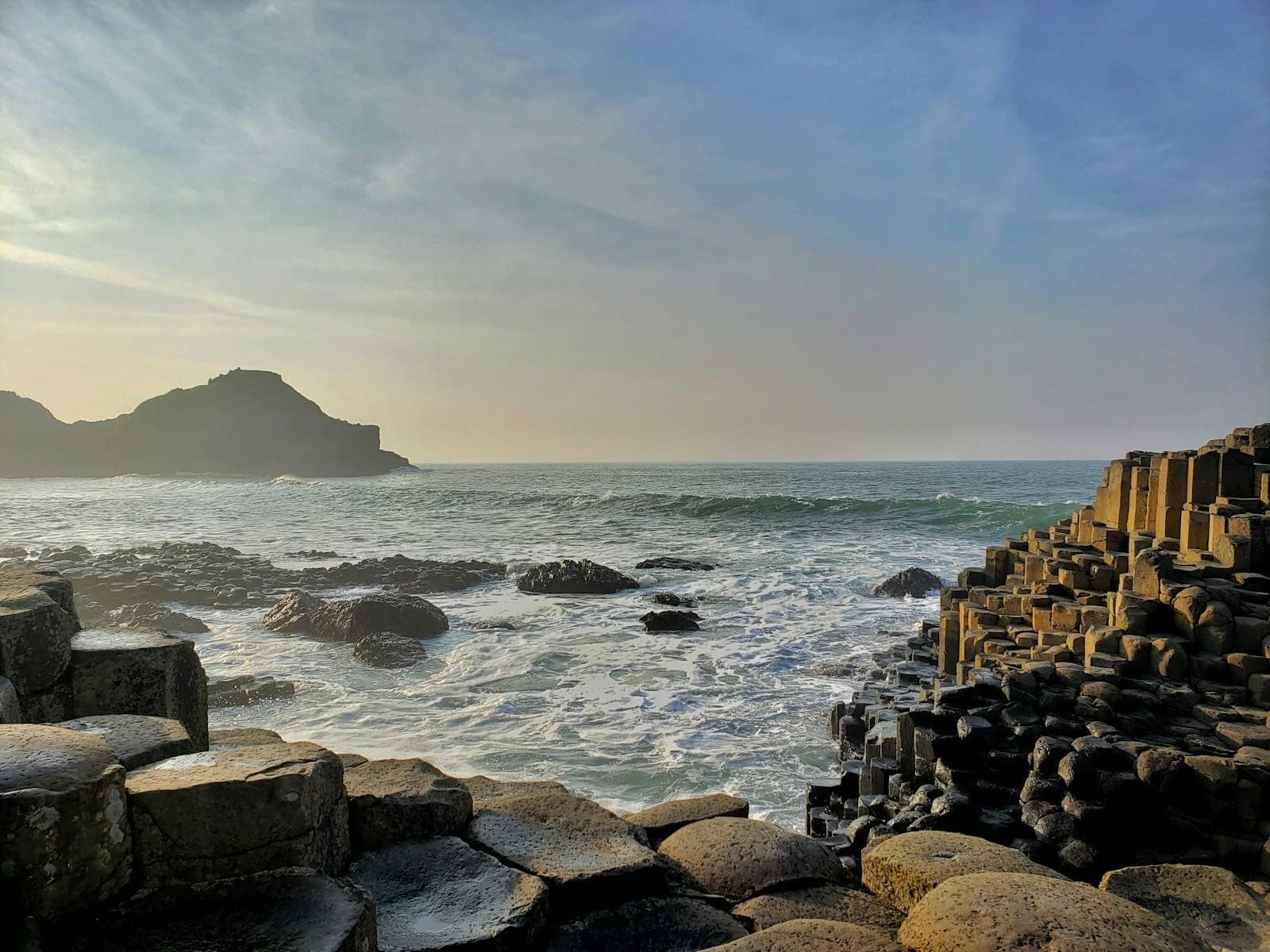
Free on foot, paid by car: what you actually pay for
Let's settle the confusion that fuels thousands of searches: a public right of way runs through the Giant's Causeway site, and walking down to the columns costs nothing. What the National Trust sells is the "Visitor Experience": on-site parking, access to the Visitor Centre exhibition, an audio guide and guided tours. In 2026 that ticket sits at around £13.50 to £15 per adult depending on the season (cheaper off-peak rates, free for National Trust members), best booked online in advance.
In practice, the distinction hinges on your car: if you park at the official Visitor Centre car park, the ticket is de facto mandatory for everyone in the vehicle. If you arrive on foot, by bus or from another starting point, nobody will ask you for a ticket to walk down to the basalt columns. The main path runs about 1 km from the centre; an accessible shuttle covers it every 10 to 15 minutes for £1 per person each way.
Should you skip the Visitor Centre altogether? Not necessarily: the exhibition puts the Antrim basalt plateau and the legend of Finn McCool into context, and the audio guide comes in eleven languages. But if your budget is tight or you have done your reading, a "stones only" visit is perfectly legitimate — the National Trust itself confirms it on its website.
The smart alternatives: Bushmills Park & Ride, the Dunseverick path, off-peak hours
First option for avoiding the official car park: the Park & Ride from Bushmills, 3 km from the site. From Dundarave car park, the National Trust offers a discounted combined ticket covering the shuttle and entry — a solution that also sidesteps the main car park's summer gridlock. Slower travellers can reach the site on the little Giant's Causeway & Bushmills Railway, a heritage tram line that follows the coast from the village.
Second option, and the most beautiful: arriving on foot along the coastal path. From the ruins of Dunseverick Castle, the Causeway Coast Way unrolls roughly 8 km of clifftop walking to the columns, without spending a penny — allow 2 to 2.5 hours in scenery that justifies the trip on its own. Short version: park in Portballintrae or Bushmills and walk in.
Third lever, whatever you choose: timing. The excursion coaches from Belfast and Dublin occupy the site roughly between 10am and 4pm. Before 9am or after 5pm you will share the columns with a handful of visitors — and the low evening light, setting the west-facing basalt ablaze, is by far the most photogenic. In summer the sun sets around 10pm at this latitude: late afternoon is a golden window.
The Causeway Coastal Route: Belfast to Portrush along the shore
The classic mistake is to shoot from Belfast to the Giant's Causeway inland (1h15 via the M2 and A26): efficient, but you miss the whole point. The Causeway Coastal Route hugs the sea for roughly 200 km between Belfast and Derry~Londonderry, and its most spectacular section — from the Glens of Antrim to Portrush — deserves a full day in itself.
The table below lists the major stops in order, with rounded cumulative distances along the coast from Belfast. Add the detours that give the drive its flavour: the narrow, vertiginous Torr Head loop, or the Glenariff waterfalls, "queen of the Glens".
| Stop | Km from Belfast (coastal road) | Suggested time on site |
|---|---|---|
| Carrickfergus Castle | ≈ 18 km | 30 min to 1 hr |
| Glenariff Forest Park (the Glens) | ≈ 75 km | 1 to 2 hrs |
| Cushendun and the Torr Head loop | ≈ 90 km | 1 to 1.5 hrs |
| Ballycastle | ≈ 110 km | 30 min to 1 hr |
| Carrick-a-Rede rope bridge | ≈ 120 km | 1.5 hrs |
| Giant's Causeway | ≈ 135 km | 2 to 3 hrs |
| Dunluce Castle | ≈ 142 km | 45 min |
| Portrush / Portstewart | ≈ 148 km | Evening, overnight stop |
Carrick-a-Rede, Dunluce, the Dark Hedges: the stops that need planning
The Carrick-a-Rede rope bridge — 20 m long, strung some thirty metres above the water — operates on timed tickets only, booked online: in 2026, expect around £13.50 per adult off-peak and £15 in high season (£8 per child, free for National Trust members). Summer slots sell out fast, and the bridge closes without notice in high winds: schedule it early in your day so you keep a fallback option.
Dunluce Castle, a medieval ruin perched on its cliff edge between the Causeway and Portrush, charges an entry fee of a few pounds (the site is run by Northern Ireland's heritage service) — the photo stop from the road, however, is free. As for the Dark Hedges, the avenue of beech trees made world-famous by Game of Thrones, the Bregagh Road has been closed to traffic since 2017: you park at the nearby car park and walk the avenue, ideally early in the morning.
That television fame is no side note when planning your trip: a study by Robert Moses Peaslee and Rosalynn Vasquez published in 2021 in the journal Adaptation (Oxford University Press) uses the Northern Irish case to show how "adaptation-induced tourism" around a hit series drives lasting increases in visitor numbers at filming locations, raising genuine carrying-capacity questions (study: doi.org/10.1093/adaptation/apaa012). The practical takeaway: at the Game of Thrones-branded sites — the Dark Hedges, Ballintoy Harbour — play the off-peak hours.
Crossing the border in a rental car: miles, pounds and cross-border authorisation
If you rent your car in Dublin, you will change country without ever seeing the border: no checkpoint, no customs sign — only the speed limit signs give the crossing away. In the Republic they are in km/h and prices are in euros; in Northern Ireland everything switches to miles per hour and pounds sterling: 30 mph in built-up areas (48 km/h), 60 mph on single carriageways (97 km/h), 70 mph on dual carriageways and motorways (113 km/h). Your speedometer shows both scales, but your brain takes a few kilometres to catch up.
The contractual point not to overlook: most rental companies in the Republic require you to notify them of any trip into Northern Ireland, for insurance and breakdown-cover reasons. Depending on the brand, this cross-border authorisation is either included or charged as an extra — check that line when you book, not at the desk. Driving north without declaring it can void part of your cover if anything goes wrong.
The checklist before crossing the border:
- Notify the rental company of your trip into Northern Ireland and check the cost of the cross-border authorisation
- Confirm that insurance and breakdown cover extend to the United Kingdom
- Carry a bank card with no foreign-exchange fees in sterling (plus a few pounds in cash for rural car parks)
- Pay Dublin's barrier-free M50 toll online by the following evening if you skirt the city
- Memorise the conversions: 30 mph ≈ 48 km/h, 60 mph ≈ 97 km/h, 70 mph ≈ 113 km/h
- Check that your sat nav displays speed limits in the right unit after the border
Driving on the left and narrow roads: the Glens and Torr Head
The whole island drives on the left, and the Causeway Coastal Route is actually a good training ground: the coastal A2 is wide, well surfaced, and traffic stays moderate outside July-August. Roundabouts — taken clockwise — and the first minutes after every stop are the moments demanding the most attention, especially if you alternate driver and passenger.
The serious business starts on the detours: the Torr Head road is a clifftop single track, with passing places for oncoming cars, steep gradients and free-roaming sheep — magnificent in clear weather, best avoided in fog or if driving on the left still makes you tense. The same logic applies in the upper Glens: narrow lanes lined with stone walls, where you hug the left more than feels natural.
One piece of advice worth gold for continental drivers: rent smaller than usual. On these roads, 10 cm less width beats any amount of horsepower, and wing mirrors brush the hedges sooner than you think. Our full guide to driving on the left in Ireland breaks down the method for getting the hang of it in half a day.
How long, where to stay, what weather to expect
From Belfast, the Antrim coast fits into one packed day: an early start via Carrickfergus, the Glens, Carrick-a-Rede, then the Giant's Causeway in the late afternoon once the coaches have left. But the ideal pace is two days with a night on the coast, between Ballycastle and Portstewart: you keep the detours (Torr Head, Glenariff) and, above all, you get the Causeway at sunset — and, why not, a second quiet visit the next morning. From Dublin, add roughly 260 km and 3 hours of driving each way: an overnight stay on the coast becomes near-essential.
For accommodation, the Bushmills–Portrush–Portstewart strip offers the most practical base for an early-morning start at the columns; Ballycastle is the best hub for combining Carrick-a-Rede with the Torr Head road. In high season, book several weeks ahead: the coast's hotel capacity remains modest compared with its summer crowds.
The weather, finally, is the one variable you cannot negotiate: at 55° north facing the Atlantic, conditions change by the hour — four seasons in one day is not a figure of speech here. A windproof jacket, shoes with grip (wet basalt is slippery) and a plan B in case Carrick-a-Rede closes for wind: that is the well-prepared visitor's mindset. The reward: dramatic skies, rainbows and a quality of light that grey continental days simply do not deliver.
Sixty million years under your feet
The roughly 40,000 columns of the Giant's Causeway were born about 60 million years ago, when basalt flows linked to the opening of the North Atlantic blanketed the Antrim plateau. As it cooled slowly, the lava contracted and fractured into regular, mostly hexagonal prisms — the same phenomenon that carved Devils Postpile in California or the basalt organ pipes of France's Auvergne volcanoes. The site has been a UNESCO World Heritage Site since 1986, a first for Northern Ireland.
Science has even dated the temperature of the event: a study by Anthony Lamur, Yan Lavallée and colleagues, published in 2018 in Nature Communications, reproduced the phenomenon in the laboratory and showed that columnar fracturing occurs as the already-solid basalt cools between 890 and 840°C (study: doi.org/10.1038/s41467-018-03842-4). In other words, the steps you will stand on froze into shape while the rock was still hotter than 800°C.
Local legend prefers another version: the giant Finn McCool is said to have built the causeway to go and challenge his Scottish rival Benandonner — and the twin columns of Fingal's Cave, on the Scottish island of Staffa, seem to back him up. Geology or mythology, the outcome is the same: a site that alone justifies the detour to the island's north — and which, let us say it one last time, costs nothing for those who arrive on foot.
Travel tips
Get our independent-travel tips by email
The house methods — costed budgets, driving, itineraries — straight to your inbox. Instant bonus: our free excerpt “The 7 mistakes to avoid on a first Namibia road trip” and the current promo code.
No time to do it yourself?
A professional can take care of it: tailor-made trip, equipped 4x4 rental or a local guide. Describe your plans and, with your consent, we pass them on to partner professionals.
1. What you need
Before you go
Readers' questions
Is entry to the Giant's Causeway free?
Yes, access to the columns is free on foot via a public right of way. What you pay for is the National Trust "Visitor Experience" — on-site parking, Visitor Centre, audio guide and guided tours — at around £13.50 to £15 per adult in 2026 depending on the season. By parking in Bushmills (Park & Ride) or arriving along the coastal path, you can visit without a ticket.
How long do you need for the Causeway Coastal Route?
One packed day from Belfast covers the essentials (the Glens, Carrick-a-Rede, the Giant's Causeway), but two days with a night between Ballycastle and Portstewart offer real comfort: the Torr Head and Glenariff detours, and the Causeway at sunset without the excursion coaches. From Dublin, add 3 hours of driving each way.
Can you take a car rented in Dublin into Northern Ireland?
Yes, but you must tell the rental company: most firms in the Republic require notification of any trip into the United Kingdom for insurance reasons, and some charge a cross-border authorisation fee. On the ground, the border is invisible — only the units change (miles, pounds sterling), along with the road signs.
Do you need to book the Carrick-a-Rede bridge in advance?
Yes: the crossing runs on timed tickets only, booked online (around £13.50 to £15 per adult in 2026 depending on the season). Summer slots sell out fast, and the bridge can close without notice in high winds — best to schedule it early in the day so you keep a fallback option.