From our field notes
Etosha or Kruger: Which Park for Your First Self-Drive Safari?
Published 2 August 2026 · updated 2 August 2026 · 9 min read
By Clément Lacaille, publisher · our method
They are the two schools of self-drive safari, and southern Africa's two best gateways for driving yourself among the animals: Etosha in Namibia, Kruger in South Africa. Both can be visited in an ordinary car, on marked roads, with camps to sleep inside the park. But the experience is almost opposite: one brings the animals to you around open waterholes, the other plunges you into dense bush where any bend can hide the big five. Here is the honest comparison, line by line.
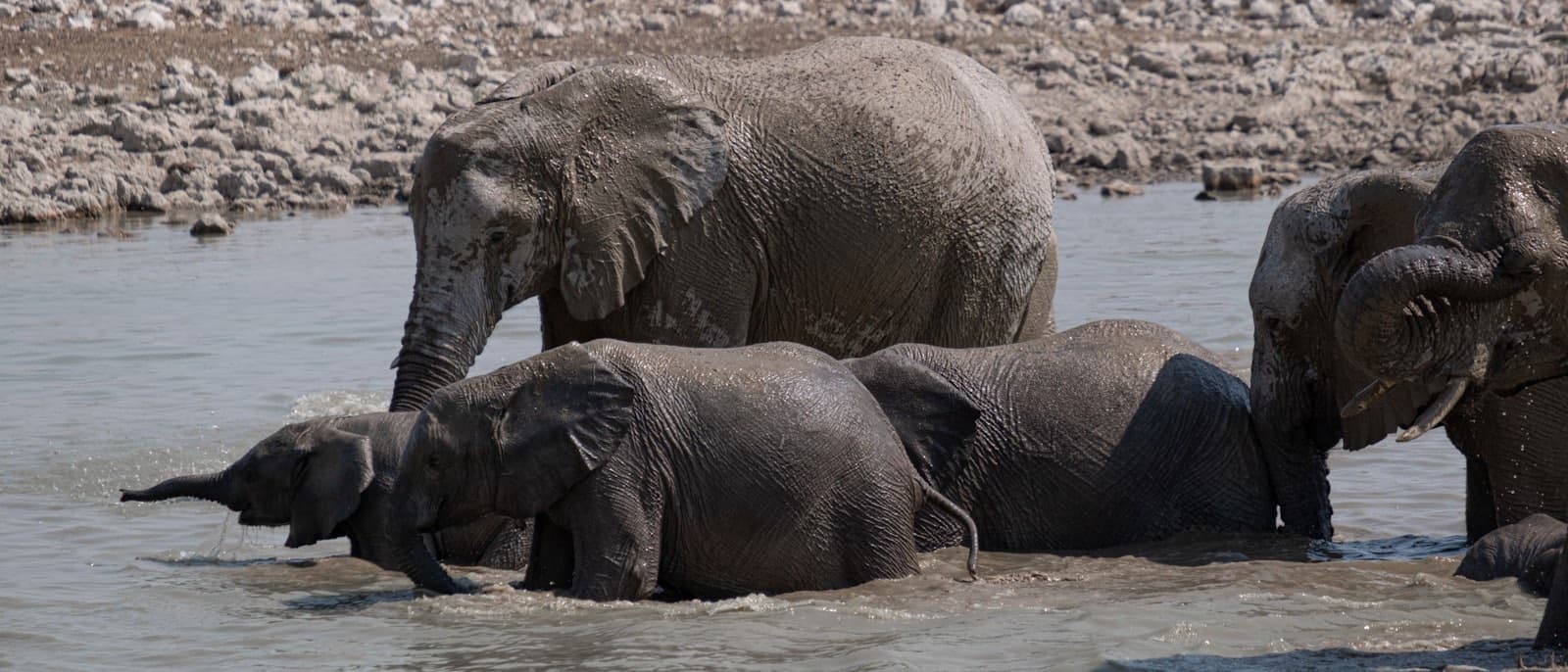
Two philosophies of game viewing
Etosha is a park of waiting: in this semi-arid landscape organised around an immense salt pan, life converges on dozens of waterholes, natural or drilled. The safari technique is crystal clear — park at a waterhole and let zebras, oryx, giraffes, elephants and, with patience, lions and black rhinos file past. Visibility is exceptional: low vegetation, white light, animals standing out hundreds of metres away. In the dry season, some waterholes deliver near-permanent theatre, including at night thanks to the floodlit waterholes of the Okaukuejo and Halali camps.
Kruger is a park of searching: a territory of bush and mopane the size of a small country, crossed by a dense network of tarred roads and gravel tracks, where the animals don't gather at one point but can be met everywhere — and nowhere. You drive slowly, read the signs, stop on the river bridges, swap tips with other drivers. Animal density and diversity are higher — the park holds the complete big five and close to 150 mammal species — but every sighting is earned more than at an Etosha waterhole.
The comparison line by line
Here is the summary of the differences that matter when planning the trip.
| Criterion | Etosha (Namibia) | Kruger (South Africa) |
|---|---|---|
| Viewing style | Waterhole stakeouts, maximum visibility | Searching the bush, more varied sightings |
| Signature wildlife | Elephants, black rhinos, lions, oryx — no buffalo | Complete big five, famed leopards, great diversity |
| Vehicle | Regular car fine, gravel roads | Regular car perfect, main network tarred |
| Best season | Dry season June to October | Dry season May to September |
| Malaria | Low, seasonal risk in the country's north | Seasonal risk area: prophylaxis often recommended |
| Access from Europe | Fly to Windhoek then ~400-500 km by road | Fly to Johannesburg then 4-5h by road or a domestic flight |
| Around the park | Damaraland, Sossusvlei, Swakopmund: the great Namibian loop | Panorama Route, Blyde River Canyon, eSwatini nearby |
What science says about your safari expectations
The choice between the two parks is best made from a simple question: what do you expect to see? A study by Peter Lindsey and colleagues among visitors to South African parks, published in 2007 in the Journal of Ecotourism, shows that first-time visitors focus their expectations on the charismatic large mammals — the big five, the great predators — while experienced visitors place more value on species diversity, birds and the overall quality of the ecosystem (study: doi.org/10.2167/joe133.0).
Applied to our duel, that grid works remarkably well: for a first safari built on 'seeing big animals, often and well', Etosha's waterholes offer the best success rate per hour spent in the park, with the bonus of guaranteed spectacle in the dry season. For a deepening safari — tracking a leopard, ticking off dozens of bird species, varying habitats — Kruger and its ecological depth take the lead.
Logistics: camps, gates and bookings
The two parks share the same principle: you sleep either in public camps inside (NWR at Etosha, SANParks at Kruger — bungalows and campsites) or in private lodges on the periphery, and the gates open from sunrise to sunset, with driving at night strictly forbidden. In both cases, the interior camps in peak periods sell out months ahead — our dedicated articles on Etosha's and Kruger's fees and hours detail the amounts and how bookings work.
The logistical differences lie elsewhere. Etosha slots into a Namibian road trip: you typically devote 2 to 3 nights to it within a two-week loop that strings together desert, coast and Damaraland — the park is a highlight of the trip, not the whole of it. Kruger can be a trip in itself: a full week from south to north doesn't exhaust it, and the neighbouring Panorama Route adds the spectacular scenery of the Blyde River Canyon. Note the health question too: Kruger lies in a seasonal malaria area, a point to discuss with a travel doctor, while the risk is more limited at Etosha.
Budget and season: nearly a draw, with nuances
On overall budget, the two options are close: South Africa offers often cheaper flights and very affordable car rentals, Namibia compensates with fewer stages and comparable fuel costs. In both countries, accommodation makes the difference — from budget camping to exclusive lodges — far more than the choice of park. Daily entry fees remain reasonable for foreign visitors in both cases, with rates revised regularly.
As for the calendar, both parks peak in the southern dry season — June to September-October — when the vegetation thins and wildlife concentrates near water. The green season (November-April) keeps real arguments at Kruger, where births and migratory birds animate the bush despite harder viewing; at Etosha, it scatters the wildlife away from the waterholes and clearly dilutes the park's comparative advantage. If your dates fall in the rainy season, Kruger is the more robust choice.
Our verdict by profile
First safari, wanting guaranteed spectacular scenes and a varied grand tour around it: Etosha, integrated into the classic Namibian loop — the formula we recommend most often to first-timers, and the one our 'Namibia on Your Own' guide develops stage by stage. Wildlife passion, wanting the complete big five, leopards and ecological depth, or simply dates locked into the green season: Kruger, possibly combined with the Panorama Route and the Cape.
The good news: this duel has no loser. The two parks are among the rare places on Earth where an ordinary driver, in an ordinary car, can live an extraordinary safari — and many travellers end up doing both, a few years apart. To settle the broader question of trip format, our guided-versus-self-drive safari comparison usefully completes this one.
Travel tips
Get our independent-travel tips by email
The house methods — costed budgets, driving, itineraries — straight to your inbox. Instant bonus: our free excerpt “The 7 mistakes to avoid on a first Namibia road trip” and the current promo code.
No time to do it yourself?
A professional can take care of it: tailor-made trip, equipped 4x4 rental or a local guide. Describe your plans and, with your consent, we pass them on to partner professionals.
1. What you need
Before you go
Readers' questions
Etosha or Kruger for a first safari?
Etosha if you want easy, spectacular waterhole sightings within a varied Namibian road trip. Kruger if you are after the complete big five, maximum diversity and a park that can fill an entire trip on its own.
Can you visit Etosha and Kruger in an ordinary car?
Yes in both cases: Kruger's main network is tarred and Etosha's gravel roads are perfectly manageable in a regular car in the dry season. A 4x4 only adds ground-clearance comfort, not extra access.
Is the big five present at Etosha?
No: Etosha has no buffalo, and its leopards are very elusive. You will however see elephants, lions and a remarkable number of black rhinos, plus arid-adapted species like oryx and springbok. The complete big five lives at Kruger.
What is the best season for these two parks?
The southern dry season, June to September-October, when wildlife concentrates near water and vegetation thins out. In the green season, Kruger remains a good choice thanks to births and birdlife; Etosha loses more of its edge.