From our field notes
When to visit Namibia: the calendar, region by region
Published 18 July 2026 · updated 18 July 2026 · 10 min read
By Clément Lacaille, publisher · our method
'When should I visit Namibia?' has two answers. The short one: the dry season, May to October. The real one: it depends on what your itinerary contains, because Etosha, the dunes, the coast and the Zambezi strip do not live to the same rhythm. Here is the calendar, region by region — and the three calendar traps that spoil trips.
The principle: one desert, four climates
Namibia is arid almost everywhere, and yet the year is not uniform: a dry, luminous austral winter (May-October, cold nights, infallible skies), a summer of thunderstorm rains (November-April, mostly January-March, green landscapes and heat), and in between, regions that obey neither rule — the coast, fog-bound all year, and the Zambezi strip, near-tropical.
We devoted a whole article to the dry-versus-green season duel, with the month-by-month table. This one takes the problem from the other end: region by region, so you can fit your route to the calendar — or the other way round.
Etosha: the great show from August to October
The deeper the dry season, the more Etosha's waterholes concentrate the wildlife: it is mechanical, and it is why August, September and October offer the most spectacular sit-and-wait sessions — elephants, rhinos, lions and giraffes taking turns at the same waterhole. The flip side: camps fully booked months ahead and busier roads.
In the green season Etosha changes register: the game disperses and sightings must be earned, but the pan fills in some years, migratory birds arrive in their thousands, and springbok and zebra young are born between December and February. A more intimate Etosha, for travellers who already have patience.
Sossusvlei and the Namib: good all year, scorching in summer
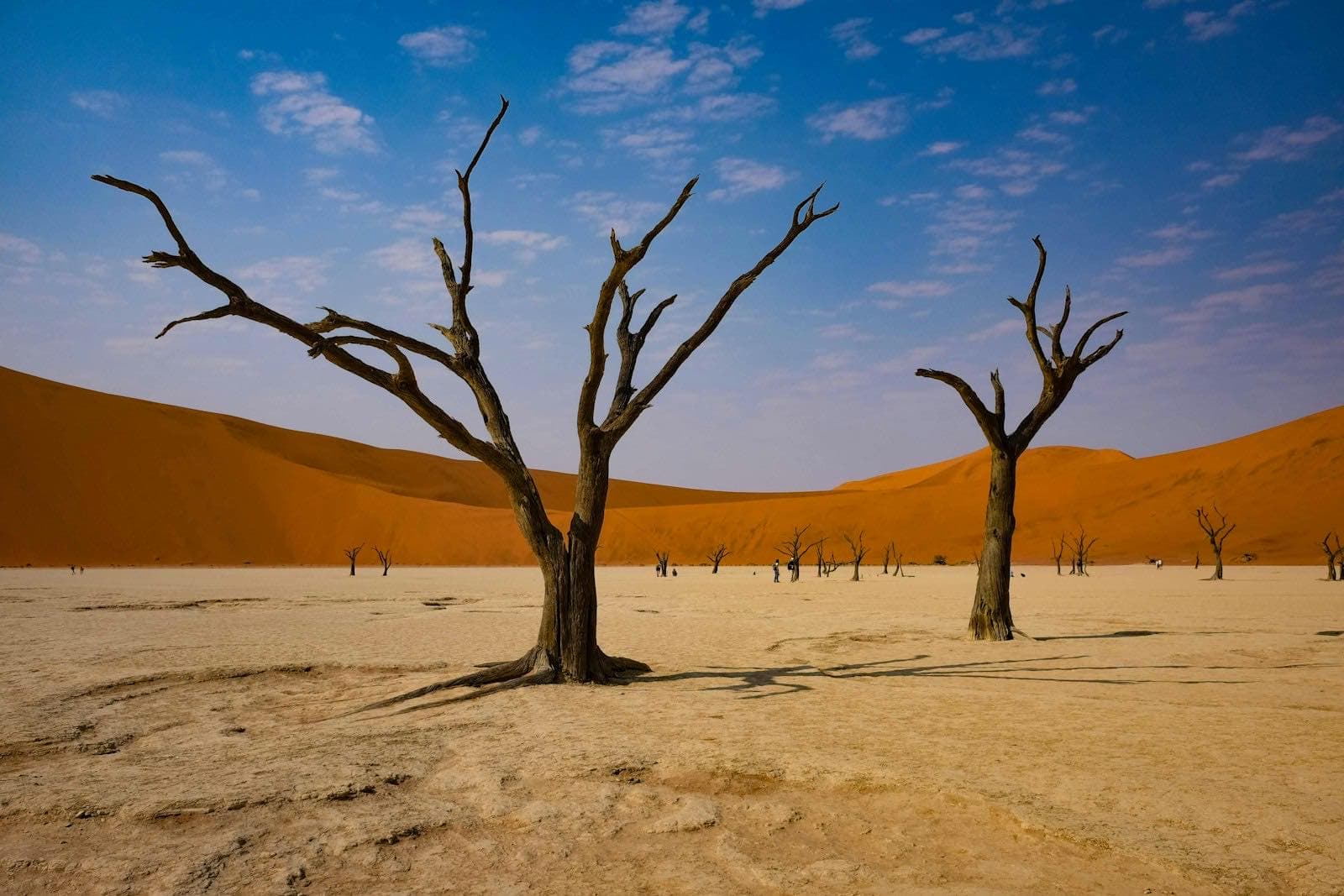
The dunes depend on no wildlife season: Sossusvlei works twelve months a year. The variable is heat: from October to February, the furnace demands you be in the dunes at gate opening and out before 11am. From May to September, cold mornings and crystalline air give the sharpest light — and the walk up Big Daddy becomes a pleasure again.
After good rains (some years, January-March), a rare phenomenon: water occasionally reaches Sossusvlei and turns the vlei into a mirror at the foot of the dunes. It cannot be planned — but if it happens during your trip, cancel the rest of your morning.
The coast — Swakopmund and Walvis Bay: permanent anti-summer
The cold Benguela current gives the coast a disorienting microclimate: morning fog much of the year, 15 to 20°C while the interior reads 35. At the height of the Namibian summer, Swakopmund is the country's air-conditioned refuge; in winter, pack the fleece for the Walvis Bay seal cruise.
The classic calendar trap: scheduling the coast while thinking 'beach'. The sea is cold all year and the sun often only breaks through in early afternoon. The coast is visited for the Cape Cross seals, the lagoon's flamingos, Sandwich Harbour and the end-of-the-world atmosphere — not for tanning.
Damaraland and Kaokoland: the golden window from April to June
In the north-west, everything is about water. At the end of the rains and just after (April-June), Damaraland is at its best: ephemeral rivers still active, softened landscapes, desert elephants moving up the Huab and Ugab riverbeds, temperatures back to civilised. From July to October, the wildlife concentrates on the last waterholes — easier to find, in landscapes more mineral than ever.
In the middle of the rains, some Kaokoland tracks become impassable and riverbeds must be crossed with care: only schedule the remotest areas with experience — or shift them to the dry season.
The South — Fish River Canyon: the hike only opens in winter
The canyon viewpoints can be admired all year (avoiding summer's burning hours). But if your dream is the great 85 km trek along the canyon floor, the calendar decides for you: the hike is only permitted during the austral winter, roughly early May to mid-September, deadly heat forbidding it the rest of the year — permit and medical certificate required.
The neighbouring Kalahari follows the country's general rule, with a green-season bonus: the red dunes cover themselves in blond and green grasses, spectacular at sunrise.
The Zambezi strip: tropical Namibia, out of phase
In the far north-east, the former Caprivi strip resembles nothing else in the country: perennial rivers, woodland, hippos — and a genuinely subtropical climate. Dry season (May-October): passable tracks, wildlife concentrated along the Kwando and Chobe, mosquitoes in retreat. Rainy season: sumptuous landscapes but difficult tracks and more present malaria — the region is a malaria zone, serious protection required in every season.
If you combine it with the Okavango Delta or Chobe in neighbouring Botswana, same logic: the dry winter is the safe bet — it is, in fact, when the Okavango flood peaks, the delta's famous paradox.
The calendar in one table
Crossing the regions yields three lessons. For a classic first trip (Sossusvlei, coast, Damaraland, Etosha): May-June and September offer the best ratio of spectacle to crowds to temperatures. July-August add the absolute wildlife guarantee, at the price of crowds and peak rates. The green season (December-March) is the choice of photographers, birders and budgets — accepting its share of chance.
| Region | Best window | Worth knowing |
|---|---|---|
| Etosha | August-October | Waterholes at their peak; book camps very early |
| Sossusvlei / Namib | May-September | Good all year; scorching summer, mornings essential |
| Coast (Swakopmund) | All year | Permanent fog and coolness; a refuge in summer |
| Damaraland / Kaokoland | April-June, then Jul-Oct | Desert elephants; tricky tracks after the rains |
| Fish River Canyon (trek) | May to mid-September | Hike closed the rest of the year |
| Zambezi strip | May-October | Malaria zone; difficult tracks in the rains |
Free excerpt
The 7 mistakes to avoid on a first Namibia road trip
A real excerpt from our Namibia expertise: 4x4 insurance, gravel speed, NWR bookings, season, fuel, Etosha… The 7 costly mistakes, and the right reflex for each. Instant access, with the current promo code.
No time to do it yourself?
A professional can take care of it: tailor-made trip, equipped 4x4 rental or a local guide. Describe your plans and, with your consent, we pass them on to partner professionals.
1. What you need
Before you go
Readers' questions
What is the best month for a first trip to Namibia?
May, June or September: the dry season is established (visible wildlife, tracks in good condition, nights already cold but mild days), without the July-August peak of crowds and prices. If your absolute priority is wildlife density at Etosha, aim for September-October instead — booking the camps far ahead.
Can you go in January or February?
Yes, knowingly: spectacular afternoon thunderstorms, green landscapes, newborn antelope, gentler rates — but dispersed wildlife at Etosha, strong heat in the south and a share of chance on some north-western tracks. It is a very fine, different trip: more photographic than wildlife-focused.
When can you see baby animals and migratory birds?
The birthing peak for springbok, zebra and wildebeest falls between December and February, at the start of the green season. Migratory birds are present roughly November to March — flamingos on the coast, raptors and waders inland when the pans fill.
When can you hike the Fish River Canyon?
The full descent (about 85 km, 4 to 5 days) is only permitted from early May to mid-September, on permit, with a medical certificate. Outside that window the heat at the canyon floor is dangerous and hiker access is closed — only the rim viewpoints remain accessible.