From our field notes
Visiting Etosha Self-Drive: Gates, Entrance Fees and Visiting Strategy
Published 20 July 2026 · updated 27 September 2026 · 8 min read
By Clément Lacaille, publisher · our method
In short: Etosha's four gates (Anderson, Von Lindequist, Galton, King Nehale) open at sunrise and close at sunset, roughly 6:00-7:30 am and 5:30-7:30 pm depending on the month; the permit is paid at the gate and is valid for 24 hours. Etosha is the only major park in southern Africa genuinely designed for self-drive safari: flat gravel roads, waterholes visible from your own car, no guide requirement. All you need to know beforehand: the opening hours of the four gates, the entrance fees (the increase announced for 2026 is still awaiting official publication by MEFT), and the strategy that separates "we saw something in the distance" from "we spent an hour at a waterhole with lions".
Why Etosha suits self-drive so well
Unlike most major East African parks, where safari happens in an open vehicle with a guide, Etosha is explored in your own rental car, on a network of flat limestone tracks linking dozens of mapped waterholes. No game-drive booking, no compulsory guide: you drive at your own pace, stop wherever you like (inside the vehicle), and pick your own hours.
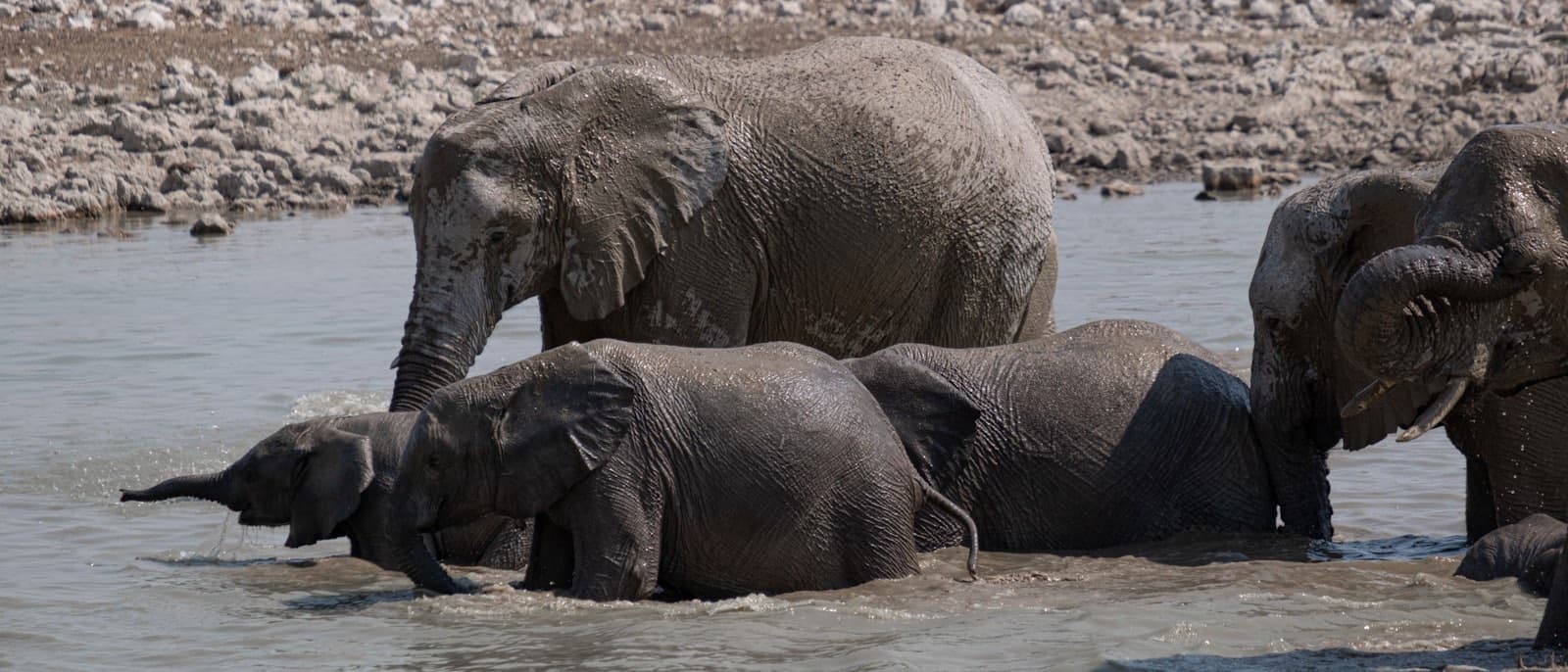
The nearly 5,000 km² salt pan that gives the park its name ("the great white place") concentrates wildlife around water, especially in the dry season: elephants, giraffes, zebras, oryx, wildebeest, lions and one of Africa's best black rhino populations gather at the same waterholes as visitors, with no need to leave the marked tracks.
The four gates and their opening hours
The park has four entrance gates: Anderson in the south (the busiest, serving Okaukuejo camp and the road in from Windhoek/Outjo), Von Lindequist in the east (serving Namutoni, the most convenient coming from Tsumeb or the Caprivi Strip), Galton in the west (a quieter sector, access to Dolomite Camp) and King Nehale in the north (the newest gate, on the Oshakati side).
All gates open at sunrise and close at sunset — in practice between 6:00 and 7:30 in the morning, and between 17:30 and 19:30 in the evening depending on the month, with the exact schedule posted at every gate and NWR camp. Arriving after a gate's or camp's closing time risks a fine: always keep a 45-minute buffer in the late afternoon, waterholes make you lose track of time faster than you'd think.
Entrance fees: MEFT's latest official schedule
The latest official schedule published by Namibia's Ministry of Environment, Forestry and Tourism (MEFT) is the one in force since 1 January 2021: an entrance fee and a conservation fee, paid together at the gate or at camp, for each person and each vehicle, valid for 24 hours from the time of entry. Keep your receipt, it is checked on the way out.
New fees have been announced for 2026; they are awaiting official publication by MEFT, so we do not repeat the amounts in circulation here. Check the amount posted at the gate before finalising your budget.
On this schedule, a non-SADC couple in a standard tourist vehicle pays N$350 per day (2 × 150 + 50). Etosha, Namib-Naukluft (including Sossusvlei and Sesriem), the Skeleton Coast, the Waterberg Plateau, Ai-Ais, Cape Cross, Dorob and Tsau//Khaeb all fall under the same, highest fee category.
| Category | Entrance fee | Conservation fee | Total per day |
|---|---|---|---|
| Adult (over 16), non-SADC foreign national | N$100 | N$50 | N$150 |
| Adult, SADC national | N$60 | N$40 | N$100 |
| Namibian adult | N$30 | N$20 | N$50 |
| Child aged 9-16, non-SADC foreign national | N$60 | N$40 | N$100 |
| Child aged 9-16, SADC national | N$30 | N$20 | N$50 |
| Namibian child aged 16 and under | Free | Free | Free |
| Child aged 8 and under (all nationalities) | Free | Free | Free |
| Vehicle, 10 seats or fewer | N$30 | N$20 | N$50 |
Do you need a 4x4 to drive inside the park?
No: Etosha's internal roads are flat, limestone-surfaced and easy driving, manageable in a rental sedan during the dry season — the park's 60 km/h speed limit has nothing to do with traction anyway. The real question isn't Etosha itself but the rest of your route (Damaraland, the Skeleton Coast, Kaokoland), which almost always tips the balance toward a 4x4 for the whole trip. Our article on the topic breaks down how to decide based on your actual itinerary.
During the rainy season (November to April), some secondary tracks close or turn muddy after a storm: the main routes between the three historic camps generally stay passable, but it's worth checking at the gate on the morning itself.
The waterhole strategy
The classic first-timer mistake is to rack up kilometres hoping to spot an animal on the track. The better method is the opposite: pick two or three well-known waterholes on the park map, park with the engine off, and wait 30 to 60 minutes — early morning and late afternoon, when the heat drives wildlife to drink. A stationary car sees far more than one that keeps moving.
The three historic camps (Okaukuejo, Halali, Namutoni) each have their own floodlit waterhole, visible from behind a low wall without leaving the camp — Okaukuejo is famous for black rhinos after dark. Sleeping inside the park rather than at its gates gives you access to these night vigils and to the often most productive early-morning hours.
Where to stay: inside the park or at the gates
The NWR camps (Okaukuejo, Halali, Namutoni, Dolomite) combine camping and rooms, with a fuel station, shop and restaurant — convenient, but book well ahead in the dry season, as demand regularly outstrips supply. Outside the Anderson and Von Lindequist gates, a wide range of private lodges and campsites, often more comfortable, means entering right at opening time to make the most of a full day inside the park, without access to the night-time waterholes.
Our article on booking Namibian campsites walks through the process and the realistic lead times for locking in a spot during peak season.
How long to plan for
Two nights give a decent first experience: one full day bracketed by two half-days. Three nights let you cross the park from west to east while changing camps, avoiding retracing the same tracks twice and covering more waterholes. Below two nights, the approach drive (often half a day from Windhoek or Damaraland) eats up too much of your time on the ground.
To place Etosha within a full Namibian itinerary, our article on ideal road trip length breaks down how to split days between the north, the coast and the south depending on your total trip length.
Sources
Free excerpt
The 7 mistakes to avoid on a first Namibia road trip
A real excerpt from our Namibia expertise: 4x4 insurance, gravel speed, NWR bookings, season, fuel, Etosha… The 7 costly mistakes, and the right reflex for each. Instant access, with the current promo code.
No time to do it yourself?
A professional can take care of it: tailor-made trip, equipped 4x4 rental or a local guide. Describe your plans and, with your consent, we pass them on to partner professionals.
1. What you need
Before you go
Readers' questions
Does the entrance fee apply per day or per visit?
Per day: the permit paid at entry is valid for 24 hours from the time of payment, not until midnight. For a two-night stay (three days of presence in the park), you'll generally need to pay three days of entry per person, unless your arrival and departure times happen to fit within two 24-hour cycles.
Can you enter and exit multiple times on the same permit?
Yes, as long as the 24-hour permit is still valid: for example, you can stay at a lodge just outside a gate and make several trips into the park on the same day without paying again, keeping the receipt to show at each crossing.
Do you need to book your entry in advance?
No, the entrance fee is paid directly at the gate or at camp, with no advance booking. Only accommodation (NWR camps or lodges) needs to be booked ahead in the dry season — access to the park itself remains open to anyone paying the day rate.
Did entrance fees go up in 2026?
An increase in Namibia's park entrance fees has been announced for 2026, but the new fees are awaiting official publication by MEFT: the latest schedule published on the ministry's website is still the one in force since 1 January 2021. Check the amount posted at the gate before finalising your budget, especially if your trip is planned several months after booking your vehicle.