From our field notes
The Jaffna Islands: Delft, Nainativu and the Causeways at the End of Sri Lanka
Published 31 July 2026 · updated 31 July 2026 · 8 min read
By Clément Lacaille, publisher · our method
Past Jaffna, the road does not stop at the water's edge: it carries on across it. Causeways laid flush with the lagoon link the archipelago's islands one by one — Kayts, Karainagar, Punkudutivu — to the jetties where ferries continue to sacred Nainativu and far-flung Delft, with its coral fort and wild ponies. It is Sri Lanka's most singular excursion, light-years from the southern beaches. Here is how to organise it from Jaffna, by car or scooter.
An archipelago at the end of the A9
The Jaffna archipelago spreads west of the peninsula, in the shallow waters of the Palk Strait, facing nearby India. Seven main islands, three of which you can reach by car thanks to a system of causeway-dykes partly inherited from the Dutch era: Kayts, closest to Jaffna; Karainagar to the north, with Casuarina beach; and Punkudutivu to the south-west, the road's terminus and departure point for the boats. The others — Nainativu, Delft (Neduntivu), Analaitivu, Eluvaitivu — are reached only by ferry.
Long cut off from the world by the civil war, the archipelago reopened to visitors along with the rest of the North. Tourism research documents this renaissance: a study published in 2021 in the International Journal of Tourism Cities, based on interviews and focus groups with local stakeholders, analyses Jaffna's conversion from 'post-war city' to tourism destination, between exceptional cultural heritage and infrastructure still catching up. A decade on, that diagnosis still describes the archipelago well: extraordinary places, a warm welcome, and almost no organised tourism — which is precisely its charm.
The causeways: driving on the lagoon
The archipelago's first experience happens behind the wheel: the causeways spanning the lagoon, flush with milky turquoise water, dotted with wading fishermen, hundreds of shorebirds and, in season, flamingos. The longest links Punkudutivu to the Kurikadduwan jetty: a narrow road laid over the water for several kilometres, hypnotic at daybreak. Drive slowly — the causeway is shared with bicycles, buses and goats — and stop only at the widened passing points rather than on the dyke itself.
By car or scooter, the drivable archipelago makes a half-day trip from Jaffna: the Dutch fort of Hammenhiel between Karainagar and Kayts, village temples and churches, Casuarina beach for a swim. It is also the perfect warm-up the day before a ferry day to Delft.
Nainativu: the island of two shrines
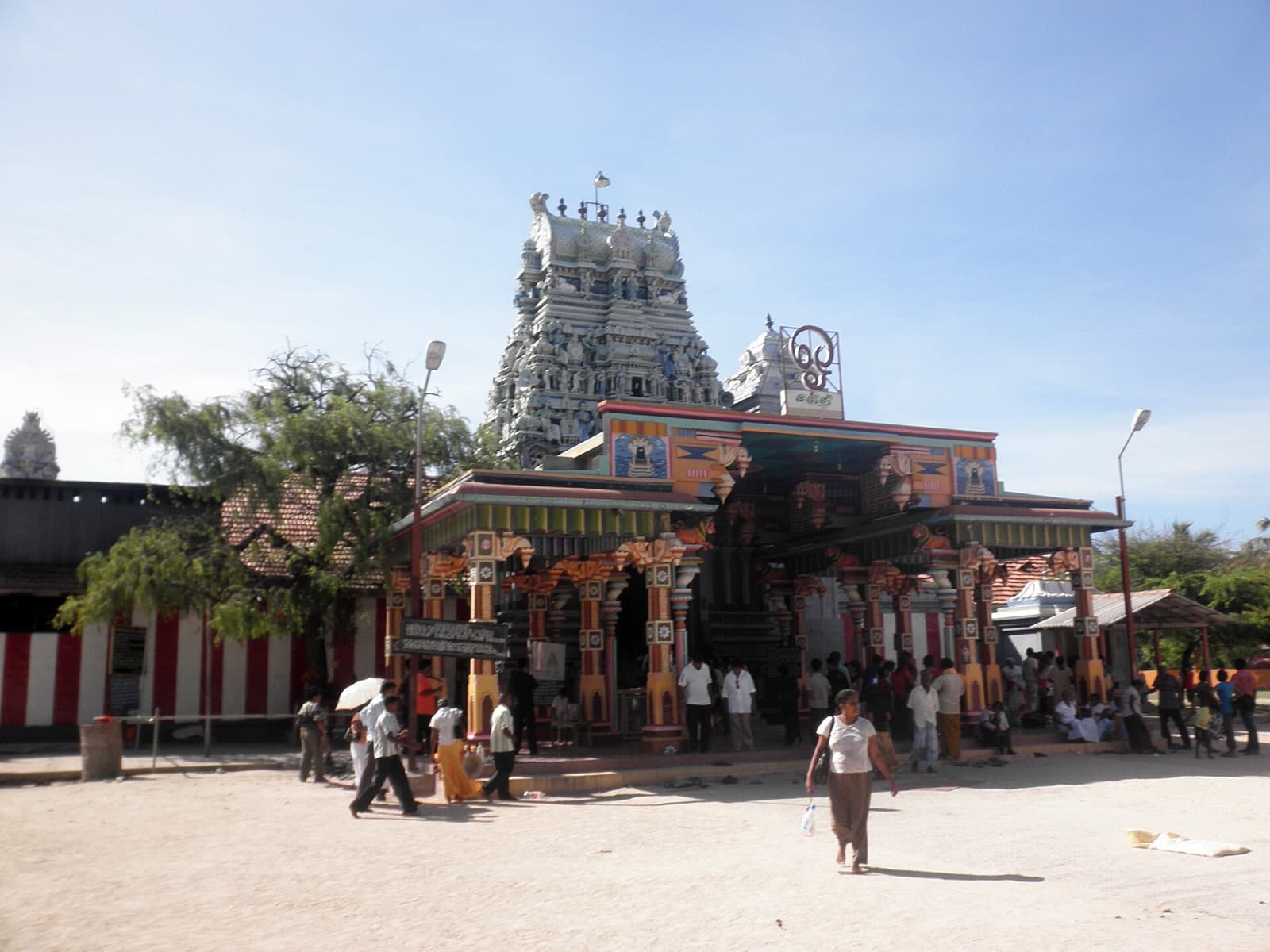
Twenty minutes by boat from Kurikadduwan, tiny Nainativu concentrates two major pilgrimage sites: the Nagapooshani Amman Kovil, a Hindu temple to the serpent goddess whose multicoloured gopurams tower over the jetty, and, a kilometre away, the Nagadeepa Purana Vihara, one of the country's most venerated Buddhist shrines — the Buddha himself is said to have visited, according to tradition. Watching the two streams of pilgrims cross on the same jetty sums up Sri Lanka better than many speeches.
Local ferries shuttle all day for a symbolic fare, no booking needed; crossings are simply more spaced out in the middle of the day. Allow two hours ashore for both shrines, shoulders and legs covered for each.
Delft: wild ponies, coral and a baobab
Delft — Neduntivu in Tamil — is the long-haul excursion: about an hour's crossing from Kurikadduwan, to a flat, windswept island unlike anywhere else in the country. Walls and houses are built of fossil coral; wild ponies, descendants of mounts introduced in the Dutch era, roam in small groups across a palmyra steppe; and you visit, in happy disorder, the ruins of a coral-built Dutch fort, a centuries-old baobab attributed to Arab seafarers, and a colonial dovecote. The whole has an end-of-the-world island flavour that amply justifies the day.
Logistics: the public ferry leaves Kurikadduwan in the morning (arrive early, seats go fast), the crossing is free or nearly so, and the return runs mid-afternoon — check the day's time at the jetty, it varies. On the island, tuk-tuks and local pick-ups offer the island tour at negotiable prices; there is no ATM and no restaurant worthy of the name: bring water, cash and lunch.
Organising the day from Jaffna
The sequence that works: leave Jaffna around 6:30 am, road and causeways to Kurikadduwan (about an hour and a quarter), morning ferry to Delft, island tour, back at Kurikadduwan mid-afternoon, a stop at Nainativu on the way back if the shuttle times allow — otherwise give it its own late afternoon — and the causeways at sunset to finish. Your car or scooter stays parked at the Kurikadduwan jetty: no visitor vehicles cross on the archipelago's ferries.
Two tips from experience: avoid full-moon days and major poya (Buddhist festivals), when Nainativu draws considerable crowds; and pack a hat and serious sunscreen — the archipelago is flat, coral-white and shadeless, and the glare is ferocious.
What our guide says
Our 'Sri Lanka on Your Own' guide devotes a full chapter to the North — Jaffna, the peninsula and the archipelago — with verified ferry times, the detail of the drive up from Colombo on the A9, and how it fits with the Cultural Triangle in a three-week itinerary.
Travel tips
Get our independent-travel tips by email
The house methods — costed budgets, driving, itineraries — straight to your inbox. Instant bonus: our free excerpt “The 7 mistakes to avoid on a first Namibia road trip” and the current promo code.
No time to do it yourself?
A professional can take care of it: tailor-made trip, equipped 4x4 rental or a local guide. Describe your plans and, with your consent, we pass them on to partner professionals.
1. What you need
Before you go
Readers' questions
Can you take your car or scooter to the islands on the ferry?
No: the archipelago's ferries carry passengers, bicycles and local freight, not visitors' vehicles. You park at the Kurikadduwan jetty (a simple lot, informally watched thanks to the constant activity) and explore Delft and Nainativu on foot, by tuk-tuk or in a local pick-up.
How much time should you allow for the Jaffna islands?
A full day for Delft (morning ferry, mid-afternoon return), a half-day for Nainativu and the causeways. The ideal is two nights in Jaffna, splitting it: drivable archipelago and Nainativu on day one, Delft on day two.
Are the Jaffna islands worth the detour from the south of the country?
Not on their own — it is the whole North that justifies the journey up: Jaffna, its Tamil culture, temples and cuisine, with the archipelago as the finale. Allow three days minimum, within an itinerary passing through Anuradhapura or Trincomalee on the way up or back.