From our field notes
Kolmanskop, the ghost town of the Namibian desert: visit, permit and access from Lüderitz
Published 29 July 2026 · updated 19 August 2026 · 8 min read
By Clément Lacaille, publisher · our method
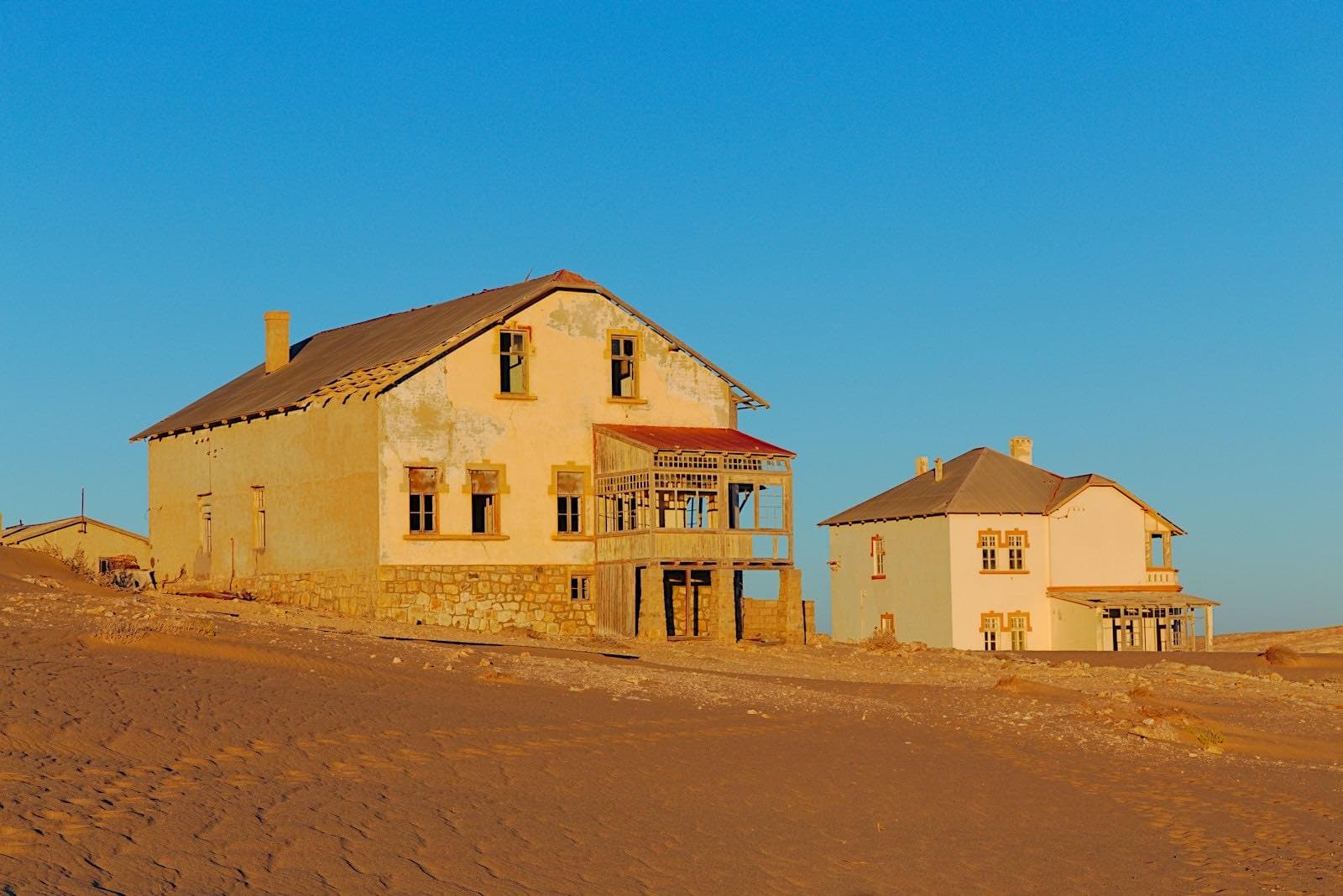
About ten kilometres from Lüderitz, on the edge of the Namib Desert, Kolmanskop is one of the most photographed ghost towns in Africa. Born from the diamond rush after 1908, this small German mining town was abandoned by the mid-20th century, then slowly reclaimed by the sand: today the dunes spill into living rooms and bedrooms, climb the staircases and pour through the broken windows. Located in the Sperrgebiet, the former forbidden diamond zone, it can only be visited with a permit. This guide covers the site's history, the mandatory permit, visiting hours, sunrise photography and access by car from Lüderitz or Aus, to be combined with the Namibian south.
A town born from diamonds, then given back to the desert
Kolmanskop's history spans only a few decades. In 1908, a worker picked up a diamond along the railway line near Lüderitz, in what was then German South West Africa under colonial administration. The find triggered a genuine fever: a town was founded in the middle of the desert, with grand houses, a hospital, a school, a casino, a ballroom and even an ice factory. During the 1920s, Kolmanskop concentrated wealth out of all proportion to its size, entirely geared towards diamond extraction.
The decline was as swift as the rise. Richer deposits found further south, towards Oranjemund, drew the activity away, and the town was gradually deserted before being abandoned by the mid-20th century. Once the inhabitants had left, nothing held the sand back: the Namib dunes crossed the thresholds and invaded the rooms. It is precisely this reconquest by the desert that gives the place its singularity and beauty today.
Why the sand reclaimed the town
Kolmanskop sits on the edge of a desert where sand is constantly set in motion by powerful, steady winds coming off the Atlantic. Once human maintenance stopped, nothing stood in the way of the advancing dunes, which piled up against the walls and then inside the buildings until they filled entire floors.
This phenomenon is anything but anecdotal: a study by Besler published in 2013 in Geografiska Annaler ("Helga's Dune: 40 years of dune dynamics in the Namib Desert") documents the movement speed of the Namib dunes over several decades, which sheds light on the gradual burying of Kolmanskop's houses. In other words, the town did not collapse: it was slowly enveloped, room after room, by a desert whose mobility can actually be measured. Reference: doi.org/10.1111/geoa.12013.
The access permit: mandatory, hours and photography
Kolmanskop lies within the Sperrgebiet, the former "forbidden zone" created to protect diamond mining. You therefore cannot enter freely: an access permit is mandatory. It is typically obtained in Lüderitz or through an agency/tour operator; check the current price at the time of your visit rather than relying on a fixed figure, as it changes. The visit usually takes place in the morning, with guided tours that tell the story of the site and give access to the buildings.
For photography, there is a specific permit, often called a "photo permit" or sunrise permit, which allows earlier entry to photograph the houses in the low morning light, before the crowds. It is the favoured option for photographers who come for the famous sand-filled rooms. Check the exact conditions in advance (morning opening time, guided-tour window, permit type) with your point of sale, as they shape the organisation of your day.
| Item | Reference point |
|---|---|
| Location | ≈ 10 km east of Lüderitz, in the Sperrgebiet |
| Permit | Mandatory, obtained in Lüderitz or via an agency |
| Guided tour | In the morning, in a group (historical account + buildings) |
| Photo permit | "Sunrise" permit: earlier entry for morning light |
| Price | Variable — check at the time of the visit |
| Access | Tarred road from Lüderitz / Aus |
Access by car: wind, sand and a tarred road
Good news for a road trip: access to Kolmanskop is on a tarred road. From the south of the country, you reach Lüderitz via the B4 that crosses Aus, then drive the last few kilometres to the site located just east of the town. For access itself you don't need a specific 4x4: the difficulty comes not from the track but from the conditions.
The real factor to anticipate is the wind, often strong and sand-laden in this coastal region. Sand can build up on the road and reduce visibility, and it gets in everywhere. Plan to close the vehicle up tightly, protect your photo gear (fine grains are the enemy of lenses), and bear in mind that windows and bodywork suffer from sandblasting in strong wind. Fill up and do your shopping in Lüderitz, the last service point before the wide-open south.
Photographing the sand-filled houses
Kolmanskop is a photographic subject unlike any other: ochre dunes surging through a doorway, faded wallpaper, light carving diagonals of sand across empty rooms. The sunrise permit makes full sense here, because the low morning light brings out the texture of the sand and avoids the harsh contrasts of midday. Move slowly from house to house: each room frames differently depending on the orientation of the windows and the height of the dunes.
As for gear, a wide angle helps to take in a whole room and its dune, while a longer focal length isolates details (a handle, a radiator emerging from the sand). Absolutely protect your lenses from airborne sand, change optics under cover, and carry a cloth. Finally, respect the place: don't move the sand, don't climb on fragile structures, and follow the guides' instructions.
Combining Kolmanskop with the Namibian south
Kolmanskop is rarely visited on its own: it fits naturally into a loop of the Namibian south. The Aus area, on the road to Lüderitz, is known for its wild desert horses; further east, the Fish River Canyon, one of the largest canyons in the world, is the other great highlight of the south. Many itineraries string these sites together over a few days, working around the long distances typical of Namibia.
Plan the logistics around these distances and your visiting hours (the morning at Kolmanskop). Booking a night in Lüderitz or Aus lets you start the visit early, especially if you have taken the sunrise permit, then get back on the road towards the canyon or head up into the centre of the country. To fine-tune the stage and the driving times, rely on our dedicated guide.
| Route | Approximate distance |
|---|---|
| Lüderitz → Kolmanskop | ≈ 10 km |
| Aus → Lüderitz | ≈ 120 km |
| Aus → Fish River Canyon (area) | a few hours' drive |
Free excerpt
The 7 mistakes to avoid on a first Namibia road trip
A real excerpt from our Namibia expertise: 4x4 insurance, gravel speed, NWR bookings, season, fuel, Etosha… The 7 costly mistakes, and the right reflex for each. Instant access, with the current promo code.
No time to do it yourself?
A professional can take care of it: tailor-made trip, equipped 4x4 rental or a local guide. Describe your plans and, with your consent, we pass them on to partner professionals.
1. What you need
Before you go
Readers' questions
Do you need a permit to visit Kolmanskop?
Yes. Kolmanskop lies within the Sperrgebiet, the former forbidden diamond zone, and access requires a mandatory permit, obtained in Lüderitz or through an agency. A "sunrise" photo permit exists for earlier entry.
When does the visit take place?
Guided tours take place in the morning. Holders of a photo/sunrise permit can enter earlier to enjoy the low light before the crowds. Check the exact hours when booking, as they can change.
Do you need a 4x4 to reach Kolmanskop?
No, access is on a tarred road from Lüderitz (via Aus on the B4). The point of attention is not the track but the wind and sand, which can reduce visibility and get in everywhere: protect your vehicle and your photo gear.
Can you combine Kolmanskop with the Fish River Canyon?
Yes, it is a classic pairing in the Namibian south. Travellers often visit Kolmanskop and Lüderitz, then head to the Fish River Canyon, taking into account the long distances and the morning visit at Kolmanskop.