From our field notes
Twyfelfontein, Namibia: UNESCO Rock Engravings, Mandatory Guide and Official Fees
Published 29 July 2026 · updated 13 October 2026 · 8 min read
By Clément Lacaille, publisher · our method
The Twyfelfontein entrance fee is N$270 per international adult and N$220 for ages 8 to 17 (free under 8), with the compulsory local guide included and payment in cash at the visitor centre, according to the National Heritage Council's latest gazetted schedule. Yes, you can visit on a self-drive trip: the site, Namibia's first UNESCO World Heritage Site (2007), is open daily from 8am to 5pm and reached on a signposted gravel track off the C39 west of Khorixas. Below: the official fees for Twyfelfontein and its neighbours, what the guided walk shows you, and how to fit it into a Damaraland loop.
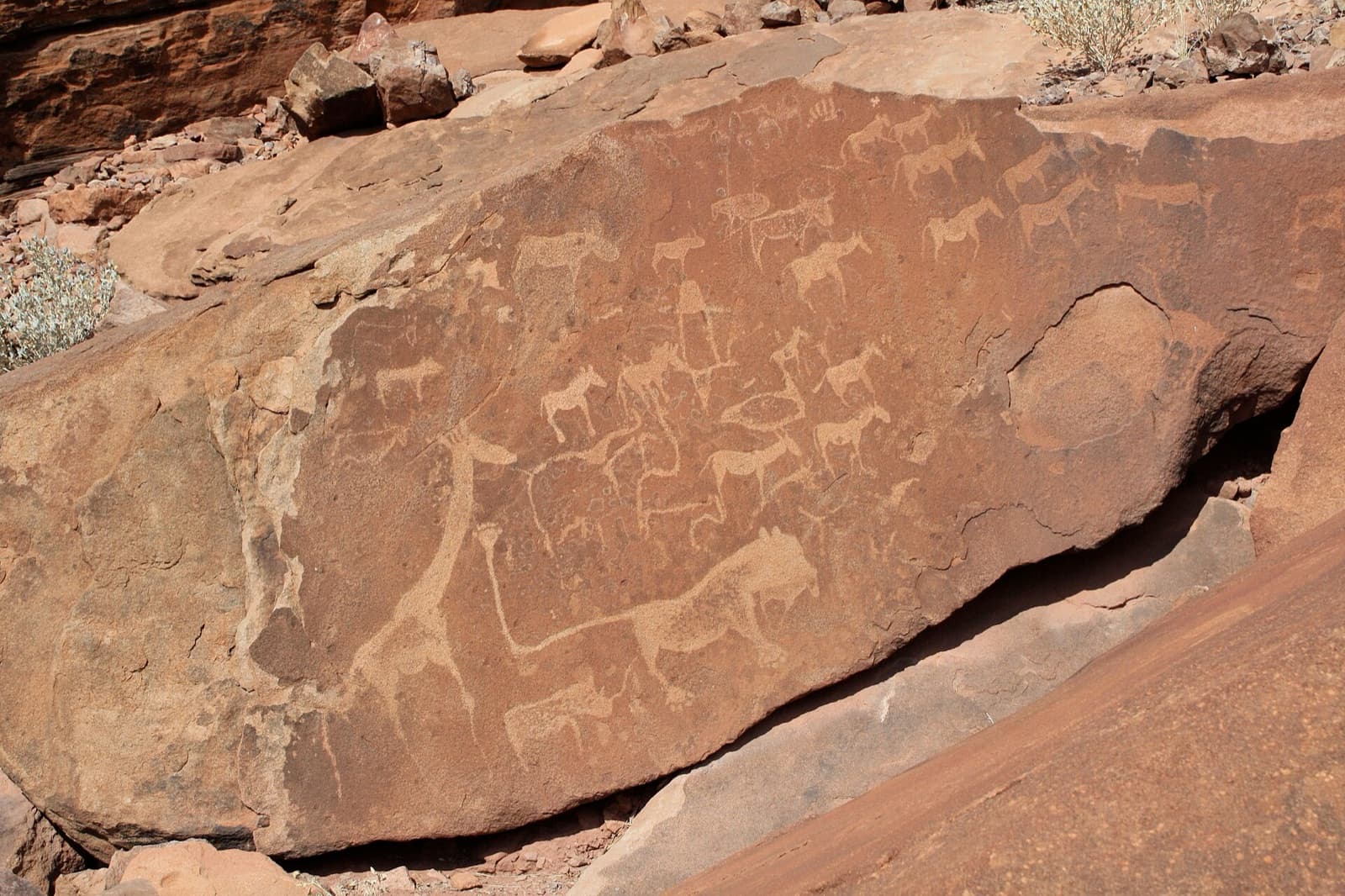
The largest rock engraving site in southern Africa
Twyfelfontein holds over 2,000 rock engravings (petroglyphs) spread across more than 200 sandstone slabs, the oldest dating back roughly 6,000 years. They were made by San communities, hunter-gatherers who occupied the region for millennia before the arrival of the first herders and, later, European settlers.
The motifs are overwhelmingly animal figures: giraffes alone account for roughly 40% of the engravings, alongside rhinoceros, zebra, oryx, lions and both animal and human tracks. Some researchers, including John Kinahan, read a shamanic function into them, tied to rain rituals and the location of water points, rather than a simple inventory of local wildlife. In 2007 the site was inscribed on the UNESCO World Heritage List — a first for Namibia — and remains protected under Namibia's 2004 National Heritage Act, managed by the National Heritage Council.
Mandatory guided tour: what to expect on site
You can't walk the trails at Twyfelfontein on your own: a local guide is compulsory, and the cost is included in the entrance fee. Guides are recruited from the surrounding community and wait for visitors at the visitor centre from opening time; tours depart regularly throughout the day and last roughly 45 minutes to an hour of easy walking among the sandstone blocks. A tip is welcome — for many guides, it makes up a significant share of their income from the job.
The site is open daily from 8am to 5pm. Aim for an early-morning visit, right at opening: the low-angle light shows off the engravings best, temperatures are still bearable, and the enclosed desert valley the site sits in gets genuinely brutal by midday.
Entry fee: the official schedule, and cash only
The fee is set by the National Heritage Council of Namibia. Its latest schedule published in the Government Gazette (General Notice 559 of 2023, Gazette No. 8206 of 4 September 2023, covering 1 April 2024 to 30 April 2025) sets the guided tour of the main site at N$270 for international visitors aged 18 and over, N$220 for ages 8 to 17, free under 8 (N$100 for an adult SADC national), guide included. To our knowledge no newer schedule has been gazetted, so the amount actually charged in 2026 may differ: check it at the visitor centre. Payment is cash-only at the visitor centre: no card is accepted at the gate, which still regularly catches out travellers used to the payment terminals at nearby national parks.
So carry cash in Namibian dollars before you get there (South African rand is accepted at parity): the nearest town, Khorixas, has a few shops but not always a reliable ATM — better to withdraw in Swakopmund, Windhoek or Outjo ahead of this leg of the trip.
| Site (guided tour) | International adult (18+) | Age 8-17 | SADC adult | Namibian adult |
|---|---|---|---|---|
| Twyfelfontein main site | N$270 | N$220 | N$100 | N$80 |
| Organ Pipes and Burnt Mountain only | N$250 | N$200 | N$80 | N$60 |
| Petrified Forest | N$270 | N$220 | N$100 | N$80 |
| Brandberg White Lady, Jochman and White Giraffe Cave | N$270 | N$220 | — | — |
Getting there self-drive: the track from Khorixas
The site is reached via a signposted gravel track that branches off the main C39 road about 25km west of Khorixas — allow 45 minutes' drive from that small town, itself connected to Namibia's paved network. The track is generally well-graded and manageable, in dry conditions, by a carefully driven sedan; a 4x4 is still recommended, especially after the rainy season (January to March), when the surface deteriorates and some sandy sections get trickier.
Twyfelfontein fits naturally into the classic Damaraland loop, between the coast (Swakopmund, Spitzkoppe) and Etosha — see our guide on driving on gravel tracks for the basics (speed, braking distances, handling loose surfaces) before tackling it.
Around the site: Organ Pipes, the petrified forest and Burnt Mountain
The same C39 corridor serves several sights, each worth 30 to 45 minutes, that pair naturally with Twyfelfontein. The Organ Pipes are vertical dolerite columns, the remnant of a cooled lava flow; Burnt Mountain, a hill of purplish-black shale that looks genuinely scorched, is especially photogenic in late afternoon. The petrified forest, a little further along the C39, displays fossilised tree trunks roughly 280 million years old, swept there by a prehistoric flood and surrounded by ancient welwitschia plants — a short guided visit is offered there too. Each is a separate ticket under the same official schedule: N$250 per international adult for the Organ Pipes and Burnt Mountain, N$270 for the Petrified Forest (table above).
The nearby Damara Living Museum rounds out the stop with a cultural demonstration of the traditional lifestyle of the Damara community that lives in the region today.
Where does the ticket money go? The Uibasen-Twyfelfontein conservancy
The site sits within the Uibasen-Twyfelfontein Conservancy, established in 1999, which received rights from the Namibian state to manage and benefit from the natural and tourism resources of its territory. Lodges in the area operate as joint ventures with the community, and the site's guides, like much of its staff, are recruited locally — a model similar to the one already seen at nearby Spitzkoppe.
The site is run for the benefit of the local community through the Twyfelfontein-Uibasen conservancy: entry fees and guiding pay for jobs on site. In practice, paying your entry and your guide without haggling, and choosing accommodation linked to the conservancy rather than an outside chain, remains the most direct way for your visit to benefit the people who live here.
Twyfelfontein in the itinerary: before or after the desert elephants
This stop pairs naturally with the rest of Damaraland: the desert-adapted elephants that roam the dry Huab and Ugab riverbeds, best sought on a guided excursion from a local lodge, and the Brandberg's 'White Lady' rock painting, reached via a guided walk up the Tsisab Gorge from Uis. One or two nights on site are enough to fit in Twyfelfontein in the morning, one or two nearby stops (Organ Pipes, Burnt Mountain) in the afternoon, and an elephant excursion the next day if time allows.
In the classic direction of the Namibian loop, this leg sits between the coast (Swakopmund, Spitzkoppe) and Etosha — a logical link that avoids a long detour.
Quick reference
Hours and fees change regularly, so double-check the current amount before you leave; the table below sums up what you need to plan the stop.
| Question | Short answer |
|---|---|
| Access | ≈45 min from Khorixas, C39 then a signposted gravel track; sedan possible in dry conditions, 4x4 recommended after rain |
| Hours | Daily, 8am–5pm; aim for opening time for the light and the cool |
| Fee | N$270 per international adult, guide included (latest official National Heritage Council schedule, 2024-2025); cash only |
| Visit | Mandatory local guide, roughly 45 min to 1 hour of easy walking; a tip is welcome |
| Pair with | Organ Pipes, Burnt Mountain, petrified forest (30-45 min each) along the same C39 corridor |
What our guide covers
Our 'Namibia Self-Drive' guide covers the whole Damaraland leg in detail: a recommended visiting order for Twyfelfontein and its nearby sights, conservancy-affiliated campsites and lodges, and the time windows that maximise your odds of spotting the desert elephants. Enough to arrive on the C39 with a clear plan instead of improvising between stops.
Sources
Free excerpt
The 7 mistakes to avoid on a first Namibia road trip
A real excerpt from our Namibia expertise: 4x4 insurance, gravel speed, NWR bookings, season, fuel, Etosha… The 7 costly mistakes, and the right reflex for each. Instant access, with the current promo code.
No time to do it yourself?
A professional can take care of it: tailor-made trip, equipped 4x4 rental or a local guide. Describe your plans and, with your consent, we pass them on to partner professionals.
1. What you need
Before you go
Readers' questions
Can I visit Twyfelfontein?
Yes, every day from 8am to 5pm, but only on a guided walk: you buy the ticket (guide included) at the visitor centre and set off with a local guide for 45 minutes to an hour. No booking is needed; bring cash.
Can you visit Twyfelfontein without a guide?
No. A local guide is mandatory to walk the site, and the cost is included in the entrance fee. Tours, lasting roughly 45 minutes to an hour, depart regularly from the visitor centre from 8am.
How much does entry to Twyfelfontein cost?
According to the latest official National Heritage Council schedule (Government Gazette No. 8206, covering 1 April 2024 to 30 April 2025): N$270 per international adult, N$220 for ages 8 to 17, guide included. No newer schedule has been gazetted, so check the amount on site. Payment is cash-only at the visitor centre.
Can a sedan reach Twyfelfontein?
Usually, yes: the gravel track linking the C39 to the site, about 25km west of Khorixas, is well maintained and manageable in a carefully driven sedan in dry conditions. A 4x4 is still recommended after the rainy season (January-March), when the surface deteriorates.
What's the best time of day to visit the site?
Morning, right at the 8am opening: the low-angle light shows the engravings at their best and temperatures are still bearable. The enclosed valley where Twyfelfontein sits gets very hot by midday.
How much is the Petrified Forest entrance fee in Namibia?
N$270 per international adult, N$220 for ages 8 to 17, free under 8, guided tour included, under the same National Heritage Council schedule as Twyfelfontein (Gazette No. 8206, 2024-2025). The Organ Pipes and Burnt Mountain cost N$250.