From our field notes
Ngorongoro Crater in a rental 4x4: the mandatory ranger nobody mentions
Published 27 July 2026 · updated 27 July 2026 · 7 min read
By Clément Lacaille, publisher · our method
Put 'self-drive' and 'Ngorongoro' in the same sentence, and the experience still isn't a solo one: the moment your 4x4 starts down the descent track, a ranger from the conservation area climbs aboard — mandatorily — and stays until you climb back out. The rule catches almost every traveller planning their own itinerary off guard, because it appears on no counter sign at the rental desk, and most 'self-drive Ngorongoro' pages stop at the 4x4 price and the crater service fee. Here is what really governs a descent into Africa's most crowded caldera — ranger included — and why it differs sharply from a fully autonomous Serengeti or Tarangire.
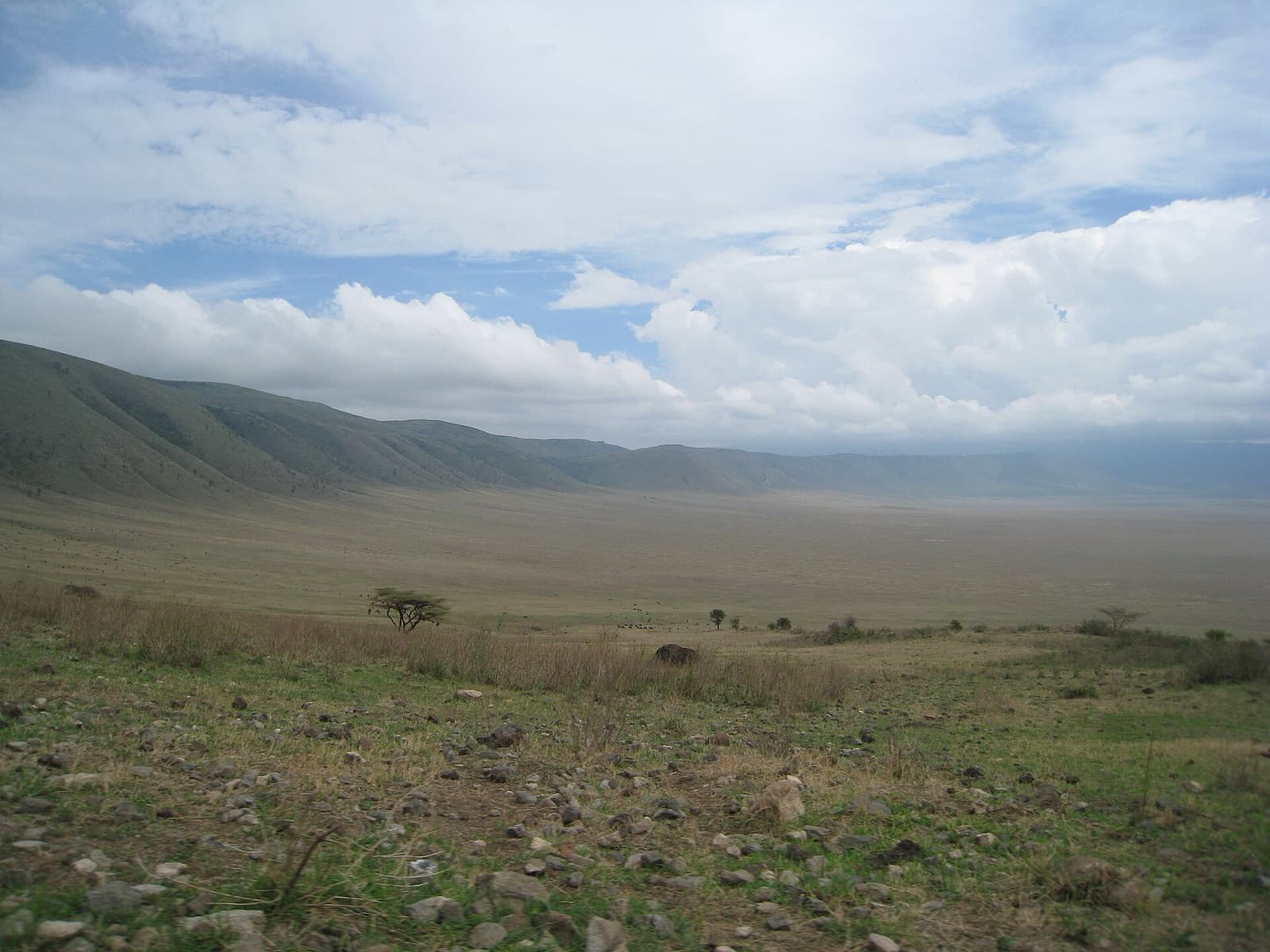
A word that misleads: 'self-drive' doesn't mean alone in the caldera
Technically, nothing stops a traveller from renting their own 4x4 in Arusha and driving down into Ngorongoro Crater without ever booking a guided safari: the Ngorongoro Conservation Area (NCA) accepts private vehicles on the same footing as tour operator cars. But the independence stops at driving: a sworn NCA ranger must board every vehicle that starts down the descent track, whether it's a rental 4x4 or an operator's own car.
This isn't a comfort option or a safety suggestion — it's an administrative rule of the protected area, on the same footing as the compulsory 4x4 or the time cap. The ranger knows the tracks, points toward wherever wildlife is concentrated that day, and above all enforces the caldera's traffic rules: stay on marked tracks, don't crowd groups of vehicles already stopped, leave the floor before the ramps close.
How much the ranger costs, and where to book one before reaching the gate
Unlike Tanzania's regular national parks (TANAPA), where permits are bought by card at the gate on the day, the NCA doesn't sell this service over the counter to a lone traveller: arranging a ranger is coordinated in advance, usually through the accommodation booked on the rim or an NCA-registered agent, before you even reach the Lodoare gate. Sorting this out in the days beforehand avoids a wait — or even a refused descent — at the gate.
The going rate sits around $20-50 US per descent, payable in cash most of the time: keep small dollar bills set aside from the rest of your travel budget, on top of the card that the neighbouring TANAPA gates require. The fee covers a one-off service and has nothing to do with the conservation area's own entrance fees, settled separately.
The crater service fee and the six-hour cap, a separate bill entirely
Paying to enter the conservation area doesn't grant the right to descend: going down into the caldera is subject to a separate crater service fee of $295 US per vehicle (not per person), for a same-day return trip — the same figure documented in our article on the budget for a Tanzania safari. This charge comes on top of the ranger's fee and the NCA's standard entrance fees.
Time on the crater floor is capped at six hours, checked at both access ramps: rangers at the barriers log the entry time and expect you out before the site closes at 6pm. Going back down a second time the same day, or switching vehicles mid-route, generally means running through the entire procedure again — ranger and crater fee included.
Three access tracks, mostly one-way
The caldera isn't crossed at random: three tracks link the rim to the floor, each with its own function to keep dense traffic moving on slopes that are sometimes vertiginous.
| Track | Direction | Landmark |
|---|---|---|
| Seneto | Descent only | Enters on the caldera's western side |
| Lerai | Ascent only | Exits to the south, near Lake Magadi and park headquarters |
| Lemala (Sopa) | Descent and ascent | Two-way track, near Sopa Lodge |
Why so much oversight: what congestion research shows
The arrangement — ranger on board, one-way tracks, six-hour cap — isn't red tape for its own sake: an environmental impact study led by Julius Nyahongo with a team of Tanzanian and Norwegian researchers (Tanzania Wildlife Research Institute and the Norwegian Institute for Nature Research), published in 2007 under the title 'The effects of vehicle congestion on the environment – an EIA in the Ngorongoro crater' (NINA Report 258), documented concrete effects of vehicle overcrowding on the caldera's wildlife: avoidance behaviour in large predators, reduced feeding rates in lions surrounded by vehicles, and an observed decline in some wildebeest and gazelle populations in the most heavily visited areas.
That study, commissioned after decades of steadily rising visitor numbers at the site, directly informed the zoning and traffic-management recommendations in force today. The mandatory ranger aboard every self-driven vehicle is part of that logic: enforcing in real time rules that signage alone cannot impose across 260 km² of open caldera.
Ngorongoro isn't the Serengeti: where the oversight stops
This constraint is specific to the Ngorongoro Conservation Area and doesn't extend to the neighbouring major Tanzanian national parks: at both the Serengeti and Tarangire, managed by the Tanzania National Parks Authority (TANAPA), a traveller in a rental 4x4 explores the tracks in full independence, no ranger imposed on board, permits paid by card at the gate. The difference comes down to the site's legal status — a multi-use conservation area where Maasai pastoralism and tourism share the land, versus a classic national park dedicated solely to wildlife protection.
Many travellers discover the nuance while planning their route: they budget for the vehicle and the fuel across the whole Tarangire-Ngorongoro-Serengeti loop without realising that only the crater leg requires this extra travelling companion. Better to plan for it before booking accommodation on the rim.
Fitting the descent into a self-drive itinerary
The most comfortable logistics remain sleeping on the rim, at 2,300 m, to hit the Seneto track at the first slot — raking light and an almost empty caldera before the midday convoys arrive. Simba public campsite, where zebras graze between the tents, combines a modest budget with one of the country's most memorable wake-ups; our destination page on Ngorongoro Crater covers accommodation options and the full caldera in detail.
Once back up via Lerai, the road continues naturally toward the Serengeti through the Naabi Hill gate, where full independence returns — no ranger, no imposed time slot. To cost the whole loop, park fees included, our article on the budget for a self-drive Tanzania safari breaks down, item by item, what a Tarangire-Ngorongoro-Serengeti loop really costs.
Travel tips
Get our independent-travel tips by email
The house methods — costed budgets, driving, itineraries — straight to your inbox. Instant bonus: our free excerpt “The 7 mistakes to avoid on a first Namibia road trip” and the current promo code.
No time to do it yourself?
A professional can take care of it: tailor-made trip, equipped 4x4 rental or a local guide. Describe your plans and, with your consent, we pass them on to partner professionals.
1. What you need
Before you go
Readers' questions
Can you drive down into Ngorongoro Crater alone in your rental car?
You can drive your own rented 4x4, but not descend unaccompanied: a sworn ranger from the conservation area must board for the duration of the descent, booked in advance and usually paid in cash, around $20-50 US.
Does the mandatory ranger replace the crater service fee?
No, they're two separate payments. The crater service fee ($295 US per vehicle, same-day return) grants entry into the caldera; the ranger's fee, paid separately, covers their presence on board during the descent.
Do you also need a ranger to visit the Serengeti or Tarangire by rental car?
No: both parks are managed by the Tanzania National Parks Authority (TANAPA), where full independence applies, permits are paid by card at the gate and no escort is required. Only the Ngorongoro Conservation Area imposes this mandatory ranger.
How long can you stay in the crater?
Time on the floor is capped at six hours, checked at both access ramps (Seneto going down, Lerai coming up), with the site closing at 6pm. Going down a second time the same day generally means repeating the whole procedure, ranger and crater fee included.