From our field notes
Tolls in Canada: the 407 ETR and the Confederation Bridge, what a rental car actually pays
Published 28 August 2026 · updated 28 August 2026 · 8 min read
By Clément Lacaille, publisher · our method
On travel forums planning a Canada road trip, tolls rarely come up — and that's good news: unlike the United States next door, dotted with turnpikes, Canada has only a handful of toll roads in the entire country. The issue isn't how many tolls there are, but how they work: the 407 ETR, the highway that loops around Toronto, has no booth and no barrier at all, and bills by the kilometre from a simple licence-plate scan — a classic trap for a rental car that ends up on it by mistake, or because a GPS was in a hurry. At the other end of the country, the Confederation Bridge to Prince Edward Island saw a far friendlier change in summer 2025. Here's what to know before hitting the road.
Canada, a country with almost no tolls — two exceptions aside
Nearly the entire Canadian road network is free, including major transcontinental routes like the Trans-Canada Highway or the Icefields Parkway between Banff and Jasper covered in our country guide. That comes from a historical choice to fund roads through general taxation rather than tolls, unlike the United States, where turnpikes and toll roads crisscross many states. On a road trip through the Rockies, Vancouver Island or the Yukon's far north, tolls simply never come up.
Two exceptions account for almost every case where a rental-car traveller can get billed: Highway 407 ETR in the greater Toronto area, Ontario, and the Confederation Bridge linking New Brunswick to Prince Edward Island, on the classic Maritimes route. Add to that two toll bridges near Montreal, the A25 and A30 — more of a footnote for a visitor, but real enough for anyone driving through the city.
The 407 ETR: the one real toll trap for a rental car
Opened in 1997, the 407 ETR was the world's first fully electronic, barrier-free toll highway: no booth, no stopping, just overhead gantries reading a transponder — or, failing that, the licence plate — above each lane. The rate depends on which of its twelve zones you're in, the time of day and the day of the week, with sharp peaks during office hours. The 2026 rate schedule, effective 1 January, pushed the toll on zone 8 (between Highway 400 and Yonge Street) to 108.79 cents per kilometre westbound on a weekday at 3:30 p.m., up from 77.72 cents in 2025 — a targeted hike on the sections and time slots that were already the most congested, while lighter-traffic zones stayed largely unchanged at rush hour.
For a tourist driving a rental car, the real trap isn't the rate so much as the total absence of a barrier: you can end up on it without even realizing, via a GPS shortcut meant to dodge a jam on Highway 401, the free highway that runs parallel to the 407 for much of its length. Without a transponder fitted — true of the vast majority of standard rental cars — the crossing is billed as "video tolling": a camera photographs the plate, and the per-kilometre rate charged is noticeably higher than what transponder holders pay, on top of a per-trip processing charge.
Who gets billed, and how much the rental company adds on top
The company that operates the 407 ETR bills the rental company directly, as the vehicle's legal owner, which then passes the charge on to the customer — usually weeks after the car is returned, charged to the card on file with the rental contract. On top of the base toll, rental companies routinely add their own fee, and it varies widely between brands according to traveller reports on North American forums: Hertz commonly charges a flat administrative fee of around $14 to $16 CAD per recorded crossing (roughly €9 to €10), while Enterprise runs a service called TollPass, billed at $5.35 CAD per day of actual use and capped at $35 CAD for the whole rental (about €3.30 a day, capped around €22). Other brands charge processing fees of around $5 CAD per trip on top of the toll itself.
| Item | Approximate amount | Euro equivalent |
|---|---|---|
| 407 ETR, dense zone, 2026 peak hour | ≈ CAD 1.09 / km | ≈ €0.68 / km |
| Hertz administrative fee per crossing | CAD 14-16 | ≈ €9-10 |
| Enterprise TollPass | CAD 5.35 / day, capped at CAD 35 | ≈ €3.30 / day, capped at ≈ €22 |
| Confederation Bridge (since 1 August 2025) | flat CAD 20 | ≈ €12.50 |
| A30 bridge near Montreal (light vehicle) | ≈ CAD 4.40 one-way | ≈ €2.70 |
How to avoid an unpleasant surprise
Two habits are enough. First, ask explicitly at the rental counter — at Toronto Pearson Airport in particular — whether a toll package such as TollPass is available and at what rate: better to know the capped amount upfront than to find a surprise charge in your inbox a month later. Second, switch on the "avoid tolls" setting in Google Maps or Waze before driving around the greater Toronto area: the free Highway 401 serves the same destinations as the 407, with more traffic at rush hour but no risk of a delayed bill. That precaution alone rules out almost every accidental crossing travellers report.
The Confederation Bridge: the good news from summer 2025
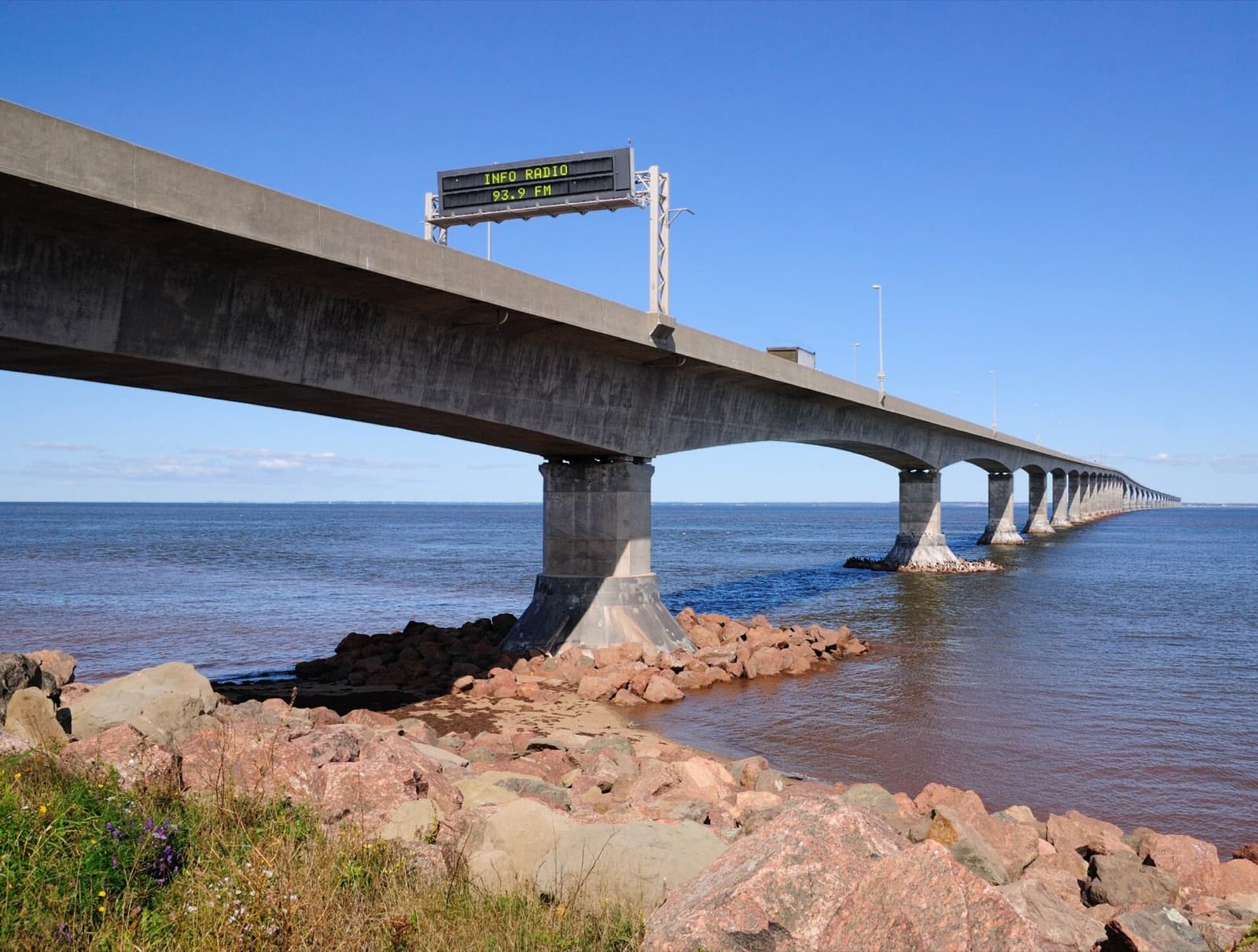
On the Maritimes leg that closes out a Canadian road trip through the Gaspé Peninsula and Prince Edward Island, the Confederation Bridge — 12.9 km long, Canada's longest bridge, spanning waters that ice over part of the year — used to cost more than $50 CAD per light vehicle. On 28 July 2025, Prime Minister Mark Carney announced a dramatic cut to a flat $20 CAD, effective from 1 August 2025, funded by a federal subsidy covering a large share of the bridge's operating costs; the same announcement halved fares on eastern Canada's ferries, including the Marine Atlantic route between Newfoundland and Nova Scotia. The toll is collected in one direction only, when leaving the island via Borden-Carleton: crossing onto Prince Edward Island remains free, as before.
What research says about tolls in Canada
A study by transport economist Robin Lindsey, published in 2007 by the Canadian C.D. Howe Institute under the title "Congestion Relief: Assessing the Case for Road Tolls in Canada", uses the 407 ETR as a case study to show that time-of-day pricing can genuinely ease congestion — but also explains why so few other Canadian routes have followed suit since: political acceptability, far more than economic efficiency alone, is what determines whether a toll road ever gets built. That very political scarcity of tolls is precisely why Canada remains, overall, one of the simplest countries in the world for a rental-car road trip — as long as you know where the two exceptions are.
What our guide covers
Our "Canada Self-Drive" guide breaks down the country's main routes — the Rockies, Vancouver Island, the Yukon, the Gaspé Peninsula and the Maritimes — with, for each, the real distances between fuel stops and the driving quirks specific to that region. On a route that crosses the Toronto area or loops through Prince Edward Island, just keep these two tolls in mind: one is avoided with a simple GPS setting, the other now costs far less than it did before summer 2025.
Travel tips
Get our independent-travel tips by email
The house methods — costed budgets, driving, itineraries — straight to your inbox. Instant bonus: our free excerpt “The 7 mistakes to avoid on a first Namibia road trip” and the current promo code.
No time to do it yourself?
A professional can take care of it: tailor-made trip, equipped 4x4 rental or a local guide. Describe your plans and, with your consent, we pass them on to partner professionals.
1. What you need
Before you go
Readers' questions
Should you really worry about a surprise toll in Canada?
No, in the vast majority of cases: the Canadian road network is almost entirely free, including on major transcontinental routes. The one real risk is the 407 ETR around Toronto, a barrier-free camera-tolled highway you can end up on without meaning to via a GPS route.
How do you avoid the 407 ETR with a rental car?
Turn on "avoid tolls" in Google Maps or Waze before driving around greater Toronto: the free Highway 401 serves the same destinations, with more traffic at rush hour but no risk of a delayed bill. It's the simplest and most reliable habit.
How much does a 407 ETR crossing actually cost with a rental car?
The toll itself depends on the zone, time and day — up to roughly CAD 1.09 (€0.68) per kilometre in dense zones at peak hours in 2026. On top of that come rental-company fees that vary widely: around CAD 14-16 (€9-10) in flat fees at some brands, or CAD 5.35 per day (capped at CAD 35) for a TollPass-style package at Enterprise.
Is the Confederation Bridge to Prince Edward Island tolled?
Yes, but the price dropped sharply: since 1 August 2025, it fell from about CAD 50.25 to a flat CAD 20 (≈ €12.50) per light vehicle, following a federal subsidy announced by Prime Minister Mark Carney. The toll is only collected when leaving the island, never on the way in.