From our field notes
The Waterberg Plateau in Namibia: hiking, wildlife and visiting
Published 29 July 2026 · updated 29 July 2026 · 8 min read
By Clément Lacaille, publisher · our method
Between Windhoek and Etosha, a long wall of red sandstone rises from the plain: the Waterberg Plateau. Three hours' drive from the capital, this national park makes an ideal break on the way north, but it is well worth the detour in its own right. Its cliffs shelter permanent springs, a sanctuary of reintroduced endangered species and Namibia's last colony of Cape vultures. Here is where it is, what you can see, which hikes are on offer at the foot and on top, and how to reach it easily in an ordinary saloon car.
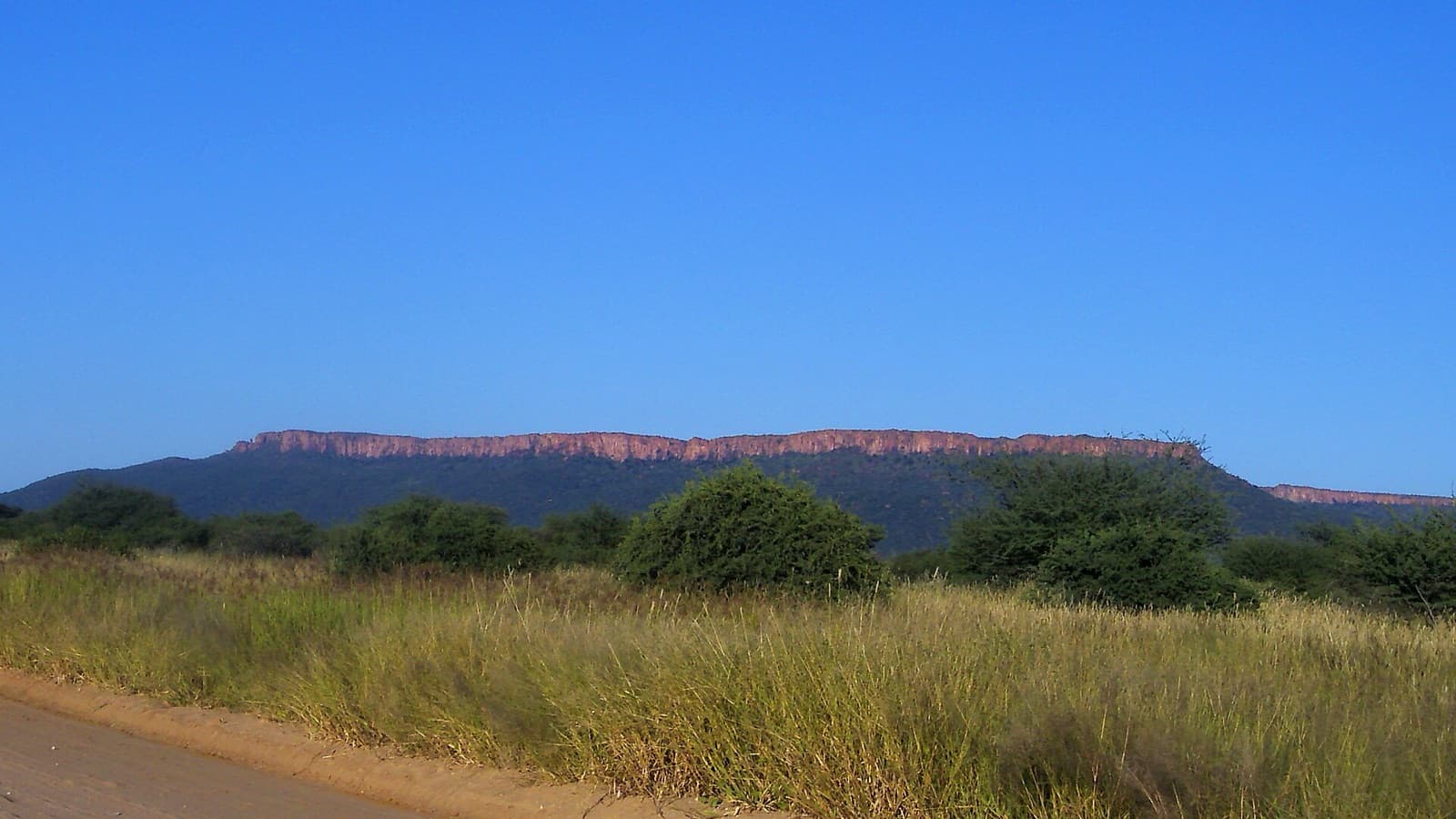
Where the Waterberg is and why to stop
The Waterberg Plateau stands in north-central Namibia, about thirty kilometres south-east of Otjiwarongo, the region's crossroads town. From Windhoek, allow roughly three hours' drive: it sits almost halfway between the capital and Etosha National Park, which makes it a natural break on the way north. Many travellers spend a night here to split the long driving day and arrive fresh at Etosha the next day.
But reducing the Waterberg to a mere stopover would be a shame. The plateau stretches some fifty kilometres long and towers about 200 metres above the plain, its ochre cliffs cutting against the savanna. The national park (Waterberg Plateau Park) protects both the summit, which cannot be reached by car, and the strip of forest and springs running along its base, where the accommodation, trailheads and most wildlife sightings are concentrated.
A geology of red sandstone and springs
The Waterberg is a sandstone plateau of the Etjo Formation, laid down more than 180 million years ago. This porous rock acts like an immense sponge: rainwater seeps in through the top, migrates slowly through the sandstone mass and re-emerges as permanent springs at the foot of the cliffs, where the sandstone rests on an impermeable layer of marl. Hence the Afrikaans name Waterberg, the "water mountain".
These springs are what make the place unique. In a semi-arid region, they sustain dense vegetation, almost a gallery forest, right up against the dry savanna. It is this contrast that explains the site's biological richness: fig trees, acacias and ferns thrive in the shade of the red walls, offering shelter and a water source that draw birds and mammals all year round.
A sanctuary for endangered species
The top of the plateau, isolated by its cliffs, was turned into a reintroduction sanctuary from the 1970s onward. Species that had become rare or vanished from the region were resettled here: black and white rhino, roan antelope and sable antelope (two large dark antelopes with curved horns), Cape buffalo and various other antelopes. The relief closes off the plateau like a natural enclosure, which has made it easier to protect these vulnerable populations.
The Waterberg cliffs also shelter the only colony of Cape vultures (Gyps coprotheres) surviving in Namibia, a species that is endangered at the regional scale. A study on the ranging behaviour of this endangered Namibian population documents the conservation stakes the plateau represents, both for the vultures and for the reintroduced large herbivores. A dedicated viewpoint, a "vulture restaurant" where carcass is sometimes laid out, lets visitors catch sight of these large-bodied birds.
Hikes at the foot and on the plateau
At the foot of the cliffs, a network of marked trails starts from the reception area and can be walked independently: short loops to the springs, climbs to viewpoints over the plain, botanical paths in the shade of the walls. Access to the top of the plateau, however, is most often done under supervision (a guided outing or an organised multi-day hike depending on the season): the reintroduced wildlife and the fragility of the environment justify this. Ask locally, as arrangements vary with the season.
Here is an indicative overview of the walking formats to help you plan before you arrive.
| Type of hike | Indicative duration | Difficulty | Summit access |
|---|---|---|---|
| Loops at the foot of the cliffs | 1 to 3 h | Easy | No |
| Climb to a viewpoint | 2 to 4 h | Moderate (elevation) | No |
| Guided outing on the plateau | Half a day | Moderate | Yes, supervised |
| Multi-day trek | 3 to 4 days | Demanding | Yes, supervised |
Birds, endemics and the best season
The Waterberg is a birding hotspot. Around the springs and on the walls you can spot raptors, hornbills and sought-after species such as Hartlaub's spurfowl, endemic to Namibia's mountainous zone. Alongside the Cape vultures come other scavengers, and the forest-savanna mosaic concentrates a fine diversity of birds within a small area — enough to fill a morning with binoculars.
For visiting, the dry season (May to October) remains the most comfortable: passable trails, clear skies, wildlife more concentrated around water, cool mornings. The rainy season (December to March) turns the plateau green and swells the springs, with superb light, but the heat and showers can hamper walking. Whatever the period, bring water, a hat and good shoes: the climbs are done in full sun.
Getting there by car and combining with Etosha
Access is simple and does not require a 4x4. From the main tarred road (B1) south of Otjiwarongo, you turn east onto a road that becomes a well-maintained gravel track for the last few kilometres. A saloon car gets through without difficulty in dry weather; drive carefully on the gravel and avoid driving at night, as everywhere in Namibia. Parking and the reception area are at the foot of the cliffs.
On an itinerary, the Waterberg slots naturally between Windhoek and Etosha: a night here breaks the journey, offers a walk in the open air and eases you into the bush atmosphere before the great wildlife park. Those coming up from the west can also combine it with other nature stops in the region, such as a cheetah conservation centre, to build a rich and varied journey north.
Free excerpt
The 7 mistakes to avoid on a first Namibia road trip
A real excerpt from our Namibia expertise: 4x4 insurance, gravel speed, NWR bookings, season, fuel, Etosha… The 7 costly mistakes, and the right reflex for each. Instant access, with the current promo code.
No time to do it yourself?
A professional can take care of it: tailor-made trip, equipped 4x4 rental or a local guide. Describe your plans and, with your consent, we pass them on to partner professionals.
1. What you need
Before you go
Readers' questions
Do you need a 4x4 to reach the Waterberg?
No. You reach the plateau via a tarred road and then a well-maintained gravel track for the last few kilometres. A saloon car gets through without trouble in dry weather. Drive carefully on the gravel and avoid driving at night.
Can you go up onto the plateau freely?
The trails at the foot of the cliffs can be walked independently, but access to the summit is generally supervised (a guided outing or an organised hike), because the plateau is a sanctuary for endangered species. Arrangements vary with the season, so ask locally.
What animals can you see at the Waterberg?
The summit shelters reintroduced species: black and white rhino, roan and sable antelope, buffalo. The cliffs host Namibia's only colony of Cape vultures. Around the springs, the diversity of birds is remarkable, with endemics such as Hartlaub's spurfowl.
How much time should you allow and how to combine it?
One night is enough to break the journey between Windhoek (about 3 h) and Etosha and do one or two hikes. The Waterberg fits ideally as a stop between the capital and Etosha National Park, possibly alongside other nature stops in the region.