From our field notes
NamibRand and the Starry Sky: Where to Stargaze in Namibia
Published 21 July 2026 · updated 21 July 2026 · 7 min read
By Clément Lacaille, publisher · our method
Few countries offer a night sky as black as Namibia's: one of the lowest population densities on Earth, a desert stretching for hundreds of kilometres without lighting, and a private reserve — the NamibRand Nature Reserve — officially recognised as one of the darkest on the planet. That's enough to turn an ordinary night of camping into a lasting memory, as long as you know where and when to look up.
Why Namibia's sky is unusually dark
Light pollution — artificial light scattered into the atmosphere by cities — is the main obstacle to stargazing elsewhere in the world. A landmark study by Fabio Falchi and co-authors, published in 2016 in the journal Science Advances and titled "The new world atlas of artificial night sky brightness", mapped this pollution worldwide: it places the great desert regions of southern Africa, Namibia included, among the least affected inhabited areas on the planet (study available online).
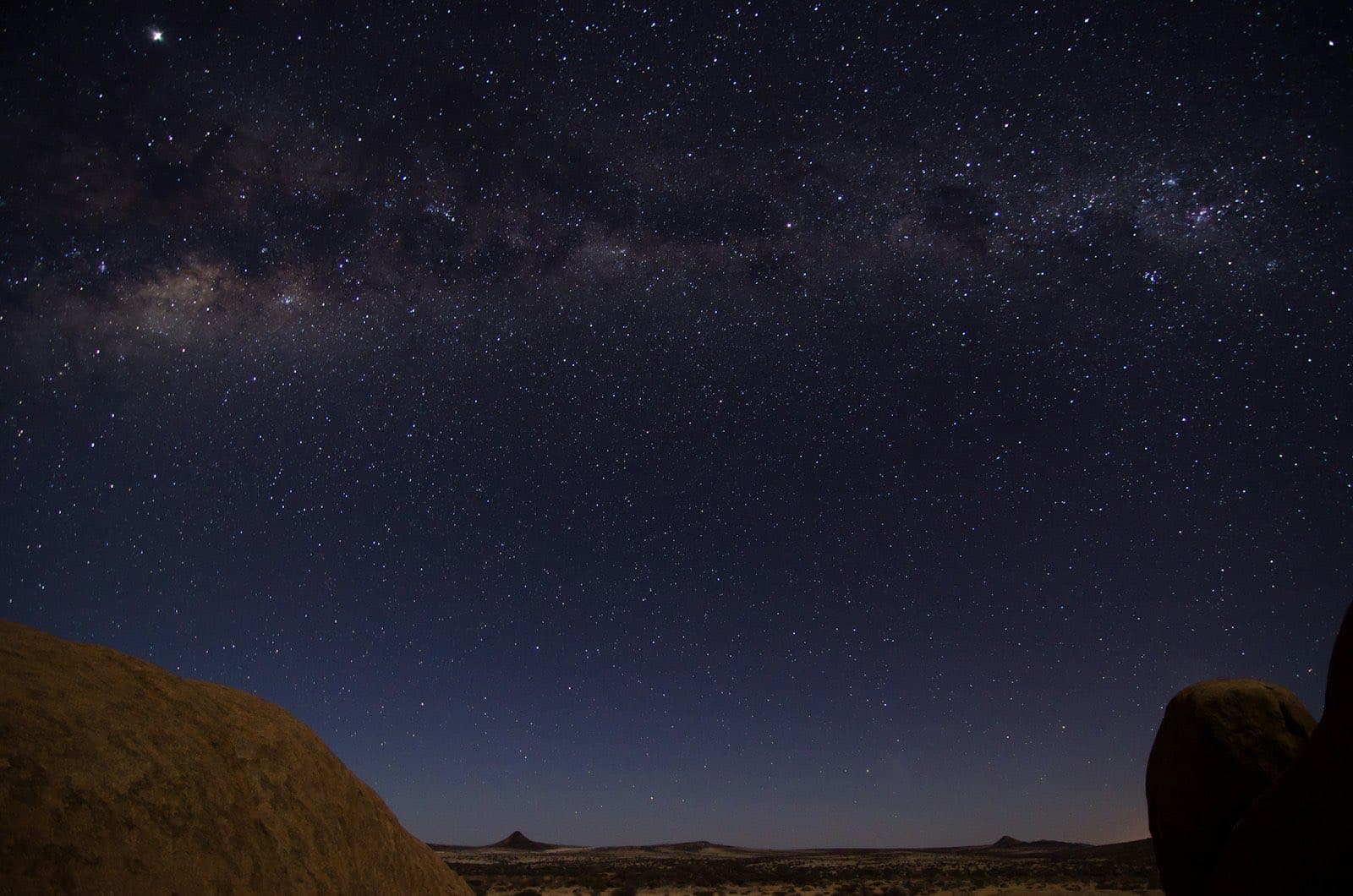
In practice, this comes down to Namibia's low population density — among the lowest in the world — combined with the near-total absence of large towns in the Namib desert. The result: the Milky Way is visible to the naked eye on a clear night, without needing to travel far from a camp or lodge.
NamibRand, Africa's first dark sky reserve
In 2012, the International Dark-Sky Association designated the NamibRand Nature Reserve, a private reserve of more than 200,000 hectares bordering the Namib-Naukluft, as an International Dark Sky Reserve at Gold level — the strictest category, reserved for the darkest skies measured anywhere in the world. It was, at the time, the first such designation in Africa and in a developing country.
Lodges within the reserve (Wolwedans among them) apply strict outdoor lighting rules — low, ground-facing fixtures, warm tones — to preserve this darkness, and several offer telescope observation sessions led by an astronomy-trained guide.
When and how to observe in good conditions
The new moon offers the darkest sky possible; the nights around it, when the moon is still low or absent early in the evening, are also very favourable. The dry season (May to September) generally brings clearer skies, with less cloud or dust suspended in the air than at the end of the rainy season.
From the southern hemisphere, Namibia's sky offers something extra: the core of the Milky Way and both Magellanic Clouds, invisible from Europe, become naked-eye targets on a clear night.
- Give your eyes at least 20 minutes to adjust to the dark, without looking at a screen during that time.
- Use a red-light torch rather than a standard white head torch to preserve your night vision.
- Favour new-moon nights or nights when the moon sits low early in the evening.
- Check with your lodge or camp whether a guided telescope session is available — often the easiest way to spot planets and deep-sky objects.
Free excerpt
The 7 mistakes to avoid on a first Namibia road trip
A real excerpt from our Namibia expertise: 4x4 insurance, gravel speed, NWR bookings, season, fuel, Etosha… The 7 costly mistakes, and the right reflex for each. Instant access, with the current promo code.
No time to do it yourself?
A professional can take care of it: tailor-made trip, equipped 4x4 rental or a local guide. Describe your plans and, with your consent, we pass them on to partner professionals.
1. What you need
Before you go
Readers' questions
Do you need special equipment to stargaze in Namibia?
No, the naked eye is plenty to see the Milky Way on a clear night in the desert. Binoculars or a camera with a long exposure let you go further, and several NamibRand lodges offer guided telescope sessions.
Is NamibRand the only good place to stargaze in Namibia?
No, most of the country offers a very dark sky away from towns — Sossusvlei, Damaraland and the Kalahari all work well too. NamibRand stands out for its official certification and the observation infrastructure built into its lodges.
What's the best time of year to stargaze in Namibia?
The dry season, May to September, generally brings clearer skies. In any case, favour nights close to the new moon for the darkest sky possible.